• Home >
  • Back Issues >
  • Laser Focus World >
  • Volume 47, Issue 10
  • Volume 47, Issue 10

    More content from Volume 47, Issue 10

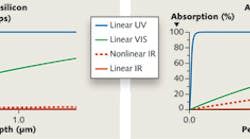
    FIGURE 1. The absorption curves for silicon are plotted for an energy density of 1 J/cm2. For pulse durations of 6 ps (left) the linear absorption is dominant above the nonlinear absorption. Even at 500 fs (right) the nonlinear absorption is too low to reach the desired 1 µm scale optical penetration depth.
    Ultrafast laser pulses with proper energy density and wavelength can now be used for processing materials where thermal influence must be minimized, including drilling metals ...
    Oct. 1, 2011
    Caries (commonly called cavities) in teeth can be seen more easily under near-IR (NIR) light than visible light, and in fact show higher contrast in NIR than under the blue light...
    Oct. 1, 2011
    1110lfwnbf2
    A team of researchers from the Institute of Photonic Sciences (ICFO) and the Catalan Institute of Research and Advanced Studies (ICREA), both in Barcelona, Spain, have developed...
    Oct. 1, 2011
    Tunable narrowband terahertz pulses in the range of 0.3 to 2.4 THz were created via difference frequency generation using a photoconductive antenna (PCA) design developed by researchers...
    Oct. 1, 2011
    Scientists from the Optoelectronics Research Centre, University of Southampton and Penn State University have created an optical fiber with a hydrogenated amorphous silicon (a...
    Oct. 1, 2011
    An engineering team at the University of California–Los Angeles (UCLA) Henry Samueli School of Engineering and Applied Science has developed a polarizing organic photovoltaic ...
    Oct. 1, 2011
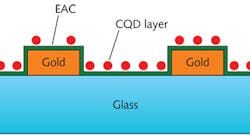
    FIGURE 1. A tunable colloidal quantum-dot photo field-effect transistor includes gold electrodes on glass, a layer of aluminum-doped zinc oxide (AZO) serving as an electron-accepting channel (EAC), and a submonolayer of colloidal quantum dots (CQDs). Incident light causes dissociation of electrons at the AZO/CQD interface, which are harvested by applying a voltage across the electrodes.
    A submonolayer of lead sulfide quantum dots on aluminum-doped zinc oxide forms a photo field-effect transistor; its bandgap is tunable to wavelengths suitable for use in photovoltaics...
    Oct. 1, 2011
    FIGURE 1. Commercial multiphoton microscope with the scan head attached to a conventional upright fluorescence microscope. The upright is the preferred option for in vivo imaging, frequently with the use of water immersion lenses.
    Advances in ultrafast lasers, beam delivery systems, and optics are helping researchers develop new applications of nonlinear microscopy and improving prospects for clinical diagnosis...
    Oct. 1, 2011
    (Courtesy of Nanosensors)
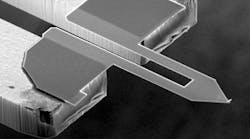
    FIGURE 1. The cantilever and sharp tip span the tines of a quartz tuning fork in the Akiyama-probe resonant surface-probe sensor. The tines vibrate in an opposing motion while the cantilever vibrates perpendicular to the tine motion.
    In the nanopositioning industry, prices continue to fall as resolution, linearity, and reliability improve. Engineers can now use standard optical components and off-the-shelf...
    Oct. 1, 2011
    (Courtesy of Bar-Ilan University)
    A noninvasive blood glucose, blood pressure, and heart-rate monitoring technique is based on the optical analysis of speckle patterns or “vibrations” reflected from human skin.
    Noninvasive, photonics-based blood glucose monitors for diabetes sufferers are being developed that use techniques such as optical coherence tomography (OCT) and Raman spectroscopy...
    Oct. 1, 2011
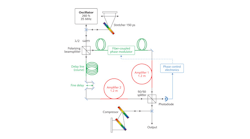
    FIGURE 1. The outputs of two femtosecond fiber amplifiers are coherently combined using a fiber-coupled phase modulator with its error signal provided by a photodiode and associated electronics.
    The optical outputs of two—and potentially more—femtosecond fiber amplifiers seeded by the same oscillator can now be coherently combined, providing a way to greatly increase ...
    Oct. 1, 2011
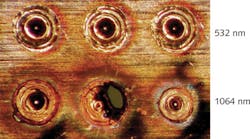
    FIGURE 1. Typical spot welds on bare copper are large and irregular when using a 1064 nm Nd:YAG laser, but are much better controlled and uniform when using a 532 nm green Nd:YAG laser.
    Welding small conductive parts is a unique challenge for welding technologies. Laser welding offers a great fit for this scale of joining; however, 1064 nm pulsed Nd:YAG technology...
    Oct. 1, 2011
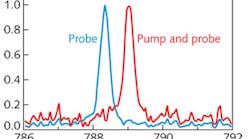
    A pump pulse changes the refractive index of a bR sample; as a result, the wavelength of a portion of a probe pulse selected by a grating changes at picosecond speed.
    The development of all-optical data processing is getting a boost from European researchers who are pioneering the use of an optically active protein for ultrafast photonic switching...
    Oct. 1, 2011
    FIGURE 1. A schematic diagram depicts traditional pitch polishing of a sphere (a) and an asphere (b; exaggerated shape). The black arrows indicate the long strokes (>3 cm) made during polishing as the pitch lap is rubbed against the optic. In the VIBE compliant polishing process (c), the black arrow indicates the short strokes (1–2 mm) made during polishing as the conformal VIBE polishing lap is rubbed against the optic.
    The VIBE process is a full-aperture, conformal polishing process that uses high-frequency, random motion to rapidly remove sub-surface damage and eliminate mid-spatial-frequency...
    Oct. 1, 2011
    (Courtesy of the University of California–Berkeley)
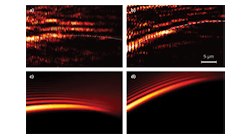
    The trajectory of plasmonic Airy beams (PABs) can be manipulated by changing the angle of incidence of the light in the test setup. Experimental results show a PAB created with a 7º incident angle (a) and a 28º incident angle (b). The lower images are the corresponding numerical simulations (c) and (d), respectively. Scale bar is 5 µm.
    Light can travel seemingly without diffraction in a curved arc in free space. Such peculiar optical beams are named "Airy beams" after English astronomer Sir George Biddell Airy...
    Oct. 1, 2011
    (Courtesy of X. Zhang)
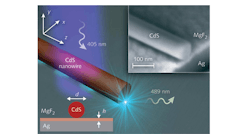
    FIGURE 1. CdS nanowire laser produces surface plasmons that generate blue-green light from a subwavelength strip, where the nanowire rests on a silver slab coated with a thin layer of magnesium fluoride.
    The cutting edge of laser technology keeps getting smaller. Optically pumped nanowire and plasmon lasers have reached subwavelength scales. Metal-clad semiconductor nanolasers...
    Oct. 1, 2011
    (Courtesy of E. Goulielmakis)
    A photonic system produces custom-shaped sub-femtosecond light transients used to probe the behavior of electrons within atoms. To create the transients, a supercontinuum is first divided into three channels (seen as blue, yellow, and red); beam parameters for each channel are manipulated before recombining the light (white).
    Attosecond (as) photonics is a rapidly developing tool to help scientists study the behavior of matter and energy at this extraordinarily short time scale.
    Oct. 1, 2011
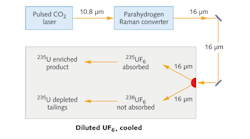
    In the Silex process, light at 10.8 µm from a CO2 laser is converted to a 16 µm wavelength and used to separate U-235 from U-238.
    Satisfied with tests it completed last year on the Silex process for laser enrichment of uranium, GE Energy wants to build a massive nuclear-fuel plant based on the process.
    Oct. 1, 2011