• Home >
  • Back Issues >
  • Laser Focus World >
  • Volume 47, Issue 9
  • Volume 47, Issue 9

    More content from Volume 47, Issue 9

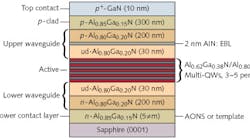
    FIGURE 1. A schematic shows the layer structure of a pseudomorphic LED designed to emit at about 240 nm. The device structure includes an application-oriented nitride substrate (AONS), multiple quantum wells (QWs), and an electron-blocking layer (EBL).
    While progress is being made in the development of semiconductor UV lasers and LEDs, their external quantum efficiency remains low. One potential solution could be application...
    Sept. 1, 2011
    1109breaks Fig1
    Although the process of turning graphite oxide into a supercapacitor turns out to be very simple, it was not immediately obvious to the scientific community until Rice University...
    Sept. 1, 2011
    Researchers at the Leibniz Universität Hannover (Hannover, Germany) have achieved a new efficiency high for the frequency doubling of continuous-wave laser light.
    Sept. 1, 2011
    1109lfw Breaks Fig2
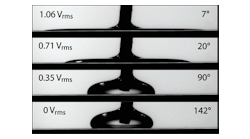
    In electrowetting, an applied voltage changes the wetting angle of a liquid; the phenomenon is used in liquid lenses and, with pigmented fluids, in liquid displays.
    Sept. 1, 2011
    Using scanning tunneling microscopy, researchers at the University of Illinois at Urbana-Champaign (Urbana, IL) have observed the subnanometer structure of amorphous silicon (...
    Sept. 1, 2011
    Researchers at Wake Forest University (Winston-Salem, NC) and Fisk University (Nashville, TN) have analyzed the crucial role that electron and hole mobilities have in strontium...
    Sept. 1, 2011
    Researchers at the Max Planck Institute for the Science of Light (Erlangen, Germany) have developed the first soft-glass, hollow-core photonic-crystal fiber to offer singlemode...
    Sept. 1, 2011
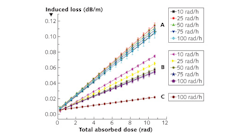
    FIGURE 1. Radiation response as a function of absorbed dose is compared for three types of step-index multimode (SIMM) fiber cores: GeO2 and P2O5 co-doped (A); P2O5 doped (B); and GeO2 doped (C). The co-doped fiber core shows a simultaneous increase in sensitivity to dose and reduction in sensitivity to dose rate.
    A step-index multimode fiber co-doped with phosphorus and germanium is an excellent sensor for gamma-radiation doses; its low dependence on dose rate makes it potentially useful...
    Sept. 1, 2011
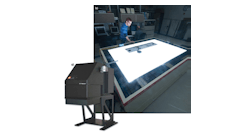
    FIGURE 1. Solar simulators come in a large variety of shapes and sizes, with varying capabilities. A large-area simulator (a) tests a commercial silicon PV module. The module is face down with voltage and current wires going toward the technician; the two metal pieces at each end correct for intensity variation during the flash. (Courtesy of Spire Solar) Many commercial solar simulators are much smaller in size (b). (Courtesy of Newport Oriel Instruments)
    Solar simulators—instruments that simulate the irradiance and spectral output of our own Sun in order to test photovoltaic solar cells in indoor environments—are not created equal...
    Sept. 1, 2011
    FIGURE 1. Small NIR plastic optics of PEI may be manufactured using the HRDT process.
    Understanding the plastic optics production process and the material requirements of the application enables customers to incorporate plastic optics into designs that lower costs...
    Sept. 1, 2011
    (Courtesy of GE Global Research)
    A prototype optical holographic drive system records data onto a volume-holographic disc capable of holding 500 Gbytes of data.
    Researchers at GE Global Research (Niskayuna, NY) have made progress toward their goal of creating a practical 500 Gbyte CD-sized disc based on holographic technology.
    Sept. 1, 2011
    (Courtesy of Harvard University)
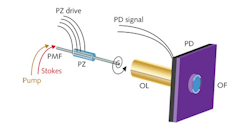
    A piezoelectrically (PZ) actuated scanning-fiber endoscope delivers pump/Stokes light for CARS and SRS microscopy in a spiral pattern to biological tissue through a special gradient-index (GRIN) objective lens (OL). An optical filter (OF) transmits the anti-Stokes wavelength to a photodiode (PD) for processing. The physical endoscope uses a 1 m section of fiber and the fiber scanner and objective lens are only 1.4 mm in diameter. Though the current system uses a 10 mm photodiode for light collection, simulations indicate that collection using a 5 mm or smaller detector will be possible.
    Both stimulated Raman scattering (SRS) and coherent anti-Stokes Raman scattering (CARS) microscopy use light from a pump and probe laser beam scanned over tissue or a test sample...
    Sept. 1, 2011
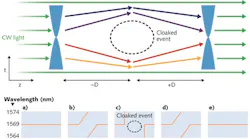
    A pair of split time lenses (STLs) in combination with a section of fiber having negative dispersion (-D) creates a time hole within which an event can occur undetected by the probe beam (top). Fiber with positive dispersion (+D) and a second pair of STLs close the time hole. Viewing the process in another way, the wavelength versus time of a single-wavelength source (a) is altered by STLs (b); a fiber time-compresses the altered sections (c) to create a time hole. A second fiber decompresses the altered sections (d), and finally another pair of STLs undoes the wavelength changes (e).
    "Temporal cloaking," a time analogue of invisibility cloaking, has been demonstrated optically by scientists at Cornell University (Ithaca, NY).
    Sept. 1, 2011
    (Courtesy of UCLA)
    An emissive polymer light-emitting device operating at 8 V undergoes strains of 0% (left), 20% (center), and 45% (right).
    The push to create wearable electronic devices is gaining steam.
    Sept. 1, 2011
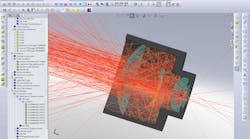
    FIGURE 1. An image of interactive ray tracing for an infrared optical system shows the stray light paths.
    Infrared (IR) surveillance systems are used in satellites that survey the earth's surface to carry out environmental analysis—for example, to monitor marine pollution or study...
    Sept. 1, 2011
    Conard Holton2
    Since its founding in 1958, the Defense Advanced Research Projects Agency (DARPA) has sponsored photonics research, from fundamental science to laser weapons.
    Sept. 1, 2011
    One of the many rewards of a lengthy career in journalism is the opportunity of meeting unusually talented people and interviewing them for publication to a wide audience.
    Sept. 1, 2011
    1304qa Chang New
    I don't feel I am adequately compensated for the work I do. How is compensation determined, anyway?
    Sept. 1, 2011
    (Courtesy of Sigma Space Corp.)
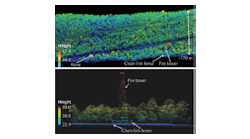
    The single-photon lidar system provides an oblique view (top) and a side-view image (bottom) of the biomass distribution in the New Jersey Pine Barrens, including a fire tower surrounded by a chain-link fence. An independent ground-based hypsometer measurement of the tower height at 33.3 + 0.3 m was in good agreement with the 33.2 m height determined by the lidar.
    Compared to conventional waveform-digitizing altimeters or laser time-of-flight lidar techniques, photon-counting lidar is a more efficient technique as it requires only one detected...
    Sept. 1, 2011