‘Cooked’ fiber doubles range of ultralow-noise supercontinuum lasers
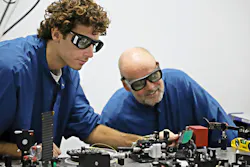
A breakthrough in ultralow-noise supercontinuum lasers by a group of researchers at the Technical University of Denmark (DTU) Electro nearly doubles the spectral range achieved by comparable low-noise systems.
The group’s advance will likely lead to improvements of the speed and sensitivity of medical imaging, gas sensing, and spectroscopy—any applications that detect weak optical signals.
“Our group has been a world leader in supercontinuum lasers for decades now, driven by our desire for applications with an impact in the real world,” says Andrea Arduin, a postdoc researcher at DTU Electro. “This work is part of a large project called Tabletop Synchrotron. We want to use optical fibers and supercontinuum to generate light within the largest possible range of the optical spectrum—mimicking a synchrotron facility.”
An optical fiber typically consists of two cylinders of slightly different glasses, and the inner one is the core that guides light much like a pipe routes water. “Usually, when light travels through a material it’s unchanged—no new colors are generated,” says Arduin. “Think of a prism, in which white light is split into its rainbow components.”
But when light is super intense, new components can be generated within the material via nonlinear effects. An optical fiber is a great tool for this “because it can keep light intensely focused within a small area (its core) for lengths as long as kilometers,” he says. “It allows us to generate many new colors, although some of them may be invisible to our eyes. A supercontinuum is a light source that spans a large and continuous range of wavelengths.”
Cook the fiber to tweak dispersion
How does it work? “Light of different colors travels within the fiber via dispersion,” says Arduin. “Dispersion is a property that changes how a supercontinuum is generated, and essentially there are two options: A large range of noisy and unstable wavelengths vs. a smaller range that are stable and reliable. Our method ‘cooks’ the fiber by exposing it to high temperatures for nearly an hour, which allows us to completely change its dispersion within a small section.”
The researchers double the range of wavelengths within the stable and reliable class of supercontinuum sources. “Our supercontinuum has the largest range of wavelengths covered in its class—it’s the best of both worlds because it covers a large range of wavelengths but is also stable and reliable,” says Arduin.
As it is, the group’s source is good to go now. “One of the main limitations is the loss of silica glass, so it would be interesting to move to different types of glasses, such as fluoride or chalcogenide fibers—but it will be challenging,” he says.
The significance of this advance? It’s now possible to change the properties of a small piece of fiber by heating it. “Previously, tapering the fiber size down was the only option,” says Arduin. “Cooking it does the opposite process because it makes the fiber core larger, which isn’t normally possible. We’ve used the technique to improve supercontinuum generation, but now I’m curious to see if someone else comes up with another application for this.”
Most surprising moment? “Definitely when I first saw it working—but we knew from simulations that it should work,” Arduin says. “I sent Ole an email with a subject line: Preliminary Eureka! This effect of thermal exposure had been ignored, even though the technique was used for other purposes, so it was great to see it work within the lab.”
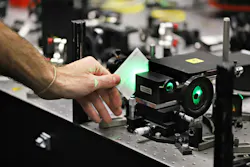
Lower noise unlocks applications
All applications of high-noise supercontinuum sources can benefit from lower noise, Arduin points out, and some more than others. “One of the research areas our group is working on is optical coherence tomography (light-based ultrasound), and reducing the noise of the source will allow us to reduce the noise of the images,” he explains. “Another example from a previous collaboration of ours is detecting gas traces through spectroscopy. The signal from gas traces is weak and, if the light source is noisy, these measurements can end up taking hours to do. Our new source works much better for this type of application.”
What’s next? The mid-infrared because “many new applications can be unlocked by low-noise supercontinuum sources, so we’re currently working on a couple of different systems there,” says Arduin.
FURTHER READING
A. Arduin, S. Rao D. S., A. B. Skov, and O. Bang, Optica, 13, 6, 1098–1103 (2026); https://doi.org/10.1364/optica.595939.
About the Author
 Sally Cole Johnson
Sally Cole Johnson
Editor in Chief
Sally Cole Johnson is Laser Focus World’s editor in chief, and she has more than 25 years’ experience as a science and technology journalist. She specializes in physics and semiconductors, and wrote for the American Institute of Physics for more than 15 years, and also covered theoretical physics and neuroscience for the Kavli Foundation, and complexity for the Santa Fe Institute. Johnson has also written extensively about military embedded systems, high-performance computing, software-defined networks, and infosec. She is a member of the National Association of Science Writers (since 2001).
When she isn’t writing about optics, photonics, or quantum advances, you can find her outside in northern NH in the garden with birds landing in her hand or heading for the mountains with her bike, skis, or crampons and ice axe.