Nitinol laser welding parameter selection and quality evaluation
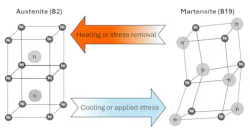
Nitinol is a metal alloy whose shape memory and superelastic behavior arise from reversible solid-state transformations between austenite and martensite, driven by changes in temperature or applied stress. Nitinol typically contains approximately 50 to 51 atomic % nickel, with the balance being titanium. Even small changes in nickel content can substantially alter transformation temperatures and functional behavior. Processing and heat treatment also influence these properties. The name “nitinol” comes from a combination of its composition of nickel and titanium (NiTi) and the Naval Ordnance Laboratory (NOL), where the alloy’s remarkable properties were discovered in 1959.
Shape memory and superelastic properties
To better understand nitinol’s shape memory and superelastic properties, it’s important to understand its two main crystal structures. The austenite phase, which is stable at higher temperatures, has an ordered cubic crystal structure known as B2, while the martensite phase, which forms at lower temperatures, has a monoclinic crystal structure known as B19. Changes in temperature or applied stress can cause nitinol to transform between these two crystal structures (see Fig. 1). This reversible transformation is the main mechanism behind nitinol’s shape memory and superelastic behavior, which enable the alloy to remember a designated shape and return to it when warmed to its transformation temperature. This property is very valuable in medical applications because it allows nitinol devices to be deformed into a smaller or more convenient shape for insertion into the body and then recover their designed shape when exposed to body temperature.
Nitinol is also superelastic and bends extensively under high stress, up to approximately 8 to 10% strain, and then returns to its original shape without permanent deformation once the load is removed.1 This flexibility allows medical devices to move through curved and narrow pathways in the body while maintaining their intended shape and function.
Nitinol is widely used in medical devices, but the biocompatibility of the finished device depends on surface condition, corrosion resistance, nickel release, and intended tissue contact. It has become an essential material within the cardiovascular, neurovascular, endovascular, peripheral vascular, orthopedic, spinal, urological, and dental fields for applications ranging from neurovascular stents and heart valve frames to orthopedic staples and single-use suture passers. Beyond medical applications, nitinol is used for aerospace applications, including morphing wing structures, variable geometry chevrons for aircraft jet-engine noise reduction, and self-deploying spacecraft components such as solar arrays, where it enables lightweight, compact, and low-maintenance designs. Similarly, for automotive and oil & gas applications, nitinol is used in HVAC actuators, pedestrian safety systems, temperature-responsive valves, and subsea pipe couplings, where it provides reliable, maintenance-free operation without external power.
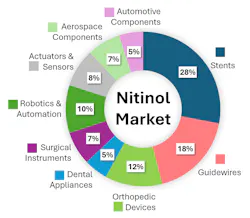
The application landscape of the U.S. nitinol market (see Fig. 2) is predominantly led by the medical sector, where Nitinol’s shape memory and superelasticity properties have enabled significant advances in medical device design and patient care.2
Nitinol laser welding parameters
Welding or joining nitinol is often necessary when manufacturing medical devices, surgical tools, or components for other industries with complex shapes or multiple parts—such as tubes, wires, and sheets, that can’t be produced from a single piece of material—to allow precise control of the final device geometry. Among the available joining methods, laser welding is one of the most widely used for NiTi alloys because it produces narrow and high-quality welds with low heat input, limited heat-affected zone (HAZ), fast process, and excellent process repeatability.
But laser welding NiTi alloys can present significant technical and metallurgical challenges if the process parameters are not set correctly, because nitinol is highly sensitive to processing conditions and even small variations in manufacturing or finishing can significantly alter its functional properties. Excessive heat generated during welding can cause unwanted phase transformations and microstructural changes, which can negatively affect the material’s transformation temperature, shape memory effect, superelasticity, and fatigue life. Variations in laser welding parameters can also lead to inconsistencies in weld quality and mechanical performance, so parameters such as pulse duration, pulse shape, spot size, focus position, laser power, and energy, as well as the type of shielding gas and the method used to deliver it to the weld area, plays an important role in controlling the amount and distribution of heat supplied to the material and determining the final weld quality.
Using a relatively small laser spot size, an appropriate pulse shape, and a short pulse duration allows the laser energy to be concentrated within a small area for a short period of time, which controls how long the material is exposed to laser heat. This limits heat transfer into the surrounding nitinol and reduces the size of the HAZ, which can be beneficial for NiTi alloys because it helps preserve the high-temperature B2 phase at room temperature and limits decomposition into equilibrium phases. A large HAZ can negatively affect nitinol by changing its microstructure and transformation behavior, which may reduce its shape memory, superelasticity, and fatigue life.
Proper shielding gas delivery helps protect the molten weld pool and the surrounding HAZ from atmospheric contamination and oxidation during the welding process, while also improving the surface finish and cosmetic appearance of the weld. This is especially important for medical components or surgical tools, where excessive oxidation can affect the surface quality, corrosion resistance, and biocompatibility of the finished device. Poor surface conditions can also increase the risk of nickel-ion release, which is an important consideration for nitinol devices that come into contact with human tissue or blood.
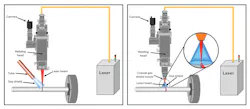
One of the most common shielding methods used in industry is side-tube gas delivery. But this method may not provide sufficient or uniform gas coverage over the entire welding zone. As shown in Figure 3, the coaxial shielding gas delivery system that delivers the shielding gas around the laser beam can provide several advantages compared to conventional side-tube delivery. These advantages include maintaining more uniform gas coverage during welding, improving the surface finish, preventing spatter and smoke from reaching the optics, reducing gas consumption, and providing better protection of the weld area.
Post-welding evaluation of nitinol properties using differential scanning calorimetry
Post-welding evaluation of nitinol is important to determine whether the welding process has changed its functional and mechanical properties—especially at and around the weld location. The fusion zone experiences melting and re-solidification, resulting in an as-cast microstructure, while the HAZ is exposed to high temperatures without melting. Excessive thermal exposure in the HAZ can cause over-aging, recrystallization, and grain growth, potentially reduce mechanical strength, and shift the transformation temperatures of the nitinol alloy. Testing such as weld strength, hardness, microstructure analysis, and transformation temperature measurements can be used to evaluate the quality of the welded joint. Among these methods, differential scanning calorimetry (DSC) is particularly helpful for examining changes in nitinol’s phase transformation temperatures near the welded area and confirming that its shape memory and superelastic behavior are maintained after welding.
The DSC procedure should follow ASTM F2004 to determine the transformation temperatures of NiTi alloys. A DSC instrument should first be calibrated using an appropriate reference standard to ensure accurate temperature measurements, and then the nitinol specimen should be subjected to controlled cooling and heating cycles according to the temperature range and heating/cooling rates specified in the standard. Resulting DSC curves should be analyzed to determine the characteristic phase transformation temperatures of the nitinol material. This procedure should first be performed on the base material and then on the welded material so the two DSC curves can be compared.
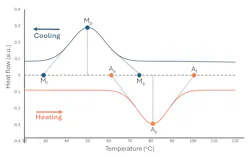
By comparing the curves, any shift in the transformation temperatures, such as martensite start (Ms), martensite peak (Mp), martensite finish (Mf), austenite start (As), austenite peak (Ap), and austenite finish (Af), can be identified, as shown in Figure 4. During cooling, the martensitic transformation begins at Ms, reaches its peak transformation at Mp, and is completed at Mf, when the material becomes fully martensitic and reaches its more flexible state. During heating, the transformation back to austenite begins at As, reaches its peak at Ap, and is completed at Af, when the material becomes fully austenitic and recovers its original shape and rigidity. Any shift in these transformation temperatures can indicate whether the heat generated during welding has altered the phase transformation behavior and functional properties of the nitinol material.
REFERENCES
1. E. Henderson, D. H. Nash, and W. M. Dempster, J. Mech. Behav. Biomed. Mater., 4, 261–268 (2011); https://doi.org/10.1016/j.jmbbm.2010.10.004.
2. See https://marksparksolutions.com/reports/us-nitinol-market.
About the Author
Najah George
Najah George is senior director of R&D at Photon Automation (Greenfield, IN).