FLIR THERMAL CAMERAS HELP ECOLOGISTS USE TEMPERATURE TO MONITOR STRESS
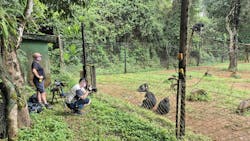
Flir thermal cameras are helping scientists at the University of Sussex in the UK to undertake groundbreaking stress studies in great apes.
These advanced thermal cameras help ecologists see fluctuations in nose temperature, a known metric of stress levels. It is hoped the studies will aid researchers in a number of ways, including the identification of sanctuary chimpanzees and gorillas most suitable for release into the wild.
Among those pivotal in turning these ambitions into reality is lead researcher Gillian Forrester (PhD, SFHEA), Professor of Comparative Cognition at the university’s School of Psychology.
“I look at the building blocks of cognition across evolutionary time: how we became the intelligent, walking, talking, tool-using great apes we are today,” she explains. “It’s effectively a proxy for looking at things we do and don’t share with our common ancestors.”
One factor shared across ancestral species is stress, in particular the way the biology of individuals reacts to stress.
“If we are stressed, overwhelmed or in fear, our face experiences a change in blood flow. Our nervous system reroutes the blood in our face to other sensory organs such eyes and ears - a physical reaction designed to help individuals look and listen for danger. A consequential side effect sees our nose get a little colder as blood moves away. We call it ‘nasal dip’ and it’s become an interesting avenue to explore in stress response and recovery.”
Assessing nasal dip using the translational capabilities of Flir thermal technology allows ecologists to overcome current scientific limitations. At present, assessing stress typically requires connecting subjects to heart monitors, blood pressure gauges or pulsometers, which is not only stress-inducing in itself but also clearly unsuitable for chimpanzees and gorillas.
In-field research
The research team is working with wild animal parks in the UK and rescue sanctuaries for chimpanzees and gorillas in Africa. Most individuals housed at these sanctuaries have experienced previous trauma at some level. “Evaluating their stress levels could allow us to better manage rehabilitation, identify suitable candidates for release and target those who aren’t so we can think about new kinds of interventions,” she explains. “It might even help identify a good adoptive mother for an incoming infant ape, for example.”
This research facilitated by Flir T1020 uncooled and A6301 cooled camera technology will assist the team in understanding the healthy/non-healthy range of nasal dip. It will also help discover how quickly individuals recover after a stress event, providing an indication of their resilience and self-regulation.
Beyond the visible
Right from the start, Flir thermal cameras have proved to be the facilitating technology of this crucial research. The University of Sussex team initially used a Flir T450sc portable, easy-to-use infrared science camera. However, in early 2025, the ecologists migrated to the Flir T1020 (T1K), largely for its HD-quality thermal images, packing more detail than ever before into each image.
The research combines Flir’s uncooled TK1 and highly sensitive cooled A6301 cameras, each selected for different environments from field observations to controlled sanctuary studies.
“We’re going to use the two different types of sensor technology - uncooled and cooled - to suit certain data collection activities,” reveals Professor Forrester. “Both sensors have advantages, but we’ll use the highly sensitive, cooled MWIR sensor of the Flir A6301 to achieve an extra level of image detail in static studies.”
At the sanctuary, a screen next to the enclosure will play videos that elicit either a negative (stress) or a positive response. If an individual ape voluntarily wanders forward to watch the video, the research team will have a static Flir A6301 cooled camera set up to study nasal dip.
Region of interest
Notably, the Flir cooled thermal cameras also allow Professor Forrester and her team to create a region of interest on the face from which to collect data. To ensure suitability, the ecologists require a threshold of at least 50 pixels per area of interest, which is where the high resolution of the Flir A6301 proves vital. Furthermore, the higher sensitivity (3-5 µm) of these cooled cameras enables researchers to detect breathing/respiration as a thermal image, providing another biological measure of interest.
Along with static studies using cooled thermal cameras, the ecologists in Sierra Leone will undertake ‘focal follow’ research, looking at the normal behavior of individual apes as they move around the sanctuary throughout the day.
“Here we’ll use the uncooled Flir T1K thermal camera because we can walk around with it, reach different sides of the enclosure and climb observation platforms,” says Professor Forrester. “It has a highly effective zoom, which will definitely prove useful in 2026 when we visit Uganda to work with our first group of habituated wild chimpanzees. We’ll track them through their natural habitat with the Flir T1K and capture samples of their stress levels.”
Thermal Ecology Kit
To bring even more advantages to research of this type, UK-based Thermal Vision Ecology - sister company to Flir distributor Thermal Vision Research - recently began developing its Thermal Ecology Kit, a mobile thermography system designed specifically for ecological surveys. The kit features a Flir cooled or uncooled camera with multiple lens options connected to a tripod and battery pack offering six hours of power. The entire system connects to a Windows tablet pre-installed with Flir Research Studio, an advanced thermal analysis software suite offering a simplified workflow for displaying, recording and evaluating data.
The kit proved successful in bat studies and was duly recommended to Professor Forrester and her team for the great ape research. Alongside easier wildlife recording, faster post-survey reporting times and increased field safety, there is no need to hold a camera for hours at a time. With its backpack design and plug & play functionality, the system is convenient to transport and use.
“Using the Thermal Ecology Kit allowed us to replace bulkier and more inflexible kit that we used for a previous field study in Gabon,” says Professor Forrester. “We use the kit with the addition of a GoPro camera 3/4 because, alongside the thermal image, we need synchronous natural-light RGB video to identify individuals. Whether using a Flir cooled or uncooled camera, we mount the GoPro on top to attain the same vantage point and provide synchronous data.
As for the next challenge, the ecology research team at the University of Sussex hopes to work with Flir experts again to develop specific software tools for data sampling. This activity will bring even more benefits to ecologists as they continue to seek greater understanding about the role of biological determinants in monitoring stress.