Why a Virtual Pivot Point Matters in Optical and Photonics Alignment
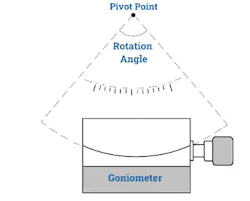
In photonics and precision optics, alignment is crucial. Whether coupling a fiber array to a silicon photonics chip, steering a laser beam onto a mirror array, or positioning lenses inside a microscope objective, every micron — often every nanometer — counts. One often-overlooked but decisive capability in high-precision motion systems is the user-programmable pivot point, sometimes referred to as a virtual center of rotation.
What Is a Pivot Point?
In multi-axis positioning systems, motion can include both translation (X, Y, Z) and rotation (pitch, yaw, roll). Every rotation occurs around a point in space: the pivot point.
In a conventional mechanical setup, this pivot point is fixed by the geometry of the axes. When a user commands a rotation, the motion system physically arcs around that location — often far away from the optical interaction point. That can make alignment cumbersome, especially when rotations inadvertently introduce lateral motion at the point of interest.