Laser technology for the entire hydrogen value chain
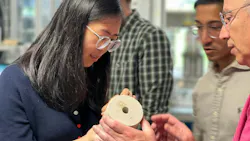
From electrolyzers to storage to fuel cells: At the Hydrogen Technology World Expo 2026 in Hamburg, Germany, the Fraunhofer Institute for Laser Technology ILT will demonstrate how laser technology makes key processes in the hydrogen economy more efficient and industrially scalable. In addition, Fraunhofer ILT will present solutions for various electrolysis technologies, the manufacturing of fuel cell components, hydrogen storage, and Power-to-X applications.
As renewable energy expands, the need to store large quantities of hydrogen over extended periods of time is growing. However, existing underground storage facilities are limited to specific geological conditions. The European research project HyCavern is therefore taking a different approach: hydrogen is to be stored in specially excavated and steel lined rock caverns, known as “lined rock caverns.” This makes underground hydrogen storage possible even in regions where traditional cavern storage is not an option.
As part of the project, Fraunhofer ILT is developing laser-based methods for the metallic lining of these storage facilities. The focus is on welding processes and protective coatings for the steel liners. These must withstand high pressures while preventing hydrogen leakage and resisting hydrogen-induced degradation over long periods of operation. The project aims to develop safe, economical, and standardizable storage systems for various European locations.
“Hydrogen can penetrate steel and cause it to become brittle over time. This is a major challenge for the steel lining of a storage cavern,” explains Dr. Yingwei Wu from the Additive Manufacturing and Repair LMD group at Fraunhofer ILT. “By applying targeted protective coatings and using suitable laser-based joining processes, we aim to prevent hydrogen from penetrating the material and causing damage there. In this way, we can help increase the service life and safety of the storage facilities.”
Efficient hydrogen production and cost-effective power generation
Electrolysis marks the beginning of the hydrogen value chain. Here, too, Fraunhofer ILT is applying laser processes in several areas. Researchers are developing processes for various electrolysis technologies, including PEM, alkaline, and high-temperature electrolysis. Depending on the cell type, lasers are used for tasks such as structuring, coating, cutting, or joining components.
This is not just about the performance of individual components. Equally important is how electrolyzers can be manufactured cost-effectively and at scale. One example is the KISSSEs project, where Fraunhofer ILT is developing AI-assisted laser welding and cutting processes for titanium expanded metal meshes used in PEM electrolyzers. Precise laser welding reduces electrical contact resistance and could eliminate the need for costly precious-metal coatings, while AI-assisted laser cutting helps optimize component edges.
Production technology also plays a crucial role in the reconversion of hydrogen into electricity in fuel cells. A key component is the membrane electrode assembly, or MEA for short. It is one of the core components of a PEM fuel cell and must be manufactured reliably and cost-effectively in high volumes.
This is precisely where Fraunhofer ILT, together with its partners, comes in. The goal is to further develop the high-volume production of MEAs. To this end, they are collaborating on new materials for catalyst-coated membranes, as well as on printing and coating processes and an in-line quality control system. The processes are to be integrated and tested in a pilot line.
Beyond these developments, Fraunhofer ILT is working on laser-based processes for several steps in MEA production. High-speed laser drying of PEM electrode layers can reduce drying times from several minutes to just a few seconds while lowering energy consumption and significantly reducing the required equipment footprint. Further approaches include laser cleaning of joining areas and subsequent laser joining of the MEA to the frame.
“When it comes to scaling up fuel cell production, every second and every square meter of production space counts,” says Manuella Guirgues from the Thin-Film Processes Group at Fraunhofer ILT. “Laser processes allow us to rethink several steps of MEA production and make them more compact and easier to integrate into continuous manufacturing lines. That is exactly what is needed when moving from laboratory-scale processes toward industrial production.”
Bipolar plates and Power-to-X
In addition to the membrane electrode assembly, the bipolar plate also influences the performance, service life, and cost of a fuel cell. Fraunhofer ILT is therefore developing laser processes for several steps in its manufacturing, from patterning and coating to cutting and hydrogen-tight welding.
The HyCoFC research project demonstrates how new materials and laser processes can be combined. The project is developing large-format hybrid compound bipolar plates for fuel cells, which are intended, among other things, for use in heavy-duty vehicles. These plates combine a metallic carrier foil with a conductive compound foil.
Fraunhofer ILT is developing laser-based processes for structuring, selectively removing individual material layers, and joining the different materials. The precise and localized processing makes it possible to tailor the properties of the hybrid plate without unnecessarily affecting adjacent material layers.
Dual-beam welding offers another way to accelerate the production of metallic bipolar plates. The process uses two laser beams simultaneously, reducing the processing time for a typical bipolar plate contour from approximately 4.6 to 2.4 seconds. In the overlapping area of the two scan fields, both beams can act on the same spot to selectively influence melt pool dynamics, enabling higher welding speeds and helping to avoid typical defects such as humping without compromising weld quality.
Many of these processes can be studied not only individually but also combined into complete production chains at Fraunhofer ILT’s Hydrogen Lab. Laser-based test facilities and test benches are available for this purpose in a space of approximately 300 square meters. Researchers and companies can test individual process steps there as well as the interaction of multiple processes under realistic conditions.
However, hydrogen serves not only as an energy carrier for fuel cells or as a storage medium. It also serves as a feedstock for other energy carriers and chemical products. For such Power-to-X applications as well, Fraunhofer ILT is developing laser-based manufacturing processes for components and systems that must withstand high thermal, chemical, or mechanical stresses.
“At the trade show, we’d especially like to talk with companies about where laser technology can add real value to their process chains,” explains Matthias Laermann, who is responsible for the Hydrogen Lab at Fraunhofer ILT. “This isn’t just about a single process. We continue to develop solutions together with our partners, always keeping the path to industrial production in mind.”
Fraunhofer ILT will present its work from October 20 to 22, 2026, at the Hydrogen Technology World Expo in Hamburg. Visitors can find the team in Hall B5, Booth F44.