2026 Nobel Prize in Physics goes to Francis Halzen for IceCube Neutrino Observatory
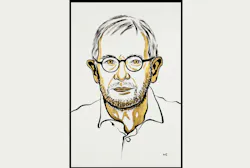
Congratulations to Francis Halzen, a physics professor at the University of Wisconsin-Madison, who won the 2026 Nobel Prize in Physics for his “decisive contributions to the IceCube Neutrino Observatory and the discovery of high-energy neutrinos of astrophysical origin.”
Neutrinos are special particles because they travel to us—and through us—without changing direction or losing energy.
Halzen first shared his vision for capturing neutrinos with extremely high energies at the South Pole back in 1988. A single neutrino can interact with an atomic nucleus, but it’s rare, and you need special equipment to detect it. When a neutrino collides with an atomic nucleus it produces a flash of light that can be tracked via sensors within glacial ice. Why the South Pole? It’s free of many types of interference and is geologically stable.
How do the sensors work? The Cherenkov light signal is detected via strings of 60 optical sensors—each has a 25.4-centimeter-diameter downward-facing hemispherical photomultiplier tube with integrated digitizing electronics, deployed more than 1-kilometer deep every 17 meters.1 Photomultiplier data is sent to the surface through optical fibers. A total of 86 strings were deployed from 2005 to 2010, at depths ranging from 1450 to 2450 meters within a hexagonal array with a triangular grid spacing of 125 meters. The cubic kilometer of ice is instrumented with more than 5,000 optical sensors.
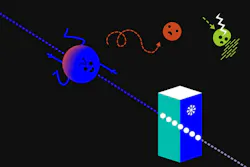
Below ~2,100 meters, where ice is clearest, the absorption/scattering length for Cherenkov light is ~200 m, and the refractive index of the ice is ~1.31. An array of surface-ice Cherenkov detectors (IceTop) located above IceCube measures cosmic-ray air showers within the 300-TeV to 1-EeV energy range. IceTop essentially provides a “veto” for in-ice events for a limited solid angle. The number of detected Cherenkov photons determines the neutrino’s deposited energy, while relative arrival times of photons determine the neutrino direction.
IceCube was completed in 2011, and Halzen and an international team of researchers quickly discovered the first high-energy neutrinos, which they later concluded must originate far outside our solar system.
The neutrino interactions continuously collected by IceCube continue to reveal details about the settings in which high-energy neutrinos are created, and it may also help uncloak previously unknown cosmic phenomena.
REFERENCE
1. See www.nobelprize.org/uploads/2026/10/advanced-physicsprize2026.pdf.
Related News
 Left to right: Karl Deisseroth, Peter Hegemann, and Georg Nagel.
About the Author
 Sally Cole Johnson
Sally Cole Johnson
Editor in Chief
Sally Cole Johnson is Laser Focus World’s editor in chief, and she has more than 25 years’ experience as a science and technology journalist. She specializes in physics and semiconductors, and wrote for the American Institute of Physics for more than 15 years, and also covered theoretical physics and neuroscience for the Kavli Foundation, and complexity for the Santa Fe Institute. Johnson has also written extensively about military embedded systems, high-performance computing, software-defined networks, and infosec. She is a member of the National Association of Science Writers (since 2001).
When she isn’t writing about optics, photonics, or quantum advances, you can find her outside in northern NH in the garden with birds landing in her hand or heading for the mountains with her bike, skis, or crampons and ice axe.