Scientists reconstruct Van Gogh’s Starry Night sky
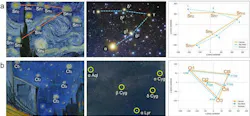
A bit of mystery swirls around the exact date Vincent van Gogh painted The Starry Night and the star cluster involved. While it’s roughly dated to June 18, 1889 from a letter he wrote to his brother Theo, the night sky at the time doesn’t align with the one painted on his canvas.
Elijah Jeong-hyun Kim, CEO of SLLAB Inc. and a Ph.D. candidate at Kyung Hee University in South Korea, and colleagues became intrigued after recognizing the star cluster in Van Gogh’s painting, but not as Aries as other scientists had earlier identified it.
“After nearly 40 years of looking at the stars, I recognized the star cluster in The Starry Night as the Hyades within Taurus,” says Kim. “This journey of mine began with the thought that Van Gogh could hardly have been inspired to paint this work by the relatively faint stars of Aries.”
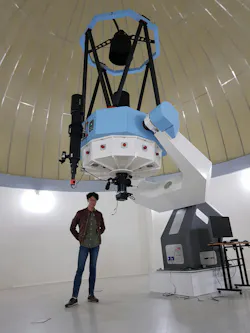
Ever since seeing Halley’s Comet in 1986 as an 8-year-old kid, Kim has carried the stars within his heart and he become an astronomer and engineer who builds telescopes. He also went on to found SLLAB Inc. (www.sllabinc.com), a South Korean space-science company.
Observational geometry reveals a location and likely date
137 years is extremely brief in astronomy time and the motions of celestial bodies can be calculated precisely, which means scientists can reconstruct the sky at the time of Van Gogh’s painting in fine detail.
To do it, Kim and colleagues Suna Kang, Jungwoo Song, and Ho Jin calculated the positions of the Moon and Venus with astronomical computing tools in Python, and verified the results against NASA JPL’s ephemerides (a mathematical model of the Solar System that shows the time, position, and velocity of points within the path of planets, planetary satellites, comets, and asteroids around the Sun). “We first defined the local time used back then, before standard time was established, and calculated which stars would have been visible to the naked eye as the dawn twilight progressed,” he says.
Observational geometry calculates where Van Gogh stood, which direction he looked, and which part of the sky he could see. “We constructed the painter’s field of view by overlaying photographs taken onsite onto his drawing,” says Kim. “This is similar to astrometric plate solving, a technique that automatically identifies which part of the sky a telescope image shows.”
The scientists matched the size and orientation of the star arrangement of Van Gogh’s painting to those of the real stars, overlaid them, and measured the degree of resemblance as a number.
“I’ll never forget the moment in Saint-Rémy when we found the spot where Van Gogh’s drawing F1541v was made, overlaid a photograph taken there on the drawing, and saw the outlines match exactly,” Kim says. “I was standing where Vincent stood 130 years earlier.”
Another memorable moment was discovering that “in the pen drawing Van Gogh later made after the painting (F1540), the shape of Hyades is even more accurate than in the original,” he adds. “Mechanically copying an unknown shape merely inherits the errors of the original and doesn’t move closer to the real thing. This means he kept the real arrangement of the stars in his mind as a reference.”
Star shape
A painting isn’t a map, so “we removed the size, position, and tilt of the stars and compared only their shape,” says Kim. “We took the level of precision from Van Gogh himself by how accurately he painted the Big Dipper in Starry Night over the Rhône (September 1888). Weather records of the 19th century also include days of questionable accuracy and values recorded qualitatively, so we collected weather data from several locations and cross-checked them to check whether the sky was clear on a given morning.”
This method can be applied to historical paintings in which the landscape still exists and the sky is depicted alongside it. The scientists applied it to Jean-François Millet’s Starry Night (c. 1850) and it confirmed a match, whereas Adam Elsheimer’s The Flight into Egypt (c. 1609) produced no match. It shows the method distinguishes cases that match and those that don’t.
“We focused on the possibility that the pre-dawn sky around July 22, 1889 was reflected within Van Gogh’s painting,” says Kim. “Next year, I plan to publish follow-up studies of other paintings. But I’m currently focusing on developing telescopes for space surveillance and research into telescopes to be installed on the lunar surface.”
FURTHER READING
E.Jh. Kim, S. Kang, J. Song, and H. Jin, Sci. Rep., 16, 31109 (2026); https://doi.org/10.1038/s41598-026-73025-5.
About the Author
 Sally Cole Johnson
Editor in Chief
Sally Cole Johnson is Laser Focus World’s editor in chief, and she has more than 25 years’ experience as a science and technology journalist. She specializes in physics and semiconductors, and wrote for the American Institute of Physics for more than 15 years, and also covered theoretical physics and neuroscience for the Kavli Foundation, and complexity for the Santa Fe Institute. Johnson has also written extensively about military embedded systems, high-performance computing, software-defined networks, and infosec. She is a member of the National Association of Science Writers (since 2001).
When she isn’t writing about optics, photonics, or quantum advances, you can find her outside in northern NH in the garden with birds landing in her hand or heading for the mountains with her bike, skis, or crampons and ice axe.