Behold: A ‘black hole star’
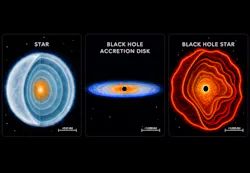
A few years ago, while using NASA’s James Webb Space Telescope (JWST) to survey some of the Universe’s earliest galaxies, astronomers noticed a peculiar and extremely bright “Little Red Dot” they’ve since concluded is a mashup of a black hole and a star.
This massive Black Hole Star cranks out 100 billion times more energy than any known star—and is more aligned with energies black holes put out.
“It’s a new type of astrophysical object—an object that radiates with the energy typically associated with black holes, but it displays some of the quintessential features of stars,” says Rohan Naidu, an assistant professor of astronomy at the University of Hawai’i now, and a NASA Hubble Fellow and Pappalardo Fellow at MIT’s Kavli Institute for Astrophysics and Space Research at the time of the discovery. “The Sun’s a ball of dense gas powered by nuclear reactions at its center, and now we may have a black hole power source enshrouded within layers of surrounding gas, paralleling the physics of stellar phenomena.”
What role did JWST play in this discovery? “Without JWST—the largest, most sensitive space telescope ever built—we would never have detected this object,” he says. “By the time it reaches Earth, all its light has shifted into infrared wavelengths unreachable from the ground. JWST’s deep images revealed this ‘Little Red Dot,’ and its powerful spectroscopy then showed us how singular it is.”
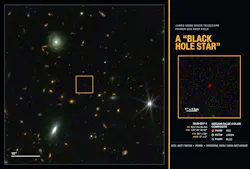
How does this light look different? “It’s a very special thing to find an object with no comparison, given the vast stores of data about billions of stars, galaxies, and black holes we have in our archival databases,” Naidu says. “MoM-BH*-1 is one in a billion! Empirically speaking, the way the light in black holes is almost entirely red and abruptly disappears below a certain wavelength—a Balmer break—is so dramatic, there’s no comparison among any known class of objects.”
An accreting black hole “can produce remarkable amounts of luminosity—some of the brightest objects known in the entire sky are accreting black holes,” he says. “Another mechanism might be ‘winds’ blowing out of the central black hole crashing into surrounding cocoons of dense gas that produce shocks and immense luminosity—indeed, some of the brightest astrophysical objects known, such as Type IIn Supernovae, involve highly energetic sources cocooned within layers of dense gas.”
The astronomers used simulations for several radiative transfer models and while they didn’t create “any pretty pictures, they helped us understand how light can be reddened by hydrogen gas without requiring any dust,” he says.
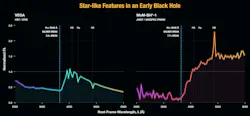
What’s next? “My collaborator Anna de Graaff (MPIA, Heidelberg) and I are fortunate to have been granted almost three full days of JWST time to study two black hole stars in exquisite detail,” Naidu says. “Observations begin in December and will be carried out during 2027. We hope to learn the detailed physics of these remarkable objects, such as exactly how massive they are and what do their ‘stellar’ features tell us about their ‘stellar’ atmospheres?”
The fundamental question Naidu is most excited about is how did BH*s form in the first place. “My team is pursuing an exciting theory that the BH*s look so much like stars because they may have formed from a single supermassive star whose imprints are found within all the ‘star-like’ features we’re noticing,” he says.
FURTHER READING
R. P. Naidu et al., Nature, 656, 329–333 (2026); https://doi.org/10.1038/s41586-026-10846-4.
About the Author
 Sally Cole Johnson
Sally Cole Johnson
Editor in Chief
Sally Cole Johnson is Laser Focus World’s editor in chief, and she has more than 25 years’ experience as a science and technology journalist. She specializes in physics and semiconductors, and wrote for the American Institute of Physics for more than 15 years, and also covered theoretical physics and neuroscience for the Kavli Foundation, and complexity for the Santa Fe Institute. Johnson has also written extensively about military embedded systems, high-performance computing, software-defined networks, and infosec. She is a member of the National Association of Science Writers (since 2001).
When she isn’t writing about optics, photonics, or quantum advances, you can find her outside in northern NH in the garden with birds landing in her hand or heading for the mountains with her bike, skis, or crampons and ice axe.