Bio-inspired GRIN lens may lead to better eye implants
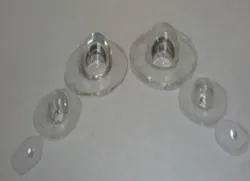
Cleveland, OH--A multilayered polymer gradient-index (GRIN) lens created by researchers at Case Western Reserve University and elsewhere has potential as implantable eye lenses, as well as lenses for other applications such as ground and aerial surveillance.
This work, which the Case Western Reserve University, Rose-Hulman Institute of Technology, U.S. Naval Research Laboratory, and PolymerPlus team describes in the Optical Society's (OSA's) open-access journal Optics Express, also provides a new material approach for fabricating synthetic polymer lenses.
GRIN lenses are made by nature, too
The lenses are built by stacking thousands of nanoscale layers, each with a slightly different refractive index.GRIN lenses have been around for a long time, both in natural (living eyes) and artificial (GRIN rods for optical fiber collimation, among others) forms.
The fabrication technique for this new lens is in many ways similar to that followed by researchers at Heriot-Watt University (Edinburgh, Scotland) and the Institute of Electronic Materials Technology (Warsaw, Poland) who create radially varying GRIN lenses by stacking glass optical fibers with differing indices together and drawing them down twice until the fibers reach subwavelength size.
In the case of the polymer GRIN lens, the varying-index structure consists of polymer layers rather than stacked glass rods.
“The human eye is a GRIN lens,” notes Michael Ponting, polymer scientist and president of PolymerPlus, an Ohio-based Case Western Reserve spinoff launched in 2010. “As light passes from the front of the human eye lens to the back, light rays are refracted by varying degrees. It’s a very efficient means of controlling the pathway of light without relying on complicated optics, and one that we attempted to mimic.”
The new technology has already moved from the research labs of Case Western Reserve to PolymerPlus for commercialization. “Prototype and small batch fabrication facilities exist and we’re working toward selecting early adoption applications for nanolayered GRIN technology in commercial devices,” says Ponting.
Paper: “A Bio-Inspired Polymeric Gradient Refractive Index Human Eye Lens,” Optics Express, Vol. 20, Issue 24, pp. 26746-26754 (2012).
About the Author
 John Wallace
John Wallace
Senior Technical Editor (1998-2022)
John Wallace was with Laser Focus World for nearly 25 years, retiring in late June 2022. He obtained a bachelor's degree in mechanical engineering and physics at Rutgers University and a master's in optical engineering at the University of Rochester. Before becoming an editor, John worked as an engineer at RCA, Exxon, Eastman Kodak, and GCA Corporation.