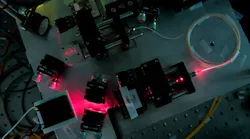
Phase-encoded photons enable secret Sagnac communications
Though significant progress has been made in quantum communications using polarization-entangled photons (see www.laserfocusworld.com/articles/332954 and www.laserfocusworld.com/articles/330741), practical implementation is difficult, considering that single-mode fiber networks are birefringent and polarization states cannot be maintained; in addition, the process is not easily scaled to long fiber lengths or high-bit-rate optical communications. Similar problems apply to quantum communications using Sagnac-interferometer-based systems. Recently, researchers at the Stockholm University in Sweden demonstrated, for the first time to their knowledge, Sagnac quantum secret sharing over single-mode fiber with lengths up to 75 km using phase-encoded photons.
A 1550 nm weak light pulse on a single-photon level is split in two at an “Alice” station that contains a novel control system for single-mode-fiber birefringence compensation. The pulses are sent clockwise and counterclockwise into a ring fiber network and return back to “Alice.” Nodes within the ring (called “Bob,” “Charlie,” and “David”) include polarization-insensitive phase-modulators that encode the photons with randomly chosen phases. In half the cases, the phases add up in such a way that the measurement results are deterministic, indicating constructive or destructive interference. These cases can be used for secret information sharing. Quantum bit-error rates of around 2% to 3% were achieved for raw transmission rates between roughly 500 and 2700 Hz. Contact Jan Bogdanski at [email protected].