Field metrology captures high-res scan of ‘untouchable’ Liberty Bell
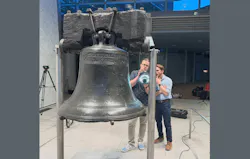
During Memorial Day weekend of 2026, our three-person team from the Virtual/Augmented Reality (VAR) Lab at Penn State Behrend set out to create a high-resolution digital twin of the Liberty Bell—without touching it—and to make the scans freely available to the public. For an artifact as historically significant and recognizable as the Liberty Bell, a freely available digital record provides an essential preservation resource and also offers a model for similar historic preservation projects around the world.
Nine hours, one shot
Our team had nine hours across three sessions with the Liberty Bell. The U.S. National Park Service gave us access outside public hours: Two mornings before the doors opened, starting at 5:30 a.m., and one evening after the Liberty Bell Center closed. Afterward, we packed up the truck and drove back to Erie, Pennsylvania. No second visit was scheduled, and we had no reason to assume we’d be given another opportunity. Every decision we made revolved around this window of time.
The rules were simple and absolute: Nothing touches the bell. No targets, no scanning spray, no fixturing, no moving the artifact toward the instrument. In a metrology lab, you bring the part to the machine. In this case, the machine went to the part—a 2,080-pound bronze casting hanging from a wooden yoke inside a glass building.
Four systems, four failure modes
We brought four capture systems, not only to be thorough but because each one falls down where another holds up.
A FARO Quantum X arm with Blu xS and xR laser line probes carried our finest surface geometry. These probes are published to be within the 10- to 25-µm range, although a probe specification isn’t the source of uncertainty of a finished multi-station model. The arm supplies a hard coordinate frame, while the probe supplies the surface—but no arm can supply reach in this case. Our working volume was fixed, so we worked on it in stations because the bell stands three feet tall and has a 12-foot circumference. No targets are permitted anywhere on the artifact, and every reposition is a possibility to introduce error into the dataset we treat as our geometric reference. This makes registration as consequential as the probe. We ran our work in PolyWorks Metrology Suite 2026.
Artec Space Spider and Eva 3D scanners covered aspects the arm couldn’t. Eva took global geometry fast. And we used Space Spider, which has a published 3D point accuracy up to 50 µm, to go after the lettering, the casting characteristics, and the geometry around the crack. Handheld structured light reaches angles an articulated arm can’t to record color the arm has no way to see.
To handle the room, which was a different measurement challenge, we used a Matterport Pro3. Its published depth accuracy is ±20 mm at 10 meters, which is coarser than the arm by orders of magnitude and is exactly right for a space rather than a surface. It also does something none of the close-range systems could because it captures the bell in its real setting instead of floating within a void. A Canon EOS R5 Mark II captured 45-megapixel imagery for documentation, texture reference, and photogrammetric processing, although the bell’s surface gave photogrammetry less to work with than we’d have preferred.
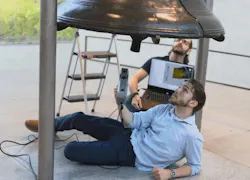
Scanning around the Liberty Bell’s ‘Spider’
The Liberty Bell’s interior was the hardest surface to scan. It has an internal metal support National Park Service calls the “Spider,” which is named for its arms that curl out around the lower edge of the bell. Good for the artifact, miserable for anyone trying to scan it. Getting up under the bell meant threading a scanner past another structure we weren’t allowed to touch.
We often worked in pairs. One person held the scanner and worked the surface, while the other carried the laptop, fed cable slack, and watched clearance. A second person wasn’t optional—when you’re the element that moves (backward for most scanning work) and the object stands still, it’s easy to lose track of where your elbow is.
The bell’s yoke was our last measurement and had to be done from a ladder. It may look simple from the floor, but it wasn’t because we had to work around bolts, split wood, and angles that changed every few inches.
Where the optics run out
The Liberty Bell’s oxidized bronze didn’t return light uniformly because two centuries of oxidation don’t lay evenly across a cast surface, and reflectance varied so much that settings read one region well but produced weaker returns elsewhere. We captured it in sections and adjusted as conditions changed, rather than running one pass at one setting. A glass-walled pavilion made ambient light part of the environment. Our early morning and evening windows were set by the National Park Service’s operations rather than by optics.
Optical capture stops at the Liberty Bell’s famous crack. Triangulation requires an emitter and sensor to both see the same patch of surface—and they can’t see inside a narrow fracture, regardless of the instrument. So we recorded the visible morphology of the crack and its surrounding surface as far as line of sight allowed. Our dataset doesn’t represent anything deeper inside the fracture because the optical systems we used could not capture geometry beyond direct line of sight.
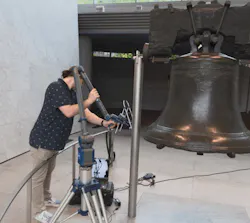
Processing the data onsite
To process the data onsite, we got a Lenovo Legion 9 with an RTX 5080 up and running from the first session to drive the scanners and give us a way to view the images and data we’d captured. A lagging machine would have cost us time when we needed to know in real time whether a pass had tracked before our window with the bell closed, not discover it two weeks later back in Erie.
After each session we opened the files before doing anything else, renamed each dataset so it traced back to scanner, session, and area, then wrote copies to the Legion, an external SSD, and the cloud. Three copies, two media, one offsite. Our scanning and photography alone have already produced hundreds of gigabytes of raw data, and it grows substantially once the VR180 and 360 video from the Insta360 Pro 2, the X5, and the Kandao QooCam 3 Ultra are transferred and processed. Between raw captures, working files, and finished experiences, this project will be well over a terabyte.
What’s the data good for?
Back in Erie, we each took one dataset through registration and cleanup. We left holes within the FARO dataset where we didn’t have data. Filled geometry looks better and means less, but anything a conservator might rely on must be honest about what it doesn’t know.
Our outputs aren’t interchangeable. A dense FARO dataset built for close geometric work is a different product from a color model built for public exploration, and the Matterport tour answers a third question entirely by preserving the relationship between the bell and the room. This distinction is the most important thing we’d tell anyone attempting something similar. Scanner specifications matter but can’t solve an occlusion or recover a pass never captured.
Most durable use? Longitudinal documentation. Artifacts change on timescales longer than any of our careers, and a detailed 2026 record gives future researchers something to work against, although any meaningful comparison will depend on how carefully any later captures and registrations are controlled.
Another reason was availability. To our knowledge, no comparable research-oriented scan of the Liberty Bell has ever been made freely available. You can see our scans and other project outputs at var.psu.edu/libertybell. Researchers, educators, and everyone interested are invited to inspect the bell from anywhere in the world and from viewpoints the visitor area doesn’t allow.
What’s next?
With a high-resolution digital twin of the Liberty Bell as it exists today, researchers can now revisit questions first explored by Penn State more than 25 years ago, including how its present-day geometry might refine models of how the cracked bell would sound if it could ring again.
This same dataset is also feeding the next phase of the project, including VR180, stereoscopic 360, and Gaussian splat experiences, as well as plans for a full-scale 3D-printed replica paired with research-informed sound. This deployment has all of us at VAR Lab thinking about which other preservation challenges could benefit from the same field metrology approach.
About the Author
Remington M. Orange
Remington M. Orange is a May 2025 graduate of Penn State Behrend’s Digital Media, Arts, and Technology program and the Schreyer Honors College. At VAR Lab, he served as Immersive Administrator and technical lead for 3D scanning and immersive media, including the Liberty Bell field capture and subsequent processing. He now lives in Brazil, where he is pursuing graduate study in occupational therapy and exploring how emerging technologies can expand access, assessment, rehabilitation, and participation within the field.
Christopher R. Shelton
Christopher R. Shelton, Ph.D., is the founder and director of VAR Lab: The Emerging Technologies Hub and an associate professor of clinical psychology at Penn State Behrend. He leads a cross-functional team applying AI, immersive technology, and digital systems to build deployable programs and products across healthcare, education, industry, and the public sector. His work spans clinical and program operations, product development, research, workforce leadership, and external partnerships. He co-led the Liberty Bell capture project as part of VAR Lab’s broader emerging technology portfolio.