Time-of-flight infrared sensing: How does it work and who uses it?

Infared time-of-flight (IR ToF) systems allow us to measure distance and build depth-aware systems by timing how long light takes to travel to a target and back. These systems calculate distance by measuring the round-trip time of an optical signal and dividing by two to account for the outbound and return paths. With the convergence of low-cost optoelectronics, compact laser sources, and fast signal processing, IR ToF has moved from specialist metrology into mainstream applications such as optical network test, laser rangefinders, LiDAR systems, and more.
Physics of ToF
ToF sensing hinges on the relationship between time, velocity, and distance: You record the round-trip travel time of the signal and multiply by the propagation speed in the medium to infer distance. The calculation is based on a propagation speed of 3 × 10⁸ m/s in vacuum, adjusted for the refractive index of the medium. It’s approximately 1 in air, so this holds as a practical formula (see Fig. 1).
To reach centimeter-level precision with direct ToF, you must resolve timing intervals in the tens of picoseconds. For example, achieving 1-cm precision corresponds to about 67-ps timing resolution. This requirement places tight constraints on your detector bandwidth, clock stability, and overall timing jitter budget.
Infrared ToF fundamentals
Near-infrared (NIR) ToF typically operates between 750 and 2500 nm, and many commercial systems use 850- or 905-nm sources, and an increasing number use 1550-nm sources. The choice of wavelength needs to account for eye-safety constraints, detector technology, and ultimately the usable range of your design.
At 905 nm, output power is limited by retinal hazard considerations, which caps the maximum permissible exposure and constrains range for a given aperture and receiver sensitivity. At 1550 nm, the eye’s cornea and lens absorb more strongly so you can use significantly higher optical powers within International Electrotechnical Commission (IEC) safety limits and extend your range without compromising safety.
Detector choices and APD advances
At 1550 nm, indium gallium arsenide (InGaAs) avalanche photodiodes (APDs) are the most common choice, while niche cases need germanium photodiodes. APD detectors underpin long-range rangefinders, fiber and free-space optical test equipment, autonomous and advanced driver assistance system (ADAS) sensing, industrial surveying, and aerospace systems.
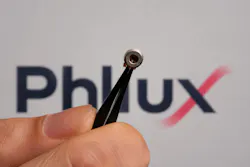
While 905 nm still dominates cost-sensitive segments such as smartphones, augmented reality/virtual reality (AR/VR), and some robotics, 1550 nm is gaining ground in applications where long range and high safety margins are important. Recent InGaAs innovations, including Phlux Technology’s Noiseless InGaAs APDs (see Fig. 2), deliver sensitivity improvements on the order of 12x, along with lower noise and higher bandwidth, which directly translate into longer range, smaller optics, or lower transmit power for a given performance target. This was achieved by adding an antimony alloy to the compound semiconductor process.
System architecture and operation
An IR ToF system typically combines a laser source, often a vertical-cavity surface-emitting laser (VCSEL), edge-emitting diode, or fiber laser, with a photodetector and readout chain capable of resolving nanosecond or sub-nanosecond pulses. Depending on the application, you can choose between direct ToF (time-domain) and indirect ToF (phase-domain) architectures (see Fig. 3)—each has its own implementation tradeoffs.
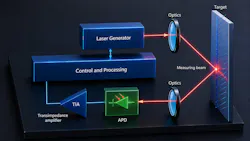
Direct ToF gives you high absolute accuracy and reduced susceptibility to multipath interference, at the cost of more demanding timing electronics. Indirect ToF, which infers distance from the phase shift of a modulated waveform, can offer high resolution with sophisticated processing, but requires careful handling of phase ambiguities and multipath.
Optical test and metrology
For optical test and metrology, IR ToF underpins instruments such as optical time domain reflectometers (OTDRs), which are used to characterize fiber links. By launching short IR pulses and analyzing backscattered and reflected signals, you can locate splices, connectors, and breaks along a fiber and quantify attenuation with distance.
To translate time into distance in fiber, apply the same ToF equation but correct the propagation speed for the fiber’s refractive index, which brings the effective velocity below that of light in free space (see Fig. 4).

Designers of OTDRs now package this capability into both integrated instruments for continuous network monitoring and portable “smart” testers for commissioning, maintaining, and troubleshooting fiber networks in the field.
Laser rangefinders and precision distance measurement
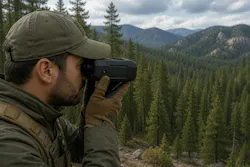
For laser rangefinders (LRFs), IR ToF gives you a straightforward way to measure distance: you emit a pulsed or modulated beam and compute distance from the returning signal’s time or phase. Today’s rangefinders can maintain millimeter-level accuracies, and in high-end or military-grade systems, you can sustain that accuracy over several kilometers.
To extend performance, you can pair a 1550-nm InGaAs APD with an ultralow-noise discrete preamplifier to achieve noise equivalent power (NEP) figures below 30 fW/√Hz over bandwidths up to 75 MHz with a 200-µm APD (see Fig. 5). This level of sensitivity and bandwidth supports demanding rangefinder and LiDAR applications, especially for defense and other long-range scenarios where every photon counts.
Automotive and mobility
Inside vehicles, IR ToF sensors help monitor driver alertness and cabin occupancy to provide depth-resolved data that can trigger safety interventions or optimize airbag deployment. Outside, they support parking assistance and low-speed obstacle detection to complement long-range LiDAR and radar systems.
For tasks such as curb detection, tight maneuvering, and low-speed autonomy, short-range ToF can be more practical than full-fledged LiDAR, particularly where cost, size, and power are constrained. By combining ToF data with camera imagery and other sensors, you can build robust perception stacks that handle everything from automated parking to last-meter navigation.
Industrial automation and process control
For industrial automation, IR ToF can serve as a cornerstone of your process control strategy, particularly where noncontact measurement is essential. Mounted on robotic arms, gantries, or conveyor systems, ToF sensors enable precise positioning, object detection, and inline dimensional checks without touching the product.
IR ToF may also play a key role in robotics for mapping and collision avoidance, especially when fusing depth data with inertial and visual information within simultaneous localization and mapping (SLAM) algorithms. In semiconductor and photonics manufacturing, ToF-based optical metrology enables generating 3D surface profiles and verifying component alignment—even on reflective, curved, or uneven parts.
Smart infrastructure and transportation
For smart cities and intelligent transportation systems (ITS), IR ToF sensors mounted above roadways can count and classify vehicles, monitor pedestrian flows, and feed adaptive traffic signaling. Because ToF inherently provides depth, you can distinguish between cars, bicycles, and pedestrians more reliably than with 2D cameras alone.
You can also apply ToF to adaptive lighting in streets and tunnels, turning luminaires on or off based on real-time traffic conditions. In rail and aviation environments, these sensors support platform safety monitoring, people counting, and obstacle detection, while in vehicles they contribute to both interior and exterior sensing tasks.
Consumer electronics and emerging applications
Consumer electronics contain IR ToF that use depth cameras for facial recognition, augmented reality gaming, and photography enhancements. Depth information allows the camera pipeline to produce realistic bokeh, segment foreground and background, and enable spatially aware applications.
In AR and VR systems, ToF sensors support room mapping, gesture recognition, and object tracking while maintaining fast update rates and low latency. Their compact size and low power draw make them well suited to wearable headsets where you can’t afford bulky optics or heavy processing loads.
Practical challenges in IR ToF
Designing IR ToF systems forces you to contend with several real-world challenges, starting with ambient light. Sunlight’s strong IR content can saturate detectors and drown out the return signal. Multipath reflections, where light bounces off multiple surfaces before reaching the detector, can introduce ghost points or distort 3D reconstructions.
Target reflectivity is also important because dark, absorptive, or transparent surfaces return less energy, while highly reflective surfaces can create multiple overlapping paths. To mitigate these effects, you can combine optical bandpass filters and shutters with advanced signal processing, including histogram-based analysis and machine learning algorithms that help distinguish valid returns from noise.
Integration with other modalities and AI
The best results may be obtained by combining IR ToF with other sensing modalities such as stereo vision or structured light, in which a known IR pattern is projected onto a scene and distortion of the pattern reveals depth.
Each technique has its weaknesses, and fusion lets you maintain robustness across a broader set of scenes and lighting conditions.
As AI becomes more tightly integrated into embedded systems, you can move beyond raw depth maps to derive higher-level insights such as object classification, behavioral prediction, and automated decision-making. Within this context, ToF outputs become just one channel in a larger perception and control stack.
About the Author
 Christian Rookes
Christian Rookes
Christian Rookes is VP of marketing at Phlux Technology, a manufacturer of avalanche photodiode (APD) infrared sensors based in Sheffield, U.K. He has more than 25 years’ experience in technical marketing in semiconductor and optical communication fields. Rookes holds a BSc in Engineering and Physics from Loughborough University and an MBA Essentials Certificate from the London School of Economics. He holds two patents, including one related to impedance matching for laser diode circuits.