If you open a physics textbook, you’ll find the speed of light is a fundamental physics constant listed as 299,792,458 meters per second. It plays a central role in Albert Einstein’s special theory of relativity (1905), which states the speed of light within a vacuum “is constant and independent of the observer’s motion.”
But Enbang Li, a physicist and associate professor at the University of Wollongong in Australia, is questioning whether the speed of light is influenced by tiny influences exerted by Earth’s gravitational field (which Einstein also wondered in 1911).
“The constancy and universality of the speed of light not only make it a cornerstone of our understanding of the physical universe but it also underpins numerous technologies, including optical communications for fiber-optic cables to transmit data as light pulses to enable high-speed internet and telecommunications,” Li says. “Speed of light dictates data transmission rates and latency within these systems.”
Does gravity impact light properties such as photon speed and frequency/energy in a subtle but measurable way? “In 1911, Einstein considered the variation of the speed of light caused by the gravitational time dilation and predicted the speed of light would increase with the gravitational potential,” says Li.
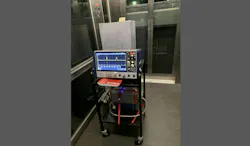
Li and his team wanted to explore this possibility by experimentally measuring the local speed of light, so they designed and built an optical system to search for impacts of tiny shifts in gravity. “Our idea was to measure the speed of light at different height levels where Earth’s gravity is different,” says Li. “So we transmitted ultrafast laser pulses through a 20-km fiber and measured the return transmission times by making the measurements inside an elevator.”
Back to basics
In physics, many optical effects are caused by interactions between photons and other fields such as electro-optic effect and magneto-optic effect.
“Gravito-optic effects are generated by interactions between photons and gravitational fields, which include changes of photon speed and frequency (energy) under different gravitational fields,” explains Li. “Gravitational time dilation tells us clocks run slower within a stronger gravitational field—and it means the local speed of light within a vacuum should increase when the gravity increases, which agrees with the theory Einstein proposed in 1911 (and later abandoned in 1915 when he developed the general theory of relativity).”
Does speed of light increase with gravitational field?
The team’s experimental results show “the speed of light increases with the gravitational field, which challenges Einstein’s postulation on the constant speed of light made in 1905, but is consistent with Einstein’s work published in 1911,” says Li.
For their experiments the researchers used the inside of an elevator to change the gravitational field, while using ultrafast laser pulses to measure the travel time within an optical fiber spool (return length of 20 km) at different heights. “Although we used various measures to isolate Earth's gravity from environmental variables (temperature, air pressure, air humidity), further experimental validation is essential,” Li says.
To confirm their earlier results with greater confidence and to ensure the exclusion of possible non-gravity factors, the researchers designed and built another fiber-optic system in which two identical optical fiber spools are arranged in a differential mode to overcome any possible common-mode influences. “We ran our experiments inside a fully airconditioned optics laboratory within a vibration-free building,” says Li. “The room temperature, air pressure, and humidity inside the laboratory were kept constant during our experiments, and we used an oscillating source mass to change the gravitational field.”
Li and colleagues’ experimental results show photons could interact with Earth’s gravitational field and, consequently, the speed of light would be affected by Earth’s gravity. “This finding should inspire new research of the interaction between photons and the gravitational field,” he says.
Photonics-based gravity detection technologies ahead?
The interaction between photons and gravitational fields “is a research subject in fundamental physics and quantum gravity, and the dependence of photon speed on gravitational field is one of the gravito-optic effects we’re exploring,” says Li. “Our work not only attempts to resolve one of the most fundamental issues in physics but also opens a path to develop photonics-based gravity detection technologies that could find applications in geodesy, resource exploration, climate monitoring, and underwater navigation, as well as natural hazard assessment.”
FURTHER READING
E. Li, Sci. Rep., 16, 13556 (2026); https://doi.org/10.1038/s41598-026-44668-1.
E. Li, Ann. Math. Phys., 8, 4, 096–101 (Jul. 3, 2025); https://doi.org/10.17352/amp.000154.
E. Li, Preprints, 2025120105 (2025); https://doi.org/10.20944/preprints202512.0105.v1.
About the Author

Sally Cole Johnson
Editor in Chief
Sally Cole Johnson, Laser Focus World’s editor in chief, is a science and technology journalist who specializes in physics and semiconductors.