Diamond quantum emitter decoupled from vibrations may be a gamechanger
A diamond color center discovered by University of Illinois Urbana-Champaign researchers emits an exceptionally bright and narrow band of quantum light (single photons)—and it’s largely immune to crystal vibrations within the lattice.
For more than a decade, diamond has served as a workhorse material for quantum science. Its crystal lattice can host atomic-scale defects, a.k.a. color centers, which behave like artificial atoms because they absorb and emit light one photon at a time.
“But within such solid-state quantum emitters, the crystal’s own vibrations (phonons) reduce the coherence and efficiency of the emission,” says Swetapadma Sahoo, a Ph.D. student who led this work within Professor Simeon Bogdanov’s group in the Department of Electrical Computer Engineering. “It constitutes a serious limitation for optical sensing applications of color centers. And to obtain spectrally clean photons suitable for quantum information protocols such as networking, these systems must be cooled down to a few Kelvin to get rid of phonons. This bottleneck motivated my search for better color centers during my Ph.D.”
Color centers: Back to basics
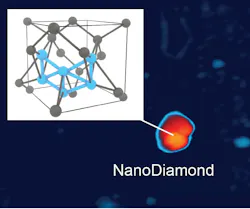
A color center is essentially an artificial atom trapped inside a crystal. It arises from a local defect—one or a few vacancies, impurities, or interstitials within an otherwise perfect crystal.
“Such a defect creates its own electronic energy levels inside the crystal’s bandgap, which allows electrons to absorb and emit light one photon at a time,” explains Sahoo. “Color centers can be used to sense electromagnetic fields, temperature, or strain with atom-scale spatial resolution and a convenient optical readout. Single photons can carry quantum information and link distant qubits for quantum networking and photonic quantum computing.”
Photons are emitted when an electron jumps between two of the color center’s discrete quantum levels. “We call the higher energy state ‘the excited state’ and the lower energy state ‘the ground state’,” she says. “For most applications, we want the emission to be as spectrally narrow and bright as possible.”
Unlike single atoms, a wide variety of bulk phonons can be absorbed or added to the lattice during the transition. “The emission line is then broadened considerably; a broad phonon sideband is formed within the emission spectrum, and sometimes the transition fails to produce a photon altogether,” Sahoo says. “The effects of phonons and vibrations worsen quickly as temperature rises. An intuitive way to picture it: A color center is like a glass of wine inside a car. However carefully you hold it, every bump on the road sloshes your wine.”
IL1
The team named the diamond color center “IL1” for the University of Illinois, and it behaves akin to riding inside a car with perfect suspension—it’s isolated in a unique way from the bulk phonons. “Instead of the broad phonon sideband typical of solid-state quantum emitters, it shows a clean set of equally spaced sharp peaks separated by ~45 THz,” says Sahoo. “This spacing is higher than the maximum vibrational frequency the diamond lattice can support (~40 THz), and if vibrations get involved in the electronic transition it can’t be bulk phonons.”
Instead, a single localized vibration of the defect structure itself is involved (the nth peak corresponds to n quanta of this vibration being created during the photon emission). “And because the defect vibrates at a frequency the lattice simply can’t carry, its coupling to the bulk phonons is suppressed,” she says. “The broad phonon sideband that normally dominates room-temperature spectra of color centers is essentially gone.”
IL1’s main emission line is merely 0.31-nm wide, which is the narrowest reported for any color center at room temperature. And its emission is exceptionally bright—more than 13 million photons per second at saturation. Bright, narrow-band single photons at elevated temperatures open a path to quantum technology outside a cryostat and better nanoscale quantum sensors.
Advance for the quantum realm
One of the biggest practical challenges for quantum sensing is to read out information with a better signal-to-noise ratio.
“For example, color center-based temperature nanosensors detect a shifting spectral line, so sensitivity scales with how narrow this line is and how many photons you collect,” Sahoo says. “IL1 improves both, and because it’s decoupled from lattice vibrations the line stays sharp even at room temperature.”
Farther out on the horizon, the IL1 center points to a way to raise the rate at which quantum information can be processed and transferred.
“For quantum networks, bit rates are well below the practical requirements imposed by the stationary qubits,” Sahoo explains. “Brighter and faster single-photon emitters directly improve these rates. And if one can operate at temperatures higher than 10K or even outside a cryostat, we remove a major obstacle to scaling these systems up—because cryogenics require space, money, and infrastructure that a deployable quantum device can’t easily carry.”
Franck-Condon principle at play
One of the most surprising moments hit when Sahoo realized several equally spaced narrow emission lines belonged to the same diamond color center. “This behavior isn’t normally observed in quantum emitters because of how many different phonon modes they couple to,” she says. “But the famous Franck-Condon principle—the textbook illustration of an electronic transition coupled to a single vibrational mode—jumped out at us.”
It was the turning point for their research because it revealed “there’s another route around the phonon-coupling bottleneck in solid-state crystals,” says Sahoo.
So the team collaborated with Professor Prineha Narang and Peter Udvarhelyi, a postdoctoral scholar, at the University of California, Los Angeles, whose first calculations suggested a candidate structure for IL1 centers—three-carbon interstitial defect, with optical and vibrational properties that closely matched those of IL1. “It was thrilling to find a good match so early on in our study and to also see IL1’s properties hold up across a wide temperature range in measurements carried out with the help of Ben Lawrie, a senior research scientist and a director for the Heterogeneous Quantum Systems Initiative at Oak Ridge National Laboratory,” says Sahoo.
The team’s biggest challenge now “is to fabricate this defect on demand within bulk diamond,” says Sahoo. “Our collaborators Viatcheslav Agafonov in France and Valery Davydov in Russia produced diamond nanoparticles for this study using a special high-pressure, high-temperature recipe. But the exact formation pathways for IL1 aren’t yet known.”
Nanophotonic resonators ahead
The application the researchers are pursuing now is “integrating IL1 centers into nanophotonic resonators to obtain coherent, indistinguishable photons at elevated temperatures,” Sahoo says. “Another application where IL1s can shine is nanoscale optical thermometry. We’re planning to study IL1’s spin manifold to assess its potential for magnetometry and quantum networking.”
Sahoo and colleagues also want to answer the following questions: Can the spin and charge states of IL1 be controlled? Can its unique localized vibrational mode be controlled? And can similar phonon-decoupled defects in materials be engineered by design? “We’re excited to see how these goals progress during the next few years,” she says.
FURTHER READING
S. Sahoo et al., Nat. Commun., 17, 8070 (2026); https://doi.org/10.1038/s41467-026-74662-0.
More Coverage
About the Author
 Sally Cole Johnson
Sally Cole Johnson
Editor in Chief
Sally Cole Johnson is Laser Focus World’s editor in chief, and she has more than 25 years’ experience as a science and technology journalist. She specializes in physics and semiconductors, and wrote for the American Institute of Physics for more than 15 years, and also covered theoretical physics and neuroscience for the Kavli Foundation, and complexity for the Santa Fe Institute. Johnson has also written extensively about military embedded systems, high-performance computing, software-defined networks, and infosec. She is a member of the National Association of Science Writers (since 2001).
When she isn’t writing about optics, photonics, or quantum advances, you can find her outside in northern NH in the garden with birds landing in her hand or heading for the mountains with her bike, skis, or crampons and ice axe.