Quantum interference control via directional photocurrent?
Quantum interference is a fundamental level of physics and chemistry. When two quantum pathways lead to the same final state, their amplitudes can interfere constructively or destructively. For a solid such as gallium arsenide (GaAs), this interference can be produced between two phase-related optical absorption pathways.
Quantum interference control of carriers—electric charges mobilized by the energy of absorbed photons—through one- and two-photon absorption, a.k.a. “1 + 2 QuIC,” was developed theoretically and demonstrated experimentally in the 1990s.
University of Michigan Professor Steven Cundiff was involved in early advances and applications of optical frequency combs, whose importance was recognized by the 2005 Nobel Prize in Physics awarded in part to John Hall and Theodor Hänsch. Cundiff and colleagues recognized that an octave-spanning frequency comb is a natural tool to produce 1 + 2 QuIC. Conversely, the phase-sensitive QuIC current can be used to detect the optical phase of the frequency comb. It established a powerful connection between frequency-comb science and quantum interference control.
At the beginning of Yiming Gong’s project, Professor John Sipe, a theoretical physicist at the University of Toronto, and colleagues predicted interference between two- and three-photon absorption (2 + 3 QuIC) would be much more than a technically difficult higher-order version of 1 + 2 QuIC. They predicted that 2 + 3 QuIC would inject carriers into a substantially narrower region of momentum space. This localization suggested optically injected electrons could form a narrow beam-like distribution—a directional current produced without an applied voltage.
“This prediction directly motivated my work,” says Gong, a Ph.D. candidate working with Cundiff. “Using an ohmic-contact AlGaAs device I designed, we experimentally demonstrated the directional 2 + 3 QuIC current and found that its angular localization agreed with the theoretical prediction. We also conducted a detailed study of its polarization dependence.”
First, a bit of quantum interference control background
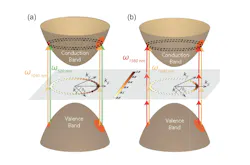
At the heart of the group’s experiment are two phase-coherent ultrafast optical fields. They compare two forms of quantum interference control, a.k.a. 1 + 2 and 2 + 3 QuIC.
For the 1 + 2 process, a carrier can reach the same final energy either by absorbing one 520-nm photon or by absorbing two 1040-nm photons. In the 2 + 3 process, it can reach the same final energy by absorbing two 1040-nm photons or three 1560-nm photons. Because each pair of pathways leads to the same final state, the associated quantum amplitudes can interfere.
The relative phase of the two optical fields determines whether this interference favors carriers moving in one direction or the opposite direction. Polarization determines the preferred direction within the plane of the semiconductor. The key physical concept is that phase and polarization of the light are translated into the magnitude and direction of an electrical current.
For a material, the group used aluminum gallium arsenide (Al0.28Ga0.72As). Its bandgap can be engineered by adjusting the aluminum concentration, which allows researchers to select the desired multiphoton absorption processes while suppressing competing processes.
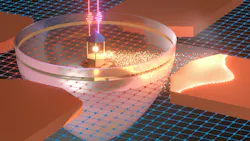
This sample contains two perpendicular pairs of electrodes, and it’s essential because a single electrode pair measures only one projection of the current. Measuring the two perpendicular components simultaneously reveals how the current rotates within the plane of the sample.
How does this method work?
The researchers begin with a mode-locked erbium-doped fiber laser “producing pulses near 1560 nm,” says Gong. “Part of the spectrum is broadened and amplified near 1040 nm. These two wavelengths are derived from the same coherent frequency comb, providing the phase relationship required for quantum interference.”
The pulses sent to the sample are approximately 85-fs long, and the group carefully overlaps them in space and time, controls their relative phase, and rotates their linear polarizations. When the two polarizations are rotated together, the injected current rotates with them.
“We measure the current simultaneously along two perpendicular axes,” says Gong. “This allows us to distinguish between two very different possibilities: A current whose amplitude merely changes as the light polarization rotates or a current vector that physically changes direction. Our measurements demonstrate the latter.”
A quantum advance?
At a fundamental level, this work moves quantum interference control from simply breaking momentum symmetry to deliberately shaping the momentum distribution of carriers inside a solid.
“An important feature of our experiment is that we obtain a direct electrical readout of the quantum-interference current through ohmic contacts—without applying an external bias,” says Gong. “Because there’s no electric field continuously driving the carriers after they scatter, the measured current is selectively sensitive to the initially injected ballistic carrier population. In this sense, the electrical signal preserves information about the microscopic momentum distribution created by the optical fields.”
It creates a bridge between two complementary descriptions of the same physics. In real space, the researchers directly measure the current along two perpendicular directions. In momentum space, they model the angular distribution of the injected carriers using the nonlinear optical response of the semiconductor, while also accounting for the finite geometry of the electrodes. “Connecting these two descriptions allows us to go beyond detecting whether a current exists: We can investigate its angular spread and determine how strongly the carrier distribution is localized around a preferred direction,” says Gong.
This is fundamentally different than viewing quantum interference only as a way to create an imbalance between carriers with opposite momenta. Breaking the symmetry between +k and −k is sufficient to produce a net current, but it doesn’t specify the shape of the underlying distribution. “A broad distribution and a narrowly localized distribution may both produce a current. Our result shows that a higher-order 2 + 3 interference process can sculpt that distribution into a much narrower, beam-like form,” Gong adds.
More broadly, the ability to create and electrically read out an angularly localized ballistic carrier distribution provides a momentum-selective probe of electronic structure. It may reveal how band anisotropy and local electronic structure govern carrier motion and scattering within semiconductors and, potentially, within other quantum materials such as transition-metal dichalcogenides.
Electrical current shows sensitive response to relative optical phase
One of the coolest aspects of this work for Gong was discovering just how sensitively the electrical current responds to the relative optical phase. Because the current is controlled by the relative phase between the two absorption pathways, a change in optical path length of only tens of nanometers can produce a visible change in the measured signal.
“We could tap the optical table and immediately see the current respond,” Gong says. “Even small air fluctuations along the beam paths could shift the relative phase enough to alter the signal. It was remarkable that such tiny and otherwise invisible optical disturbances could be converted directly into a measurable electrical response.”
The same current was also extremely sensitive to the direction of the optical polarization. Rotating the polarization didn’t merely change the current’s amplitude—it changed the direction in which the carriers were injected. “When we rotated the polarization by 90 degrees, the signal disappeared from one pair of electrodes and emerged in the perpendicular pair,” says Gong. “Our major ‘aha!’ moment grew directly out of this sensitivity. When we initially scanned the two pulse trains through one another in time, we could see a broad, noisy envelope around their temporal overlap, but the coherent structure within it was obscured. The signal indicated that the two quantum pathways were interfering, but the relative phase was too noisy for the underlying interference to appear clearly.”
This instability came from the offset-frequency noise of the frequency comb. Because the comb’s offset frequency also provided the reference for the group’s lock-in detection, its broad linewidth—initially on the order of hundreds of kilohertz—made it difficult for the lock-in amplifier to extract the signal with a satisfactory signal-to-noise ratio.
“We used a feed-forward loop with acousto-optic modulators (AOM) to compensate for the offset-frequency noise and narrowed its effective linewidth from hundreds of kilohertz to approximately 1 Hz,” says Gong.
After the offset frequency was stabilized, the measurement changed dramatically: Clear sinusoidal fringes appeared inside what had previously looked like a noisy envelope. The fringes were produced by the controlled modulation of the relative optical phase—a direct electrical signature of quantum interference. "It felt almost as if the quantum interference had crystallized out of the noise," says Gong. "What had appeared disordered suddenly became structured, reproducible, and controllable."
Another unforgettable moment was “when we rotated the polarization while measuring both orthogonal current components simultaneously,” says Gong. “As the polarization rotated by 90 degrees, the current disappeared from one electrode pair and appeared in the other. At one orientation, one component reached its maximum while the perpendicular component approached zero. After the rotation, their roles were reversed. Seeing this transfer occur between the two channels made the vector nature of the current immediately visible.”
Challenge: Device fabrication
Beyond suppressing the different sources of optical and frequency-comb noise, one of the group’s biggest technical challenges was fabricating the device itself. It required two orthogonal pairs of micron-scale electrodes to form reliable ohmic contacts with the AlGaAs sample.
The “established 1 + 2 QuIC device architectures available to us were based largely on Schottky-contact geometries,” Gong explains. “For our 2 + 3 QuIC measurement, we needed ohmic contacts to minimize contributions from built-in electric fields and directly isolate the optically injected ballistic current. There was no established recipe we could simply follow for our particular AlGaAs structure and device geometry, so we had to develop much of the fabrication process through systematic experimentation.”
Forming an ohmic contact depends sensitively on the semiconductor-metal interface, the composition and sequence of the deposited metal layers, their individual thicknesses, and the annealing temperature and duration. “We explored different metal stacks and annealing conditions, and used a plasma etch to remove the native oxide from the AlGaAs surface before depositing the contacts,” says Gong. “Even small changes in these steps can determine whether the final device behaves as a low-resistance ohmic contact or retains a nonlinear, Schottky-like response.”
The staff and instrumentation at the University of Michigan’s Lurie Nanofabrication Facility “was essential to this exploration,” Gong adds. “Solving the contact problem ultimately allowed the device to provide a direct electrical readout of the directional ballistic current.”
Theoretical work
The group’s experiment was motivated by the remarkable theoretical prediction from Professor John Sipe and his collaborators, and Gong extended it to what they could directly measure experimentally by developing an optoelectronic response model that connects the microscopic angular distribution of the injected carriers in k-space to the macroscopic current collected by their two orthogonal electrode pairs in real space.
“Our model incorporates the nonlinear optical response of AlGaAs, the polarizations of both optical fields, and the finite geometry of the electrodes,” says Gong.
The same model closely reproduced the detailed polarization dependence observed during their experiment while remaining consistent with the original prediction of a more localized carrier distribution in k-space. “I find it especially satisfying that it brings two levels of the physics into a single framework,” says Gong. “Fundamental quantum-interference phenomenon of momentum-space localization and its experimentally accessible manifestation as a directional, vector-resolved electrical current. In other words, the model shows how an invisible microscopic carrier distribution becomes a current that we can measure directly at the contacts.”
Optical metrology, electronic and quantum materials studies ahead
Gong sees two complementary application directions for this work: Precision optical metrology and the study of electronic and quantum materials.
“The first is for phase-sensitive detection of optical frequency combs,” Gong says. “Conventional electronics can’t directly follow an optical field oscillating at hundreds of terahertz. Quantum interference provides a way to translate this otherwise inaccessible optical phase information into a much lower-frequency electrical signal.”
For the group’s experiment, the current depends sensitively on the relative phase between two multiphoton absorption pathways. For a frequency comb, this relative optical phase evolves with the carrier-envelope offset frequency so the semiconductor effectively acts as a phase-sensitive optical-to-electrical mixer: Information carried at optical frequencies appears as a measurable current oscillation in the radio-frequency range.
“This could provide an extremely sensitive tool for detecting and stabilizing the offset frequency, relative phase, timing, and phase noise of frequency combs,” Gong points out. “The directional 2 + 3 current adds a vector-resolved and polarization-sensitive electrical response to this phase detection.”
A second direction is momentum-selective spectroscopy of electronic materials. By optically injecting carriers into a narrow range of directions and measuring the resulting vector current, researchers can explore how band anisotropy and local electronic structure govern carrier motion and scattering. “Extending the method beyond AlGaAs to transition-metal dichalcogenides, multivalley systems, and spin-textured or topological materials could provide a new route toward studying valley and spin dynamics—and, with appropriate theoretical modeling, potentially aspects of Bloch-band quantum geometry such as Berry curvature,” says Gong.
“As a research tool, our technique is ready now for ultrafast and frequency-comb laboratories,” says Gong. “Our near-term goal is to improve its sensitivity and stability and explore its use as a vector-resolved detector of optical phase and polarization.”
The next scientific step? Extend the method “to other materials and use wavelength, phase, and polarization to address different regions of momentum space,” Gong adds. “We’re particularly interested in anisotropic, multivalley, spin-textured, and topological materials, in which the directional current may reveal new information about band structure, carrier scattering, valley and spin dynamics, and potentially quantum geometry. Translating the concept into a compact practical device is a longer-term goal.”
FURTHER READING
Y. Gong, K. Wang, and S. T. Cundiff, Phys. Rev. Lett., 137, 036901 (Jul. 16, 2026); https://doi.org/10.1103/3v91-5pzf.
More Coverage
About the Author
 Sally Cole Johnson
Sally Cole Johnson
Editor in Chief
Sally Cole Johnson is Laser Focus World’s editor in chief, and she has more than 25 years’ experience as a science and technology journalist. She specializes in physics and semiconductors, and wrote for the American Institute of Physics for more than 15 years, and also covered theoretical physics and neuroscience for the Kavli Foundation, and complexity for the Santa Fe Institute. Johnson has also written extensively about military embedded systems, high-performance computing, software-defined networks, and infosec. She is a member of the National Association of Science Writers (since 2001).
When she isn’t writing about optics, photonics, or quantum advances, you can find her outside in northern NH in the garden with birds landing in her hand or heading for the mountains with her bike, skis, or crampons and ice axe.