Milestone reached on path to large-scale quantum sensors
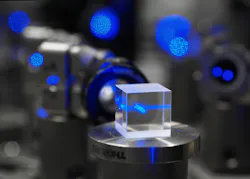
By comparing two long-baseline interferometers, which use lasers to split and measure the motion of clouds of atoms with extreme precision, a consortium of researchers led by Imperial College London recently showed it effectively cancels out undesirable experimental noise—and this principle of next-gen quantum detectors works under realistic conditions.
The Atom Interferometer Observatory and Network (AION) consortium’s inspiration comes from the extraordinary accuracy of atomic clocks and is focused on developing next-gen quantum sensor technologies.
“These amazing devices have been measuring time using principles from quantum mechanics for decades, and are now so accurate they can measure time to the 19th decimal place,” says Charles F.A. Baynham, co-lead of the Ultracold Strontium Laboratory at Imperial College London. “Physicists, including myself and colleagues, have used these for testing the Standard Model of Physics to extreme precision, but our project envisions using the same principles to search for gravitational waves from distant black holes within other galaxies.”
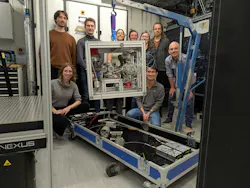
Building a quantum sensor
Baynham and colleagues rely on lasers for almost every aspect of their quantum sensor work—to cool atoms down to near absolute zero, read out their quantum state, and generate unusual quantum states of matter where the wave-function of an atom is spread out over many places at once.
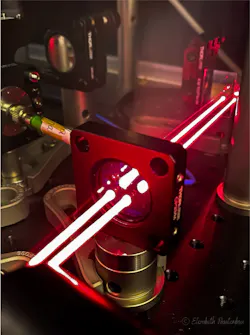
What types of lasers are involved? Quite a few, actually—including a rack of Toptica external-cavity diode lasers (ECDLs), which are either used directly or as seed lasers for others. Several of these ECDLs are locked to an ultrastable optical cavity that produces linewidths of <3 Hz. “We also use several home-built injected diode amplifiers, which are seeded by the Toptica ECDLs to maintain an injection lock through automated relocking hardware we’ve built,” says Baynham. “Two titanium sapphire lasers are used for high-power, tunable sources. One of these is phase-locked to the 3-Hz ECDL: It’s our clock laser and its precision drives this whole experiment. And to trap atoms, we use a 55-W 1064-nm fiber laser.”
These quantum states act as clocks to effectively time how long it takes light to travel from one place to another. “If a gravitational wave travels through Earth, it causes space itself to stretch very slightly,” Baynham says. “This stretch is miniscule—over a 1-km-long length, the change is about the same size as a single proton. But sensors like ours aim to detect this tiny ripple in spacetime and use it to understand how galaxies like our own formed.”
Strontium atoms
The group’s quantum sensor is made out of atoms of strontium-87 and laser light within a vacuum. “We use ultrahigh-vacuum chambers to make an extremely high-quality vacuum, and then use beams of laser light to capture, cool, and manipulate clouds of strontium atoms,” Baynham explains. “These are ‘ultracold’ atoms because we use the atoms’ interactions and laser light to cool them down to <15 nK—even though our vacuum chamber is at room temperature.”
Atoms are almost perfectly isolated from the environment around them when the researchers put them in vacuum, so they’re ideal sensors for tiny signals like gravitational waves that would otherwise be swamped by noise.
“I love that we can see our atoms by eye,” says Baynham. “If you look into our chamber carefully (some of the lasers are very powerful and need safeguards in place), we can see a glowing ball of blue light. These are atoms being levitated by laser light and are certainly the coldest thing I’ll ever see. They’re sitting around 10 mK, which is much colder than outer space. The blue glow is the photons being emitted by the atoms as they cool down—the same photons we capture with a sensitive camera to measure the atoms’ state.”
A video of the first 3D magneto-optical trap (MOT) formed in the lab. This glowing ball of atoms is at 10 s of milliKelvin—nearly absolute zero. Filmed/narrated by Charles Baynham
Simulations involved? “Yes! Our consortium has people working across the board on simulations—from simulations of how atoms interact with laser light to simulations of how dark matter might interact with our sensor (another goal of our project) and even how the movement of clouds causes gravitational signatures that might be a noise source for us,” Baynham says. “It’s really a huge team effort and I’m really grateful to be working with such a talented group of scientists.”
How is this work an advance for quantum sensors? It’s the first time an interferometer was built with the specific atom and transition needed for long-baseline sensors. “Our demonstration was only 1-mm long, but our project is soon releasing a full design for a 100-m system—in collaboration with our partners in the U.S. (the MAGIS-100 project), who are already working on such a system—with the goal of a 1-km system eventually,” Baynham says. “Our results are a milestone along the path to bring these sensors a step closer to reality.”
Sensor sensitivity improvements
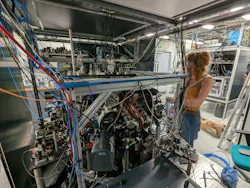
The group does have a few challenges to overcome for these sensors. “Our work is a milestone along the way, but these sensors need sensitivity improvements from a range of sources,” Baynham explains. “It’s why we’re working on various techniques to improve their sensitivity, including splitting the quantum state of the atoms by larger distance to generate ‘entangled’ states of atoms to work around noise sources from fundamental quantum mechanics, and simply starting with more atoms so we can make many more measurements in parallel.”
As far as applications ahead, “we want to search for signs of fundamental physics, but the same technology we’re building can be used for navigation without the need for GPS and for sensing masses underground through their gravitational signature,” Baynham says. “The signals from GPS are dimmer than a light bulb thousands of kilometers away, so it’s easy to jam accidentally or maliciously—but our economy completely relies on it. It turns out, the same physics used for gravitational wave detection can also measure accelerations extremely precisely. This lets researchers build quantum inertial navigators that can’t be jammed and that work underground and underwater.”
Next up? “Two things in parallel: We’re making improvements to our lab that we hope will unlock the next two orders of magnitude in sensitivity, while also launching the Atom Interferometry CERN Experiment (AICE) with our partners at CERN, where we’ll build a full-scale 100-m version of the prototype we demonstrated,” says Baynham.
FURTHER READING
C. F. A. Baynham et al., Nature, 654, 622–628 (2026); https://doi.org/10.1038/s41586-026-10617-1.
More Coverage
About the Author
 Sally Cole Johnson
Sally Cole Johnson
Editor in Chief
Sally Cole Johnson is Laser Focus World’s editor in chief, and she has more than 25 years’ experience as a science and technology journalist. She specializes in physics and semiconductors, and wrote for the American Institute of Physics for more than 15 years, and also covered theoretical physics and neuroscience for the Kavli Foundation, and complexity for the Santa Fe Institute. Johnson has also written extensively about military embedded systems, high-performance computing, software-defined networks, and infosec. She is a member of the National Association of Science Writers (since 2001).
When she isn’t writing about optics, photonics, or quantum advances, you can find her outside in northern NH in the garden with birds landing in her hand or heading for the mountains with her bike, skis, or crampons and ice axe.