Quantum entanglement: Impacts on philosophy and reality
The immense success of quantum mechanics can be routinely experienced via the transistor, the laser, nuclear magnetic resonance (NMR), and magnetic resonance imaging (MRI), the atomic clock, quantum tunneling, and more contemporaneously via quantum entanglement, quantum cryptography, and quantum computing. These are massive, tangible, technological contributions. But criticisms toward quantum mechanics as a physical theory have persisted for nearly a century.
Quantum entanglement
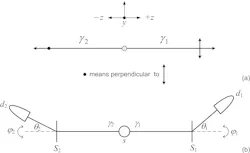
In 1930, Paul Dirac introduced the electron-proton annihilation theory known as the pair theory. In 1946, John Archibold Wheeler applied Dirac’s theory to positron-electron annihilation and arrived at a most lucid descriptions of quantum entanglement: “If one of these photons is linearly polarized in one plane, then the photon that goes off in the opposite direction with equal momentum is linearly polarized in the perpendicular plane.” In 1947, Maurice Pryce and John C. Ward,1 inspired by Wheeler, published the first quantum entanglement experimental diagram and the first correct calculation for the quantum probability describing such an experiment (see Fig. 1). This is the physics path to quantum entanglement.
In 1935 Albert Einstein, Boris Podolsky, and Nathan Rosen (EPR)2 concluded that quantum mechanics was “not complete.” In other words, it provided an incomplete description of physical reality. They also considered the interaction and subsequent separation of two systems and deduced that once the systems separated, no measurement in the first system could determine measurements in the second system. Then they further suggested that a complete description of physical reality was possible. This paper was rapidly followed by two papers by Erwin Schrödinger that supported their arguments and castigated quantum mechanics as “disconcerting” and even “repugnant.” It was Schrödinger who introduced the word entanglement to describe the interaction between two systems. He also referred to the EPR situation as a paradox.
The EPR and Schrödinger papers were philosophical in character and did not include the equations of quantum entanglement. This had to wait until the entrance of Pryce and Ward. In this regard, it is fair to categorize the path initiated by Dirac as the physical path to quantum entanglement and the path initiated by EPR as the philosophical path to quantum entanglement. The two approaches were developed independent of each other.
EPR and Bell
The EPR paper became one of the most cited papers in physics, while the Pryce and Ward paper was relegated to the archives of oblivion and was cited only by the few experimentalists who performed the first γ-ray quantum entanglement experiments via positron-electron annihilation. Notable among these was the work of Chien-Shiung Wu and Irving Shaknov.3
EPR inspired a quest for a complete description of reality that resulted in the introduction of hidden variable theories (HVTs). In turn, this led to the creation of John Stewart Bell’s theorem (1964) that highlighted the incompatibility of HVTs with quantum mechanics. Although Bell’s theorem had a significant impact in convincing quantum skeptics that HVTs were superfluous, it did not play a role in the physics of quantum entanglement.4
Where did EPR go astray?
The first part of the EPR paper is based on the premise of an “all values” spread in the x coordinate,2 which means an indefinitely large Δx. But, according to the Heisenberg uncertainty principle ΔxΔp ≈ h, this is only possible if an exact measurement of momentum p, with Δp = 0 is performed—which is physically impossible.5 Since the time of Isaac Newton, experimentalists have known that all proper measurements involve errors, or uncertainties. Once this irrevocable fact is accepted, the claims of incompleteness against quantum mechanics evaporate.
Contemporaneous misunderstandings
The main contemporaneous criticism against quantum mechanics is “the measurement problem.” In reality, quantum mechanics is a highly successful measurements theory with an interminable list of significant accomplishments demonstrating agreement between theory and experiment. Indeed, “the measurement problem” is a conceptual problem of those who believe quantum mechanics has such a problem. This experimentally unsupported concept depends on “the collapse of the wave function.”
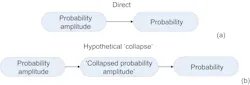
But in quantum interference, for instance, it can be neatly shown that we can go from the probability amplitude (within the mathematical realm) directly to the probability distribution (within the measurements realm) without ever considering an extra and unnecessary step involving a “collapse of the wave function” (see Fig. 2). In other words, “the collapse of the wave function” is unnecessary. Eventually, “the measurement problem” will likely dissipate as HVTs did.
Quantum reality
The foundations used to label quantum mechanics as a “not complete” description of reality are erroneous. The second argument against quantum mechanics, erected by EPR and seconded by Schrödinger, has to do with the perceived inappropriate physical influence of system I over a distant system II. This is perfectly acceptable from deterministic philosophical premises. But in quantum entanglement measurements: “The two photons are entangled and according to local realism, their planes of polarization should become independent…a typical EPR situation. Already in 1948, observations… agreed with quantum mechanics, not with local realism.”6
This outrageous, and yet wonderful, purely stochastic situation is made possible by the nonlocality of the photon, an intrinsic quantum phenomenon widely verified by measurements within the field of quantum optics.4,5
Should we hang on to the old philosophical determinism and consider quantum mechanics as outside the boundaries of our reality? Determinism was adequate to develop Newtonian physics and general relativity, but it failed dramatically to explain the physics of the atom, or coherent emission, for instance. Once we acknowledge the indeterminism of Nature, then it is possible to expand the horizons of our own reality and accept the new quantum reality—and accept the nonlocality of the photon as part of our new brave reality.
REFERENCES
1. M. H. L. Pryce and J. C. Ward, Nature, 160, 435 (1947).
2. A. Einstein, B. Podolsky, and N. Rosen, Phys. Rev., 47, 777–780 (1935).
3. C. S. Wu and I. Shaknov, Phys. Rev., 77, 13 (1950).
4. F. J. Duarte, Quantum Clear: Quantum Mechanics Free of Paradoxes (CRC; 2026); https://doi.org/10.1201/9781003649434.
5. F. J. Duarte, Quantum Optics for Engineers (CRC; 2014).
6. R. H. Dalitz and F. J. Duarte, Physics Today, 53, 10, 99–100 (2000).
About the Author
Francisco J. Duarte
Francisco J. Duarte is the author-editor of 22 scholarly books about tunable lasers and quantum optics, seven of which are solo titles.