Cryogenic photonics gives superconducting quantum hardware a path to scale
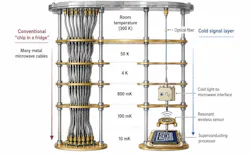
A chip alone is not the whole machine. Superconducting quantum computers are usually photographed as a gold chip at the bottom of a tall refrigerator. This image is useful, but incomplete because the chip must receive control pulses, return readout signals, stay cold, remain shielded, and track the condition of its surrounding hardware. A quantum processor is not only a qubit chip; it’s also a cold signal system. As machines grow, scaling may be limited not only by qubit quality, but also by whether the refrigerator can deliver clean signals to thousands, and eventually far more, devices.
The refrigerator has become a traffic problem. Most control and readout signals still travel through metal cables from room-temperature electronics to the coldest stage. This approach works at small scale but strains as the routing map fills with cables, each of which conducts heat. Each connector uses space. Each filter adds loss. Each channel adds a calibration point. The result isn’t just clutter—it’s heat load, insertion loss, noise management, and labor. Just as a city can’t solve congestion by adding cars to the same street, a quantum machine can’t scale by adding cables without rethinking the route (see Fig. 1).
Cryogenic photonics gives this route a lighter form. Photonics means using light, fiber, and light-sensitive devices to move information. Fiber is thin, flexible, broadband, and thermally gentle. NIST notes that optical fiber can have about 1,000x lower thermal conductivity than metal microwave cable.1 This comparison explains the appeal: Light can carry instructions while disturbing the cold machine less.
Optics has reached the qubit
Recent experiments show that optical links can now participate directly in superconducting-qubit control and readout. A photonic link has controlled and read a superconducting qubit.2 All-optical readout has translated microwave and optical signals at millikelvin temperatures, avoiding much of the cold microwave readout chain.3 And another experiment has coherently driven a superconducting qubit with light through a microwave-optical converter.4 These results do not make fiber a universal cable, but they prove optics can enter the control and readout architecture.
The best architecture will be mixed, not pure. Coaxial lines will remain useful for well-characterized, noise-sensitive microwave channels. Fiber can carry broadband signals with low heat flow. Cryogenic optical-to-microwave converters can move conversion closer to the processor, and local cold electronics can reduce cable count when placed at the right stage. Resonant and engineered structures can shape fields, isolate modes, or create compact sensing paths. No one technology wins every budget. The problem is not choosing one winner but rather assigning each tool to the place where it helps most.
Metamaterials broaden the design space beyond ordinary links—with engineered structures whose repeated cells make waves behave in chosen ways. In a cryogenic quantum package, microwave and superconducting metamaterials can be designed to set passbands, stopbands, mode densities, and coupling strengths. Recent work argues that such structures can suppress unwanted radiation, form compact shared paths, and support new ways to connect superconducting circuits.5 It matters because scale is not only about carrying a signal from one end of the refrigerator to the other, but also about building the cold wave environment itself. This control can turn packaging from a source of stray modes into a designed part of the machine.
Surviving the quantum environment
Materials still decide whether the idea survives the cold. A part that looks stable at room temperature can drift when cooled. In a recent antenna study, two ceramic resonators were compared under the same cryogenic test. One material shifted strongly and became less useful. The other, zirconium-tin titanate, held its resonance from room temperature to about 10 K; the frequency shifted by only 30 MHz, loss decreased, and the response showed little memory of the cooling path. The same device was then used as a low-power wireless link through a cryostat window.6 The lesson is blunt: Cold interfaces need cold-tested materials.
Contactless resonant links may first become a practical diagnostic layer for the refrigerator. They can monitor a package, window, shield, or nearby component without adding another metal line to the coldest stage. A large quantum machine must know more than the state of its qubits. It must know whether parts moved, fields changed, stages warmed, and models still match the hardware. A small resonant antenna won’t replace the main signal network, but it can add a low-burden way to monitor the hardware environment.
Control must also respect the real environment. In a crowded processor, a pulse aimed at one qubit can leak into a neighbor. It’s like trying to speak to one person in a packed room while nearby conversations overlap. Better hardware reduces this problem, but better signals also help. Recent work shows in simulations how to design pulses around the actual coupled, lossy system, rather than around an ideal isolated qubit.7 The goal is simple: Send a waveform matched to the real device response, not to an idealized model.
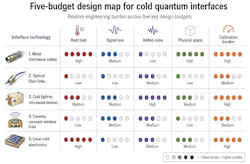
A practical design rule is to count five costs at once. Every cold interface should be judged by heat load, signal loss, added noise, physical space, and calibration burden. A link that saves space but adds too much heat won’t scale. A resonator that drifts with temperature can’t anchor a system. A cold electronics chip that removes cables but injects noise only moves the problem. A photonic circuit that can’t be tuned at low temperature also hits a wall; recent work on nonvolatile tuning of cold silicon photonic rings shows why tuning now belongs to system design.8 A scalable photonic circuit must be tunable without continuous heat dissipation. The scores will change by layout, but the budgets remain (see Fig. 2).
Cold signal layer
The missing layer is the cold signal layer. It carries timing, control, readout, calibration, and diagnostics through the refrigerator with as little disturbance as possible. It combines fiber, conversion devices, local electronics, resonant materials, metamaterials, and waveform design. It treats the refrigerator not as a box around the processor but as part of the processor. The limit is clear: Cryogenic photonics will not replace every cable or solve every packaging problem. Its value is more precise. It gives superconducting quantum hardware a cleaner way to route signals, sense the package, shape modes, and scale without simply multiplying wires.
REFERENCES
1. NIST, “Cryogenic Photonic Interconnects,” project page (2025).
2. F. Lecocq, F. Quinlan, K. Cicak, J. Aumentado, S. A. Diddams, and J. D. Teufel, Nature, 591, 575–579 (2021).
3. G. Arnold et al., Nat. Phys., 21, 393–400 (2025).
4. H. K. Warner et al., Nat. Phys., 21, 831–838 (2025).
5. A. Krasnok, Appl. Phys. Rev., 13, 021311 (2026); doi:10.1063/5.0282013.
6. I. Torres and A. Krasnok, Cryogenics, 155, 104286 (2026).
7. D. Trivedi, L. Niaz, and A. Krasnok, arXiv:2506.03316 (2025).
8. U. Adya et al., Nat. Commun., 16, 9290 (2025).
About the Author
Alex Krasnok
Alex Krasnok is an assistant professor in the Department of Electrical and Computer Engineering at Florida International University (Miami, FL). His group studies quantum photonics, cryogenic electromagnetic systems, metasurfaces, and resonant interfaces for quantum hardware.