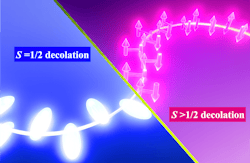
A recent discovery about quantum mechanically entangled behavior by a team of researchers led by Hironori Yamaguchi, an associate professor of physics at Osaka Metropolitan University in Japan, shows that the Kondo effect—switching quantum states between nonmagnetic and magnetic regimes—is fundamentally linked to spin size. Small spin sizes suppress magnetism, while larger spin sizes support magnetic order.
Being able to switch quantum states from nonmagnetic and magnetic regimes via spin size unleashes a powerful design strategy for next-gen quantum materials (see video).
“Our motivation came from the long-standing mystery of Kondo lattice physics, where remarkably rich quantum phenomena emerge from the interaction between itinerant electrons and localized magnetic moments,” explains Yamaguchi. “Over the years, many fascinating states have been discovered within Kondo lattice materials, but it has remained unclear which microscopic factors truly control their quantum behavior. We were particularly interested in whether the key driving force behind these phenomena could be isolated and understood in a more fundamental, quantum mechanical way.”
Kondo lattice/effect
A Kondo lattice is a type of quantum material in which two very different players coexist: Mobile electrons that can move through the crystal, and localized electrons that give rise to magnetism. “This magnetism originates from a fundamental quantum property of electrons known as spin, which acts like a tiny magnetic moment,” says Yamaguchi.
When these two components interact, they don’t behave independently. Instead, they become quantum mechanically entangled, which leads to the “Kondo effect.”
“This interaction can dramatically reshape the material’s behavior and give rise to unusual quantum states,” Yamaguchi says. “To study this physics in a more controlled way, Sebastian Doniach proposed a simplified model of the Kondo effect in 1977 known as the ‘Kondo necklace,’ in which electron motion is removed and only interacting spins remain.”
But whether the Kondo effect and its behavior fundamentally change depending on the size of the localized spin remained a mystery for quantum materials research—until now.
Yamaguchi’s team demonstrated a new type of Kondo necklace by precisely designing an organic-inorganic hybrid material composed of organic radicals and nickel ions. To do it, they used RaX-D, an advanced molecular design framework that provides precise control of the molecular arrangement within the crystal and its magnetic interactions.
What did they find? The Kondo effect changes qualitatively when the localized spin is increased from 1/2 to 1, and Kondo coupling mediates an effective magnetic interaction between spin-1 moments (stabilizes long-range magnetic order).
The researchers were stunned by how simple the key to their work turned out to be. “We initially expected the quantum behavior to depend on many complicated factors, such as the balance between different interactions or the direction of magnetic anisotropy,” says Yamaguchi. “Instead, we found that a single parameter—the size of the spin itself—acts as a switch that completely changes how the Kondo effect behaves,” says Yamaguchi.
It came as a big surprise for the team when results from different materials and simulations suddenly lined up under this one principle. “At this point, it became clear we were seeing a universal boundary rather than a material-specific effect,” Yamaguchi adds.
Simulations, not surprisingly, played an essential role in the team’s work. “Beyond numerical simulations, we also used theoretical insights inspired by quantum field theory to interpret the experimental results,” says Yamaguchi. “This combination allowed us to connect microscopic spin behavior with emergent collective quantum states.”
Challenges along the way
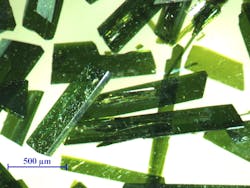
One major challenge involved “was growing high-quality single crystals of the material,” says Yamaguchi. “Because the quantum behavior depends sensitively on how the molecules are arranged, we needed to carefully optimize the growth conditions, such as temperature and solvent choice, to stabilize the targeted molecular structure. This process required considerable time and trial and error.”
On the theoretical side, another challenge was to explain why the behavior changes qualitatively when the spin size becomes larger than one half. “By using concepts from quantum field theory, we were able to construct a framework that captures this transition and connects it to the experimental observations,” Yamaguchi says.
Future quantum materials/technologies
What does the team’s discovery mean for future quantum materials and technologies? “Our discovery provides a new way of thinking about how quantum states can be controlled within complex materials,” says Yamaguchi. “In many strongly correlated systems, the Kondo effect is known to play a central role—not only in shaping magnetic properties but also in phenomena such as heavy fermion superconductivity, where the balance between competing interactions determines the emergence of superconducting states.”
By identifying spin size as a key parameter controlling the Kondo effect, “our results offer a new conceptual handle for understanding and potentially tuning these quantum phases,” Yamaguchi says. “While our work is fundamentally focused on the basic physics, such insights may help guide future strategies to design and explore quantum materials, including superconductors governed by strong electron correlations.”
FURTHER READING
H. Yamaguchi et al., Commun. Mater., 7, 5 (2026); https://doi.org/10.1038/s43246-025-01027-3.
About the Author
 Sally Cole Johnson
Sally Cole Johnson
Editor in Chief
Sally Cole Johnson is Laser Focus World’s editor in chief, and she has more than 25 years’ experience as a science and technology journalist. She specializes in physics and semiconductors, and wrote for the American Institute of Physics for more than 15 years, and also covered theoretical physics and neuroscience for the Kavli Foundation, and complexity for the Santa Fe Institute. Johnson has also written extensively about military embedded systems, high-performance computing, software-defined networks, and infosec. She is a member of the National Association of Science Writers (since 2001).
When she isn’t writing about optics, photonics, or quantum advances, you can find her outside in northern NH in the garden with birds landing in her hand or heading for the mountains with her bike, skis, or crampons and ice axe.