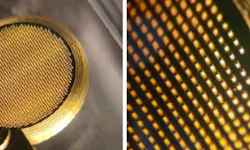
By Laura Galloway May 8, 2025 In a study published in IEEE Transactions on Terahertz Science and Technology, researchers from the University of Birmingham and Beijing Institute of Technology demonstrated a novel multi-beam antenna operating at 355 GHz. Their design integrates a surface-wave Luneburg lens—based on a metallic bed-of-nails structure—and an array of nine WR-2.2 waveguides. This is the first experimental realization of a metallic, H-plane-focused, multi-beam lens antenna at sub-terahertz frequencies using 3D printing. The antenna relies on a highly intricate structure: a GRIN lens formed from a periodic array of metallic pins (“nails”) with varying heights to control the refractive index distribution. Traditional micromachining processes struggle to fabricate this kind of geometry at sub-THz scales without costly tooling or multiple fabrication steps. To overcome these challenges, the team used the microArch® S140 from Boston Micro Fabrication (BMF)—a high-precision projection micro stereolithography (PµSL) printer—to fabricate both the lens and waveguide feeder structures in a single step. The part was printed using BMF’s HTL resin with dimensional tolerances within ±5 µm, then metallized with a 500 nm gold coating using magnetron sputtering. Key features made possible by BMF’s printing technology: Highly accurate 3D structures: Precise control over the height of the metallic pins enabled the lens to follow Luneburg’s law, critical for beam shaping at 355 GHz. Integrated waveguide array: The nine WR-2.2 waveguides were co-printed directly with the lens structure, reducing alignment error and simplifying assembly. Compact footprint: The entire antenna measured just 14 mm × 14 mm × 1.6 mm, ideal for tightly packed RF systems. Exceptional surface quality: Enabled effective gold metallization for low-loss signal propagation. Fig. 2. Photographs of the antenna: (a) As printed and (b) after gold-coating. Once printed and coated, the antenna was tested for both impedance matching and radiation characteristics. The measured reflection coefficients at all ports were below -12.5 dB across the 350–360 GHz range, indicating strong impedance matching. Radiation testing confirmed that: Multiple beams were successfully formed over a ±60° scan range Each beam had a gain exceeding 16 dBi Scan loss remained below 1.2 dB Cross-polarization levels stayed below -20 dB, confirming excellent linear polarization H-plane half-power beamwidths ranged between 5.7° and 6.3° The use of a sloped and corrugated edge ring further optimized beam pointing in the E-plane, demonstrating that 3D-printed structural modifications can fine-tune performance post-design. This work represents a milestone in the use of high-precision additive manufacturing for sub-terahertz RF hardware. BMF’s micro-scale 3D printing capabilities enabled the creation of a highly customized metallic GRIN lens with a geometry that would be prohibitively complex using conventional methods. For researchers and engineers developing next-generation wireless and sensing systems, this study showcases how micro 3D printing can open new doors—not only in antenna performance but also in design flexibility, fabrication speed, and integration. 🔍 Read the Full Study Explore the technical paper published in IEEE Transactions on Terahertz Science and Technology: Access the publication on the University of Birmingham research portal: join our List Get all of our latest updates by signing up for our Newsletter.