Space-made infrared fiber must prove its performance
Infrared (IR) fiber is sold on measurable performance. A manufacturer needs attenuation at the operating wavelength, a usable continuous length, and assurance that the fiber will withstand normal handling and service. These requirements also determine the value of producing ZBLAN fluoride-glass fiber in orbit.
ZBLAN contains zirconium, barium, lanthanum, aluminum, and sodium fluorides. Its transmission range extends into the mid-IR, beyond the useful range of conventional silica fiber. This makes it relevant to IR lasers, spectroscopy, sensing, and specialist light-delivery systems. Drawing the glass remains difficult. Crystals, impurities, bubbles, and changes in core geometry can introduce optical loss. Gravity also influences some parts of the manufacturing process—particularly convection and crystallization during heating and cooling.1,2
In 2024, the Flawless Space Fibers-1 experiment produced almost 12 km of ZBLAN fiber aboard the International Space Station. The longest continuous length reached 1,141 m. Researchers returned the material to Earth and analyzed more than 2 km of selected fiber. These are substantial engineering results that make detailed comparisons possible.2
What the flight measurements show
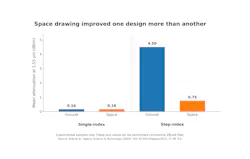
A 2026 study reported mean attenuation at 1.55 µm of 0.75 dB/m for space-drawn step-index ZBLAN, compared with 4.50 dB/m for the corresponding ground-drawn samples. The step-index fiber has a distinct core and cladding. In the same study, single-index fiber averaged about 0.16 dB/m in both environments. Microgravity improved the tested step-index design, while the single-index result showed how strongly composition and fiber design influence the outcome.3
These measured values provide a useful basis for the next generation of experiments. The comparison in Figure 1 also makes clear why fiber type, wavelength, and test method must accompany every reported loss figure. A result in decibels per meter must be distinguished from one in decibels per kilometer, and the measurement wavelength must match the intended product.
The most useful question for a laser or sensing customer is straightforward: Will the finished fiber deliver lower loss, the required beam quality, and reliable handling at the wavelength and length specified for the application?
Start with the application
A short fiber for a mid-IR laser, a spectroscopic instrument, and a long optical link will all have different requirements. The qualification plan should begin with a defined use case and an agreed acceptance limit for attenuation, geometry, bend performance, and continuous length.
Measurements at 1.55 µm are informative, but many potential ZBLAN applications operate farther into the IR. A qualification program should measure attenuation across the proposed operating band, including wavelengths between 2 and 5 µm when relevant. The results should state launch conditions, specimen length, fiber structure, measurement uncertainty, and the treatment of connector or coupling losses.
IEC 60793-1-40:2024 describes cut-back, insertion-loss, and backscattering methods for attenuation measurement. In a cut-back test, the laboratory compares transmitted optical power before and after shortening the same specimen while maintaining the optical launch conditions. This provides a useful reference for a repeatable test method, with any adaptations for fluoride glass and longer wavelengths properly recorded.4
Compare matched samples
An orbital sample should be compared with a terrestrial sample made from closely matched input material. Feedstock purity, preform geometry, core and cladding composition, thermal history, draw speed, atmosphere, coating, and storage conditions all affect the result. Record differences between the ground and flight equipment rather than attributing every measured change to gravity.
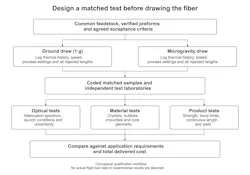
The proposed protocol in Figure 2 follows the same material through two processing environments and a common set of independent tests. A matched ground draw helps isolate the effect of microgravity. A separate, commercially available reference fiber shows the performance that customers can buy today. Together, these comparisons establish the size and practical relevance of an improvement.
Material analysis should explain the optical measurement. Microscopy, spectroscopy, inspection for crystal inclusions, and checks of diameter and concentricity can identify the dominant loss mechanisms. The 2026 study linked much of the step-index improvement to reduced crystal-related scattering while identifying impurities and other defects that remained relevant in both environments.3
Make every meter traceable
Optical performance is only part of a finished specification. Manufacturers should report the total length drawn, the longest continuous length meeting requirements, the distribution of loss across that length, and the amount rejected during production. Measurements from the beginning, middle, and end of a draw can show whether processing conditions drift.
Mechanical qualification deserves the same discipline. Relevant tests include tensile strength, proof testing where appropriate, bend performance, coating integrity, handling damage, and stability during storage. Repeated manufacturing runs allow laboratories to report both average performance and variability. Independent testing of coded specimens can strengthen confidence in the comparison.
Each tested sample also needs a record linking it to the preform, operating conditions, processing events, storage, and laboratory results. A customer should be able to trace the measured loss of a delivered section back to the conditions under which it was made.
Design verification into the payload
These requirements are central to OrbiSky’s SkyYield program. Announced by the U.K. Space Agency in February 2026, the feasibility study has since been completed, establishing a preliminary payload architecture, process-control requirements, and a verification approach for microgravity ZBLAN manufacturing. The next stage is to translate these results into functioning, instrumented hardware.
At OrbiSky, we’re developing the operational side of this approach: Monitored processing steps, bounded responses to faults, and records that connect commands and sensor readings to each experimental run. For an orbital fiber-drawing system, temperature history, draw speed, tension, geometry, and interruptions should be captured as part of the product’s evidence package. Reliable autonomous operations become valuable when they support consistent manufacturing and usable test results.
The final commercial measure is qualified fiber delivered to a customer’s specification. This measure includes inspection, rejected yield, coating, packaging, transport, and the full process cost. A flight experiment can identify a promising manufacturing advantage. A reproducible, traceable product specification gives customers and investors a basis for deciding how to scale it.
The 2026 flight results supplied a credible technical starting point. Well-designed comparisons, independent optical measurements, and process records can turn this evidence into the requirements for future IR fiber production. For SkyYield and the wider sector, the next challenge is to turn promising flight experiments into repeatable manufacturing operations that deliver both high-performance fiber and the evidence customers need to qualify it.
REFERENCES
1. U.K. Space Agency, “New studies for manufacturing advanced materials in orbit” (Feb. 9, 2026); www.gov.uk/government/news/new-studies-for-manufacturing-advanced-materials-in-orbit.
2. H. A. Moser et al., Acta Astronautica, 246, 956–967 (2026); https://doi.org/10.1016/j.actaastro.2026.04.058.
3. M. A. Arat et al. Space Sci. Technol., 6, 0572 (2026); https://doi.org/10.34133/space.0572.
4. IEC 60793-1-40:2024, Optical fibers, Part 1-40: Attenuation measurement methods; https://webstore.iec.ch/en/publication/79333.
About the Author
Sylvester Kaczmarek
Sylvester Kaczmarek is founder and CEO of OrbiSky, a U.K. company developing autonomous orbital industrial operations. OrbiSky's SkyYield program received a U.K. Space Agency contract in 2026.
Related
 Dreamstime Xxl 11079353
 Manufacturing Challenges in Space Gravitational Wave Telescopes