Momentum story: Xavveo’s CEO Sven Otte talks production-ready silicon photonic chips for imaging radar
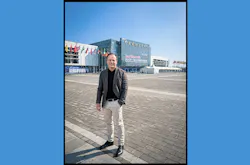
Xavveo is a Berlin, Germany-based deep tech company building a new perception architecture on proprietary silicon photonics chips. Sven Otte founded the company in 2023 along with Stefan Meister and Ulrich Keil, the same team behind Sicoya, where they spent years commercializing silicon photonics for data center transceivers.
The company recently announced its proprietary silicon photonic chips are in production for dual-use defense applications, and Xavveo is now entering the drone detection, perimeter security, and critical infrastructure markets.
Laser Focus World: How does Xavveo differentiate itself?
Sven Otte: Our architecture differentiates us. Most radar innovation today is incremental: More channels, better software, and slightly sharper resolution, whereas we took a different route and built a photonic, fiber-based sensing architecture manufactured monolithically at CMOS scale.
It delivers LiDAR-like angular resolution below 0.1 degrees, which is roughly 10x better than the market standard, and about 1/5th the cost of other systems. Because the core is photonic and fiber-distributed, it can’t be replicated from off-the-shelf components. Our chips are now production ready, which is the proof point behind everything we’re doing.
LFW: It’s an exciting time for silicon photonic chips—what’s it like to be working within this space right now?
Otte: I’ve worked in photonics for more than 25 years—from optical components at MergeOptics and Amphenol through to silicon photonics transceivers at Sicoya—and never seen momentum like this.
For most of this time, silicon photonics was a datacoms story: Getting light in and out of data centers faster and cheaper. This work matured the manufacturing base, the design tools, and packaging, and now the technology is breaking out into entirely new domains like sensing, LiDAR, quantum, and, in our case, imaging radar.
The exciting part is the ecosystem is finally ready. We can manufacture monolithically at CMOS scale using established foundry processes, which means photonics can now compete on cost and volume—not merely performance. This changes what’s possible. Ideas that would have stayed in the lab a decade ago can now become products. And Europe, with its strong photonics research base, is well positioned to lead.
LFW: What makes your chip designed for imaging radar a fit for counter-drone defense?
Otte: The near-field gap: Cheap, small drones have become a central element of modern warfare and a major threat to critical infrastructure, and conventional layered air defense largely can’t see them. Legacy radar was built for large, fast objects flying at long range—not for a Class 1 drone or a first person view (FPV) platform flying low and slow.
Our architecture was originally engineered to disrupt the imaging radar market for L4 autonomous vehicles, which is arguably the most difficult perception problem: Small objects, cluttered environments, and zero tolerance for error.
This same capability transfers directly, packaged with advanced gallium arsenide (GaAs) power amplifiers and our antenna technology, the system detects and classifies Class 1 drones, FPV platforms, and low-altitude aircraft at 5 to 10 kilometers, distinguishes drones from birds, and separates individual drones from a swarm. Its angular resolution is what makes this possible, and the photonics makes the angular resolution possible.
LFW: What makes the chip special? Any optics/photonics aspects you can share?
Otte: The architecture spans three components: A transmit chip generates a 20-GHz frequency-modulated continuous-wave (FMCW) ramp and drives eight optical channels over a fiber interface; a radio frequency (RF) CMOS receiver chip runs 12 optical channels into a 150 megasamples-per-second 12-bit converter; and an 80-GHz RF CMOS sensor unit integrates the power amplifier, low-noise amplifier, mixer, and optical front end.
The photonics does the heavy lifting. Distributing the FMCW signal optically over fiber gives us phase coherence across a physically distributed antenna array, which allows us to build what’s effectively a virtually scalable aperture.
This is how we achieve angular resolution below 0.1 degrees from compact, distributed sensor packages rather than one large monolithic array. Everything is manufactured monolithically at CMOS scale, so we inherit the cost, yield, and volume characteristics of the semiconductor industry rather than those of specialist optics assembly.
LFW: Biggest challenges involved in silicon photonics for military applications?
Otte: Three stand out: The first is environmental robustness—defense systems must perform in conditions far beyond automotive or datacoms specifications like temperature extremes, shock, vibration, or electromagnetic interference. Photonic packaging that survives a data center isn’t automatically ready for a forward operating position, so qualification is a serious engineering effort in its own right.
Second is supply chain sovereignty. When a capability becomes central to national security, it matters where the chips are made and where the raw materials come from. Building this in Germany at scale is a deliberate choice. It’s about securing the chip technology and the material base behind a capability that’s now critical to both national security and economic health.
The third is speed. Defense procurement traditionally moves slowly but the drone threat does not. The challenge for a company like ours is to deliver at the pace the threat demands while meeting the certification and reliability standards the sector rightly requires.
LFW: Any other applications?
Otte: Our platform is designed to extend across contexts without modification—and it does.
Autonomous mobility remains a core market: Perception is the limiting factor on the safety and scale of autonomous vehicles, and our distributed architecture integrates invisibly into vehicle designs while covering the full operational design domain.
Beyond passenger vehicles, the same applies to commercial vehicles, rail, and mining, where 24/7 autonomous operation depends on sensing that works regardless of weather or light.
One of the biggest emerging markets are humanoid robots. The perception requirements of humanoid robots are nearly identical to robotaxis. We’ve filed dedicated intellectual property (IP) to enable next-gen humanoid robots. It’s a step function from imitating humans to creating an artificial consciousness, where the robot is using coherently processed multimodal sensor information.
And further out, the architecture suits satellite-based Earth observation, where high-resolution, weather-independent sensing has obvious value. One architecture, many markets. This is the point of building at CMOS scale.
LFW: What’s next? Seeing any trends emerging within this space?
Otte: The biggest trend I see is the convergence of photonics and RF. For decades, these were separate disciplines with separate supply chains. Silicon photonics is collapsing this boundary, and hybrid photonic-RF systems like ours are just the beginning. I expect to see photonic signal disruption become standard wherever coherence across distributed apertures matters—from sensing to communications.
Another trend is dual-use becoming the default path for European deep tech. Nearly all disruptive new technologies from the past 100 years have a defense origin—think modern airplanes, semiconductor technology, and the internet. The upcoming physical AI systems are just another example. Technologies that make autonomous vehicles safe are the same ones that protect airports, power plants, and borders. Companies that can serve both will build more resilient businesses and, frankly, do more good.
For Xavveo, reaching production with our chips opens the next chapter of scaling deployment with defense and critical infrastructure operators while continuing to develop the automotive platform.