Frozen liquid-core optical fiber enhances nonlinear optics response
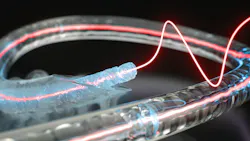
A new type of optical fiber created by Birgit Stiller’s Quantum Acoustics group at Max Planck Institute for the Science of Light (MPL) takes the core from liquid to frozen solid—and it continues to guide light and hypersonic sound waves, but with an impressively high in-fiber Brillouin gain (or optoacoustic coupling) of 434 W-1 m-1 (see video).
Standard silica fibers are made out of pure silica and completely solid—including the fiber core.
How does Stiller’s group pull off their frozen optical fiber? It consists of a silica capillary filled with liquid carbon disulfide (Cs2), which is encapsulated within a glass capillary. By dunking it into liquid nitrogen, its fiber core freezes solid at 77 Kelvin (K).
Her group works on quantum acoustics and was curious how much the properties of acoustic waves would change—in terms of acoustic lifetime—when freezing a liquid-core optical fiber. They were fortunate to collaborate with pioneers of liquid-core optical fibers research Professor Markus Schmidt and Professor Mario Chemnitz of Leibniz Institute for Photonic Technologies Jena (IPHT) on this work.
Frozen fibers
Cooling down a fiber sample (also a photonic chip) usually has advantages “in terms of low thermal phonons (less noise) and longer acoustic lifetimes, which can be used for longer storage times for optical memory,” explains Stiller, who is also a physics professor at Leibniz University Hannover. “The high Brillouin gain we discovered came as a bit of a surprise—especially because the coupling is as high as the best optical fibers in terms of Brillouin scattering, which are orders of magnitude more difficult to fabricate.”
Freezing CS2 enables a strong interaction of optical and acoustic waves, “most likely because of the enhanced effective refractive index of the frozen part,” she says. “The exact nature of the frozen CS2 is still being explored but we’re already using the high Brillouin gain for different applications, such as optical memory.”
Dipping the liquid-core fibers into liquid nitrogen to cool down the fibers was initially a “let’s see what happens” type of experiment by a Ph.D. student and an intern working with Stiller, so the high Brillouin gain came as “a bit of a surprise,” she says. “We expected a higher optoacoustic coupling—but not to this huge extent.”
As you can likely guess, freezing the optical fiber while keeping transmission isn’t a straightforward process, but “through trial and error—and a lot of patience—we obtained long-term stability,” says Stiller. “Now we need to gain a better understanding of the material’s structure.”
How is this an advance for the quantum realm? For quantum signal processing, “the giant coupling means we can enter useful regimes such as the strong coupling regime at much lower optical powers,” Stiller explains. “It also means the energy efficiency of optoacoustic signal processing increases significantly, which is interesting for our work on photonic machine learning enabled by sound waves.”

Performance gains likely
As far as applications, Stiller and her group will use these frozen fibers for photonic machine learning with acoustic waves, as well as for quantum signal processing such as quantum memory based on slowly traveling acoustic waves. “The enhanced coupling and gain will help us achieve better performance in terms of low-noise quantum signal processing and energy-efficient neural network building blocks,” she says.
This is the first proof of principle to show liquid-core fibers can be frozen for an enhanced nonlinear optics response. What’s next? “We’ll further explore the structure of the frozen fiber core and use this type of fiber for other applications like high-speed spatial resolution sensing,” Stiller adds. “And the frozen fibers will also be studied in terms of other nonlinear effects, because we expect them to behave in an interesting way—and possibly render a much increased optical linearity.”
FURTHER READING
S. Seiderer et al., Optica, 13, 7, 1415–1422 (2026); https://doi.org/10.1364/optica.600056.
About the Author
 Sally Cole Johnson
Sally Cole Johnson
Editor in Chief
Sally Cole Johnson is Laser Focus World’s editor in chief, and she has more than 25 years’ experience as a science and technology journalist. She specializes in physics and semiconductors, and wrote for the American Institute of Physics for more than 15 years, and also covered theoretical physics and neuroscience for the Kavli Foundation, and complexity for the Santa Fe Institute. Johnson has also written extensively about military embedded systems, high-performance computing, software-defined networks, and infosec. She is a member of the National Association of Science Writers (since 2001).
When she isn’t writing about optics, photonics, or quantum advances, you can find her outside in northern NH in the garden with birds landing in her hand or heading for the mountains with her bike, skis, or crampons and ice axe.