AI redefines performance metrics for AR optical systems
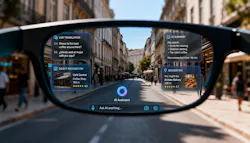
For optical engineers, the rapid development of AI-enabled smart glasses is changing more than the applications optical systems must support—it’s altering how optical performance itself is evaluated.
AR optical development has primarily focused on familiar engineering objectives: Brightness, field of view, image quality, weight, power efficiency, and manufacturability. But AI assistants create a different usage model—one in which users may rely on the display repeatedly throughout the day for navigation, translation, reminders, contextual information, and brief interactions.
This shift is already visible within the market. AI smart glasses accounted for 88% of global smart-glasses shipments in the second half of 2025, according to Counterpoint Research, while total smart glasses shipments increased 139% year over year during the same period.1 Within the AR segment, Counterpoint reports shipments of waveguide-based devices increased more than 600% year over year during the second half of 2025.2
For optical engineers, these trends are significant because they indicate AI and waveguide-based displays are increasingly converging in commercial products—and it makes the relationship between AI interaction models and optical system performance more than simply a theoretical engineering question.
Designers increasingly need to consider how these specifications work together to deliver information that’s immediately readable, visually comfortable, appropriately integrated with the physical environment, and practical for extended everyday use.
AI won’t replace the traditional metrics of AR optical performance, but it does change how optical engineers must prioritize and balance them.
Performance metric #1: Continuous information display
AI changes an important aspect of optical system design—the frequency and duration of interaction with the display. Earlier generations of AR devices were designed around discrete applications or workflows. Now, AI assistants create the potential for a continuous series of interactions. Navigation prompts, translated conversations, reminders, contextual recommendations, messages, and notifications may appear briefly whenever they become relevant. As AI systems become more proactive, information may increasingly be presented not only when users explicitly request it but when the system determines it could be useful. This changes the role of the optical system from an occasional display into a persistent communication interface between the user and an AI assistant.
It doesn’t necessarily mean displaying more information at once. In many cases, the opposite will be true. The challenge will be presenting small amounts of useful information at precisely the right time, then allowing this information to disappear without disrupting the user's view of the physical world.
For optical engineers, performance must therefore be evaluated not only by how an image looks during a controlled demonstration but by how naturally information appears and disappears potentially hundreds of times during a day. Image consistency, placement, visibility, efficiency, and the ability to minimize unnecessary visual distraction become increasingly important when the display is designed for repeated interactions.
Real-time translation provides a simple example. A translated sentence may appear for only a few seconds, but has little value if the user can’t read it immediately. A translation that is clearly visible indoors but becomes difficult to distinguish when the user walks into bright sunlight is an optical system limitation rather than an AI limitation. The display must deliver the information reliably across the environment in which the AI assistant operates.
Performance metric #2: Readability
Many AI interactions involve relatively small amounts of information—a single sentence, a translation, a meeting reminder, a navigation arrow, or a brief response to a question. Although visually simple, these interactions place demanding requirements on the optical system because users must comprehend them immediately.
It places greater emphasis on readability as a performance objective. Contrast, image uniformity, text definition, ambient illumination, virtual-image positioning, and the relationship between displayed content and the physical background all influence how quickly users can interpret information.
Real-world viewing conditions illustrate why readability must be evaluated at the system level. Information that appears sharp and legible under controlled indoor lighting may become difficult to read as ambient illumination increases or the visual background changes. Maintaining sufficient contrast, image uniformity, and text clarity across these changing conditions therefore becomes as important as achieving a particular brightness or field-of-view specification.
For AI-enabled glasses, the relevant question isn’t simply: How bright is the display? It’s instead: Can the user understand the information immediately, within the environment it’s needed, without unnecessary visual effort?
As AI interactions become more frequent, reducing the effort required to interpret displayed information will become an increasingly important measure of optical performance. Rather than optimizing primarily for visual impact, engineers increasingly must optimize for visual clarity.
Performance metric #3: Visual comfort during extended use
AI assistants also alter assumptions about how long users may wear AR glasses. Many earlier AR applications were designed around relatively defined periods of use. Everyday AI assistants, by contrast, create an incentive for users to keep smart glasses available for much longer periods—even if the display itself is active only intermittently.
Optical characteristics that may seem acceptable during a short demonstration can become significantly more noticeable when users encounter them repeatedly for several hours. Image stability, visual consistency, comfortable focal presentation, appropriate content positioning, and the minimization of unnecessary visual distraction all help reduce fatigue during the day.
Physical weight is also part of this equation. In our development work, for example, plastic waveguides reached approximately 5 grams per monocular unit, compared with approximately 8.2 grams for glass versions. Our plastic waveguides also passed U.S. and Japanese impact testing for eyewear without cracking. The significance of reducing several grams from an optical component becomes greater when the goal isn’t a device worn for a short demonstration but rather eyewear intended to remain comfortable for hours.
This reinforces the importance of evaluating optical performance as a system—rather than maximizing individual specifications independently. A wider field of view or higher brightness may be desirable, for example, but not if achieving it creates unacceptable tradeoffs in weight, power consumption, efficiency, image consistency, or comfort.
Performance metric #4: Contextual awareness
Unlike conventional displays, AI-enabled smart glasses are designed to complement—not replace—the user’s view of the real world. This distinction becomes increasingly important as AI systems gain greater contextual awareness. Smart glasses may use cameras, sensors, spatial-recognition technologies, eye tracking, and AI models to understand elements of the user’s surroundings to determine the types of information that might be relevant at a particular moment. An optical system then must present this information without interfering with the situational awareness that made it useful in the first place.
Navigation provides a straightforward example: A directional cue must remain clearly visible and allow the user to maintain awareness of traffic, pedestrians, obstacles, and their surrounding environment. The optical objective is to provide enough information to assist the user without competing with the physical world.
Emerging commercial products illustrate how this interaction model is beginning to influence system design. SABERA AI Glasses, jointly developed by Cellid and jig.jp, integrate our waveguide technology with AI translation, notifications and schedule displays, a teleprompter function, generative AI assistant integration, and other applications designed for everyday use.3 Bringing these functions into everyday eyewear illustrates why optical performance and interaction design increasingly need to be considered together. Digital information must be presented in a way that makes it immediately accessible when relevant without distracting users from their surroundings.
Optical transmittance takes on broader significance within this context. High transmittance is valuable not simply because it makes eyewear look more natural but also because it helps preserve the user’s ability to see and interact comfortably with their physical environment while digital information is presented.
It’s an important distinction between AI-enabled smart glasses and immersive display systems. For an immersive environment, maximizing engagement with virtual content may be the objective. For everyday AI eyewear, success often means the user remains primarily engaged with the physical world while receiving enough digital information to make the interaction more useful.
Optics define the user experience
Continuous information display, readability, visual comfort, and contextual awareness can’t be evaluated in isolation. Their combined effect determines whether AI-enabled smart glasses feel natural enough to become part of everyday life.
Historically, user experience was viewed primarily as a software challenge. AI-enabled smart glasses demonstrate why optics play an equally important role. Even the most capable AI assistant can’t provide a seamless experience if its information is difficult to read, distracting, uncomfortable to view, or poorly integrated into the user’s natural field of vision. Conversely, an optical system with impressive laboratory specifications may still fall short if these specifications don’t translate into a comfortable and intuitive everyday experience.
As smart glasses move toward everyday AI applications, optical engineering teams increasingly need to connect laboratory measurements with user behavior: How quickly can information be read? How does visibility change as users move between indoor and outdoor environments? Does repeated display use cause visual discomfort? Does virtual information enhance awareness or compete with it?
The industry is already developing more sophisticated ways to connect optical measurement with actual performance. Cellid, for example, collaborates with the University of Tokyo's Institute of Industrial Science on methods to evaluate AR waveguides.4 Work of this kind reflects a broader requirement for the industry: Measurements must capture not only individual optical characteristics but how these characteristics affect the complete visual experience.
Looking forward
The next phase of AR optical engineering will increasingly be defined by system-level optimization. No single specification will determine whether AI-enabled smart glasses succeed. What matters is how effectively optical characteristics work together to support an interaction model fundamentally different from that of earlier AR devices.
This changes the engineering optimization problem. Designing for the largest possible field of view, the highest possible brightness, or the smallest possible form factor in isolation is unlikely to produce the ideal everyday AI device. Each decision affects other parts of the optical and hardware system, including efficiency, thermal performance, battery requirements, weight, image quality, and ultimately wearability.
As AI becomes more capable of understanding a user’s environment to deliver information at the moment it becomes useful, the optical system must make this information available without demanding unnecessary attention. It places optical engineering squarely at the center of the transition from specialized AR devices to eyewear people can comfortably use.
The industry’s measurement methodologies must evolve accordingly. Traditional optical specifications will remain indispensable, but increasingly will serve as inputs to a larger question: Does the optical system enable information to reach the user naturally, efficiently, and comfortably within real-world conditions?
This question becomes especially important as AI capabilities advance rapidly. Improvements in software can occur through model updates and new applications, but the fundamental characteristics of an optical system are determined by physical engineering decisions involving materials, waveguide architecture, projector design, efficiency, form factor, and manufacturing processes. These decisions have long-term consequences for what an AI-enabled device can ultimately deliver.
For optical engineers, this evolution represents an opportunity as much as a challenge. As the intelligence within smart glasses becomes more sophisticated, the interface between this intelligence and human vision becomes more important.
AI may determine what smart glasses can understand and communicate, but optics will largely affect how naturally people experience it.
REFERENCES
1. Counterpoint Research, Global Smart Glasses Shipments Grew 139% YoY in H2 2025; Meta Expanded Market Share to 82% (Feb. 26, 2026).
2. Counterpoint Research, Global AR Smart Glasses Shipments Grow 148% YoY in H2 2025; Waveguide-based Devices Surge Over 600% (Apr. 8, 2026).
3. Cellid Inc., announcement regarding Cellid waveguide technology for SABERA AI Glasses (Dec. 10, 2025).
4. Cellid Inc., collaboration with the Tsutomu Shimura Laboratory, Institute of Industrial Science, The University of Tokyo, on AR waveguide evaluation methods (Mar. 2023).
About the Author
 Satoshi Shiraga
Satoshi Shiraga
Satoshi Shiraga is the cofounder and CEO of Cellid Inc. (Japan), a developer of augmented reality (AR) waveguide technology. With over 20 years of experience in the field of optical design, Satoshi has been instrumental in advancing AR glasses, focusing on high-performance waveguides that enable the sleek, lightweight, and high-resolution devices needed for widespread AR adoption.
Before founding Cellid, Satoshi conducted particle physics research at prestigious institutions including CERN (European Organization for Nuclear Research), Fermilab (Fermi National Accelerator Laboratory, U.S.), and INFN (National Institute for Nuclear Physics, Italy). He holds a master’s degree in physics from Waseda University Graduate School, where he specialized in particle physics, and was later invited to serve as a researcher at Waseda University.