Photonic integrated circuits enable massively parallel laser radar
Laser radar systems are often judged by familiar top-level metrics such as range, spot size, or scan speed. For vibration and precision measurement work, however, the underlying question is different: How much useful dynamic information can the system capture from the scene during the same physical event?
This question matters in structural testing, industrial diagnostics, and research setups where the response is transient. If the instrument captures one point at a time, the test engineer is forced to trade spatial coverage against temporal fidelity. Fast events, changing excitation, and operational conditions can make this tradeoff expensive.
PIC-based architecture designed for massively parallel optical acquisition
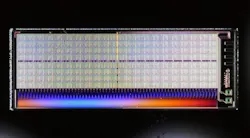
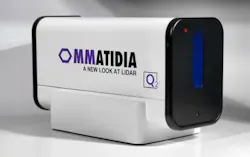
Ommatidia LiDAR (light detection and ranging) addresses this limitation with a photonic integrated circuit (PIC) architecture designed for massively parallel optical acquisition. Instead of routing the entire measurement workflow through a single sequential beam path, the system distributes optical channels so multiple points can be observed at the same time. In practice, it allows up to 128 channels (depending on configuration) of simultaneous measurements.
Parallel acquisition means a structure can be observed as a spatial system rather than as a sequence of isolated points. For vibration work, it enables modal content, phase relationships, and localized dynamic behavior to be studied during the same event instead of reconstructed from repeated runs.
The architecture sits inside a broader laser radar and laser Doppler vibrometer (LDV) workflow, which combines photonic integration, coherent detection, and frequency-modulated continuous-wave (FMCW) ranging concepts with noncontact vibration measurement to create a platform that can acquire both geometric and dynamic information while keeping setup relatively simple compared with sensor-heavy test configurations.
One useful way to understand the value of the PIC is to start with the bottleneck in conventional optical measurements. Traditional sequential systems can be accurate, but they remain constrained by the fact that the instrument must visit points one after another. If excitation is changing over time, the operator may need repeated tests or additional assumptions to assemble a full picture.
Parallel optical channels reduce this problem directly. Multiple parts of the structure are sampled during the same time window, so the engineer sees how the response is distributed across the asset rather than inferring it from repeated single-point measurements. This is especially valuable in operational modal analysis, field vibration measurement, and any setup where repeatability is limited by the environment.
Get data under real operating conditions
Photonic integration also helps at the system level. By consolidating the optical processing path into a dedicated PIC-based architecture, we can analyze multiple channels in parallel without turning the instrument into a complex lab-only platform. Therefore, the commercial value of parallel measurement is not just a higher channel count but also the portability towards practical workflows outside tightly controlled research benches.
The application implications are quite broad. For structural monitoring, simultaneous channels help capture distributed motion over bridges, towers, and large test articles. For industrial diagnostics, this allows engineers to identify localized vibration hot spots, electromagnetic effects, or mode shapes without covering the machine in contact sensors. For product development and validation, it shortens the path from measurement to interpretation because fewer repeated acquisitions are required to understand the spatial response.
Our own positioning of the platform reflects this practical focus. The technology is intended for engineers who need dense, noncontact data from real assets under real operating conditions. Rather than treating photonic integration as an abstract chip story, the system uses PICs to make an end instrument more capable within the field.
This is why the PIC angle is important. PICs are often discussed in terms of miniaturization or future potential, but the value here is more concrete. PICs enable a measurement architecture that turns parallel optical sensing into a usable engineering tool. The payoff is not only better component elegance but also faster setup, broader spatial awareness, and a better chance of capturing the right information during the first test.
Time-coherent measurement acquisition
Another practical consequence is measurement confidence. When all channels are captured during the same event, engineers don’t need to wonder whether a local change in the response is caused by actual structural behavior or by the fact that the scan reached that point at a different moment. Time-coherent measurement acquisition doesn’t remove every interpretation challenge, but it removes one of the most persistent sources of ambiguity in sequential optical testing.
This matters even more outside of ideal laboratory conditions. For field work, excitation may come from ambient wind, operational machinery, vehicle passage, drivetrain coupling, or naturally varying loading. These sources are often imperfectly repeatable. If the instrument requires repeated single-point acquisitions to build a spatial map, the reconstruction can become less representative of the real event. A parallel optical architecture reduces this dependence on repeatability.
From an engineering workflow perspective, it changes the economics of noncontact testing. Less time spent rebuilding the spatial picture means more time spent interpreting the physics. Teams can move faster from acquisition to model correlation, diagnosis, or design feedback. In many cases, this is more valuable than a modest incremental gain in conventional specification metrics.
A compelling end-market story
Integrated photonics is often presented as a component-level success that still needs a compelling end-market story. Massively parallel laser radar offers that story because the PIC is directly tied to differentiated instrument behavior. The optical integration is not hidden under the hood as a manufacturing convenience alone but instead is expressed as simultaneous channels, better temporal coherence, and a more scalable path to distributed sensing.
For industries that increasingly care about dynamic behavior, structural integrity, and efficient noncontact inspection, it’s a meaningful shift. When the system can observe many points at once, laser radar becomes less of a point-by-point instrument and more of a full-scene measurement workflow, and PICs make this shift practical.
About the Author
Oscar R. Enríquez
Oscar R. Enríquez, Ph.D., is Product Specialist at Ommatidia LiDAR, supporting the application of advanced optical vibrometry and metrology systems in real engineering environments. His background spans fluid mechanics research, experimental measurement, and technical customer enablement, helping connect field requirements with product development and system performance improvement.