Importance of application-level support grows for high-power laser systems

By the time an optic failure appears in a high-power laser system, the root cause may have started much earlier—it’s not always a coating defect. Often, the issue begins with a mismatch between what the specification says and what the laser system needs. A mirror, window, or beamsplitter may meet the requested values for reflectivity, transmission, or laser-induced damage threshold, while the real challenge is how that optic behaves under high average power, high repetition rates, ultrafast pulses, thermal loading, environmental stress, or long-term use.
As laser systems become more demanding, these early specification gaps are becoming more difficult to ignore. A laser original equipment manufacturer (OEM) and optics supplier may exchange detailed requirements via email, but still miss the one technical conversation that could have revealed the real system constraint.
This is why optics manufacturers are being pulled further into application-level discussions. In high-power and ultrafast laser markets, customers increasingly need suppliers to act as technical collaborators, not just component vendors.
OPTOMAN’s recent expansion into the U.S. reflects this shift. Our new office is a response to how North American customers increasingly want to work—with faster communication, closer technical interaction, and support that understands the application behind the specification.
Why does the U.S. market need faster access to application-level support? The U.S. is one of the world’s most active markets for advanced laser development: Defense, aerospace, semiconductor processing, fusion research, advanced manufacturing, medical laser systems, and ultrafast scientific applications are all creating demand for highly specialized optics.
Many of these applications are pushing optics into operating regimes considered extreme a decade ago. Directed-energy systems require very high laser-induced damage thresholds. Fusion research places large-aperture optics under intense optical and thermal loads. And semiconductor and industrial laser systems need stable performance under continuous operation, not just controlled laboratory conditions.
For us, the challenge was not only technical but also practical. Supporting U.S. customers from Lithuania meant working across a significant time difference. When a customer in California has a technical question in the afternoon, it’s already late at night in Lithuania. During routine projects this may be manageable, but during prototyping, system development, or troubleshooting, it can slow the entire conversation.
High-power laser projects often move quickly and requirements change. Coating parameters may need to be discussed in relation to substrate choice, pulse duration, repetition rate, operating temperature, beam quality, cleanliness requirements, or expected service life. These discussions are easier when customers have a local route into the technical team.
Local support depends on strong links between customers and engineering teams
Opening a new office is only the visible part of our expansion, but the more important work is building the systems that allow local support to function properly.
For a specialist optics manufacturer, a local team can’t simply pass messages back and forth. It must understand the application and the manufacturing process well enough to ask the right questions. And the technical team then needs enough context to design the right solution.
This is especially important for custom ion-beam sputtering (IBS)-coated optics. Incomplete or misunderstood requirements can affect coating design, substrate choice, test methods, delivery timelines, and final system performance.
In practical terms, local support helps customers define the right optical challenge before production begins. This may mean clarifying laser parameters, understanding the thermal environment, discussing lifetime expectations, reviewing handling requirements, or identifying which performance metric matters most for the application. In many cases, the most valuable support happens before a quote is finalized.
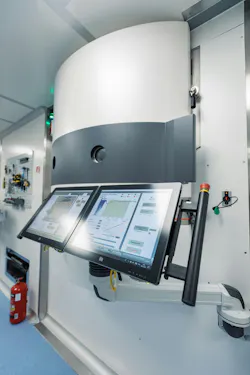
Scaling IBS coating capacity requires process control, not merely investment
OPTOMAN’s core IBS coating expertise remains based in Lithuania, and our U.S. office is designed to make our expertise easier for North American customers to access—not to replace it.
IBS is a demanding thin-film deposition process. IBS coatings are valued for producing dense, low-defect optical layers with very low scatter and absorption, which makes them well suited to ultrafast and high-power laser systems. But consistent performance depends on careful process control—from substrate preparation and chamber stability to coating design, layer stress, testing, and repeatability.
Longer term, OPTOMAN’s roadmap includes establishing IBS coating capacity in the U.S. once customer volume justifies the investment. Our goal is to build parallel capability suited to North American demand, particularly in markets where domestic manufacturing may become more important. This growth must be managed carefully. For high-performance optics, expansion is not only a question of capacity but one of process consistency.
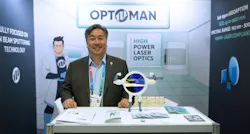
Future of high-power optics supply looks more collaborative
Laser systems are now too specialized for purely transactional supplier relationships to work efficiently. OEMs need suppliers who understand application context, system architecture, and operational tradeoffs, not just coating recipes.
For OPTOMAN, the U.S. expansion reflects this reality. Technical excellence remains essential, but proximity, communication, and responsiveness increasingly determine how effectively our expertise reaches customers.
This is the purpose of application-level support: Help customers define the right optical problem earlier, connect system requirements with coating expertise, and reduce the risk that a technically advanced optic becomes the wrong solution for the application.
About the Author
Huyen Vu
Huyen Vu is CEO and president of OPTOMAN Inc. (Folsom, CA), driving the company’s expansion into the U.S. market to supply advanced, high-damage-threshold laser optics for high-power and ultrafast laser applications. He holds dual engineering degrees in Aeronautics and two MBAs focused on International Business and International Marketing.