Metalens confocal imaging uses colors of light to eliminate mechanical axial scan
Confocal microscopy is a nondestructive imaging technique that can reject out-of-focus light and produce high-resolution optical sections, which makes it highly valuable for three-dimensional (3D) imaging. The catch? Most confocal systems still rely on mechanical axial scanning to build up depth information, and unfortunately this scanning step adds complexity, slows image acquisition, and makes the system more difficult to miniaturize.
This long-standing limitation made researchers at Penn State University wonder: Can we obtain depth information without physically moving the lens, the sample, or the focal plane while miniaturizing the system?
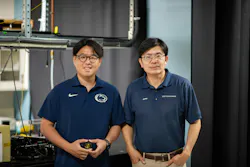
“So we decided to explore whether a metalens can change this picture,” says Yu-Jie Lin, a Ph.D. student in electrical engineering (see video). “For conventional optical design, chromatic aberration is usually treated as a problem to be corrected because different colors focus at different positions. In this work, we turned this ‘problem’ into the operating principle of the system.”
A metalens is a flat optical element made of ultrathin nanoscale structures smaller than the wavelength of light, a.k.a. meta-atoms. Each meta-atom locally modifies the light wave, and together they shape the wavefront to perform the function of a lens. In contrast, a conventional lens uses a curved glass surface to bend light to focus.
“Instead of mechanically scanning in the axial direction, our system can read out depth information directly from the reflected spectrum,” says Lin.
The researchers also “wanted to show that meta-optics can do more than make lenses thinner—it can enable new imaging architectures,” adds Xingjie Ni, a professor of electrical engineering. “Our work explores how an ultrathin metalens can transform chromatic dispersion into a compact, scan-free, high-information-capacity encoder for 3D confocal imaging.”
Metalens confocal imaging
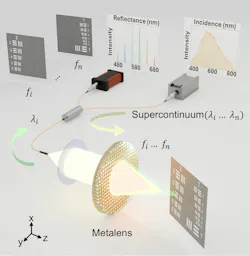
Most confocal imaging systems obtain depth information by physically scanning the focal plane or the sample along the axial direction. “Our approach replaces this mechanical scan with wavelength encoding,” says Zhiwen Liu, a professor of electrical engineering. “The metalens focuses each wavelength to a different depth, which creates many depth channels in parallel.”
Another way to think of it: A metalens creates a rainbow of focal positions along the optical axis and when the sample reflects light, the spectrum reveals which depths the confocal signal originates from. Measuring this spectrum via spectrometer provides axial information directly.
This approach combines three key elements: A highly dispersive metalens, broadband illumination, and a single-mode optical fiber that serves as the light delivery/collection path and the confocal pinhole. These three elements allow parallel depth-resolved confocal imaging over a millimeter-scale range.
Compared to earlier metalens-based chromatic confocal demonstrations, the group’s system achieves a much larger axial space-bandwidth product, ~68, over a 1.3-mm depth range. In simpler terms: it distinguishes many more resolvable depth positions within a compact optical architecture.
“One of the most exciting aspects of our work was figuring out chromatic aberration can become the central mechanism for 3D imaging,” says Lin. “For many optical systems, chromatic aberration is treated as an imperfection because it causes different colors to focus at different locations. This same effect becomes the useful signal—different colors are intentionally assigned to different depths.”
This shift in perspective was important, because instead of trying to eliminate dispersion the researchers worked to leverage it. The result is a compact system in which spectral information is directly converted into depth information.
“A particularly memorable ‘aha!’ moment came when we illuminated the system with white light through the fiber and could directly see—with the naked eye—a rainbow-like line of focal spots emerging from the metalens along the axial direction. It was a simple but striking visual confirmation of the wavelength-to-depth mapping that underlies the entire imaging concept,” Lin says.
Metalens design work
A key part of the group’s metalens design work focused on providing both strong chromatic focal shift and good focusing performance. “We wanted the focus to move substantially with wavelength, so the system covers a large depth range—but we also needed each wavelength to focus tightly enough to preserve confocal resolution,” says Linghan Zhao, a Ph.D. student in electrical engineering.
To do it, they used analytical modeling to understand how the axial information capacity depends on design parameters such as numerical aperture, aperture size, wavelength range, and axial resolution. This helped guide their overall system design and provided a quantitative target through the axial space-bandwidth product.
And the researchers used electromagnetic full-wave simulations to design the silicon nitride nanostructures that form the metalens. “In high-numerical-aperture regions, the phase changes rapidly across the device, which makes the local optical response especially important,” Zhao points out. “The design required careful control of phase, dispersion, and diffraction efficiency. The modeling wasn’t simply a final verification—it was central to understanding how to engineer the metalens for this particular imaging function.”
A few challenges ahead
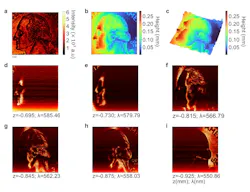
One important challenge is optical signal throughput. “In reflection-based confocal imaging, light reflected from steep slopes, sharp edges, or rough surfaces may not couple efficiently back into the fiber,” says Lin. “When this happens, depth retrieval can become less reliable within these regions.”
Another challenge is imaging within strongly scattering environments, such as biological tissue. “Scattering can reduce signal strength, distort the reflected spectrum, and make depth reconstruction more difficult,” Lin says. “Addressing this will likely require further optimization and improvements in optical design, collection efficiency, and computational reconstruction.”
And there’s also room to further improve the metalens itself. “Future designs can aim for a higher efficiency, larger axial space-bandwidth product, improved fabrication uniformity, and more compact integration with fiber-based or endoscopic platforms,” Lin says.
Nanoscale metalens transforms chromatic dispersion
The group’s work establishes the proof of concept and experimentally demonstrates a metalens can transform chromatic dispersion—traditionally considered a harmful aberration in optical systems—into a powerful mechanism for parallel, depth-resolved confocal imaging. “Our next step is to move the technology from demonstration toward practical use by improving optical efficiency, increasing axial information throughput, and testing the system within more complex imaging environments,” says Lin.
Their nanostructured metalens shows potential for surface profilometry and optical inspection, in which compact, high-resolution, scan-free depth measurements can provide immediate value for micro-optics, semiconductor devices, and precision-manufactured components. “This same concept can also enable a new generation of compact 3D optical instruments, including miniature confocal probes that capture depth information without moving parts, faster industrial inspection tools, and fiber-compatible endoscopic imaging systems for biomedical applications,” Lin adds.
FURTHER READING
Y.-J. Lin et al., Nano Lett., 26, 21, 7016–7022 (2026); https://doi.org/10.1021/acs.nanolett.6c01339.
About the Author
 Sally Cole Johnson
Sally Cole Johnson
Editor in Chief
Sally Cole Johnson is Laser Focus World’s editor in chief, and she has more than 25 years’ experience as a science and technology journalist. She specializes in physics and semiconductors, and wrote for the American Institute of Physics for more than 15 years, and also covered theoretical physics and neuroscience for the Kavli Foundation, and complexity for the Santa Fe Institute. Johnson has also written extensively about military embedded systems, high-performance computing, software-defined networks, and infosec. She is a member of the National Association of Science Writers (since 2001).
When she isn’t writing about optics, photonics, or quantum advances, you can find her outside in northern NH in the garden with birds landing in her hand or heading for the mountains with her bike, skis, or crampons and ice axe.