Dual use of existing underground fiber-optic internet cables as sensors?

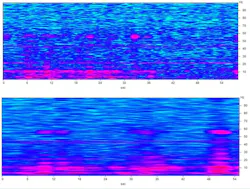
An interdisciplinary team of researchers led by the CONNECT Research Center, based at Trinity College Dublin, is developing sensors to detect and ultimately analyze tiny changes in light as it travels through existing underground and seacoast fiber-optic cables (see video). This may also help detect unusual vibrations or disturbances, and potentially become an early-warning system for events like earthquakes.
The work is part of the European Union-funded intent and context-aware optical networks (ICON) project. “ICON is a unique approach to the integrated communication and sensing paradigm,” says Aleksandra Kaszubowska, an assistant professor of electronic and electrical engineering at Trinity, as well as an assistant professor and research fellow at CONNECT. “Our aim is to open up an entirely new dimension of functionality for fiber-optic communication networks.”
The integrated communication and sensing (ICAS) system combines sensing and spatial location of passive (not connected) objects into a fiber-based mobile communication network, which Kaszubowska explains ultimately expands the network’s functionality beyond merely communications—essentially establishing dual use on the same fiber-optic cables without affecting the quality of the connection.
“To achieve it, we’re developing an intelligent ICON controller that includes user interfaces and application programming interfaces (APIs) to support different sensing applications,” Kaszubowska says. “The controller, for example, uses agentic AI and interprets the user or application intent to extract its requirements and convert them into the sensing configuration.”
It focuses on the interpretation of signals from a single source as well as information gathered from a variety of sources, including other sensing technologies or signals and external sources like weather data and vessel tracking “to extract maximum information from the data,” Kaszubowska says, “to create a complete picture of the network performance, infrastructure, and its surroundings.”
Processing the data within the ICON controller will exploit digital signal processing and machine learning algorithms aided by a digital twin—a live virtual model of the network that displays the fiber-optic cables’ behavior and allows the research team to test different sensing tasks.
The ICON team is now also developing a suite of various flexible sensing techniques to address a diverse set of requirements, including the location of the sensing signal deployment and the data processing type.
“Once the sensing configuration is established, the ICON platform can then communicate with the network controller to configure and route the distributed fiber sensing signals within the network similar to the way data-carrying signals are routed through the network,” Kaszubowska says.
Solid advantages
As it stands now, deployment of sensing can only be done on a link-by-link, application-by-application basis—a costly and time-consuming process, given the high amount of data generated by sensing devices.
“Our signal processing, event identification, and the digital twins developed in ICON will reduce data volume and interpret the events to enable more efficient utilization of the sensing,” Kaszubowska says.
Another challenge is the vulnerability of existing network infrastructure. Telemetry data assesses the network’s health and performance, but lengthy collection times and processing don’t allow for real-time event detection and response.
Kaszubowska says deploying ICON’s intelligent sensing systems will help detect interference with the infrastructure to allow preventive actions, or at least minimization of damage or disruption, and the opportunity for an immediate response.
“The location information provided by sensing will significantly reduce the duration, as well as economic and environmental cost of repairs, especially in the case of submarine cables,” Kaszubowska says.
What’s next?
First up: Demonstrate the operation and benefits of the ICON approach in ICAS, which will ultimately be achieved via two use cases—real-time network infrastructure protection and creation of availability assistance.
“The first will be use the OpenIreland testbed at Trinity College Dublin,” Kaszubowska says. “It will showcase how real-time event detection and identification, together with the ICON controller, enables protection of the network infrastructure in the case of interference with the fiber.”
The ICON approach to ICAS in optical communications and its adoption is expected to significantly improve the resilience of critical infrastructure.
“The availability of a wide range of flexible sensing technologies coupled with efficient data collection and preprocessing will enable deployment of sensing throughout the network infrastructure,” Kaszubowska says. “If integrated with external systems, this could also allow intervention to prevent damage to the infrastructure.”
Related Podcast
About the Author
 Justine Murphy
Justine Murphy
Multimedia Director, Digital Infrastructure
Justine Murphy is the multimedia director for Endeavor Business Media's Digital Infrastructure Group. She is a multiple award-winning writer and editor with more 20 years of experience in newspaper publishing as well as public relations, marketing, and communications. For nearly 10 years, she has covered all facets of the optics and photonics industry as an editor, writer, web news anchor, and podcast host for an internationally reaching magazine publishing company. Her work has earned accolades from the New England Press Association as well as the SIIA/Jesse H. Neal Awards. She received a B.A. from the Massachusetts College of Liberal Arts.