‘Multiplier effect’ solves throughput bottleneck in laser scanning and adaptive optics
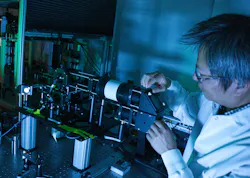
For laser scanning and adaptive optics, there are often tradeoffs in terms of speed, range, and beam size. Pick two, because you can’t have all three due to the inertia limits of high-speed laser scan mirrors, deformable mirrors, and other components.
Whether you are a neuroscientist trying to map thousands of neurons firing across the brain or a manufacturer 3D-printing a complex turbine part, the limit has always been the scanner.
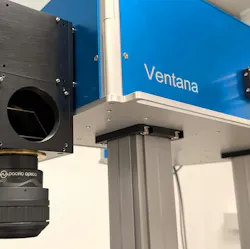
Resonant scanners are fast but “tight” (small angles). Galvos are “wide” but slow. This mechanical bottleneck has dictated the architecture of laser-based systems for decades. But Pacific Optica developed a scan engine that changes the math. Using a patented inertia-free scan angle multiplication (SAM) technique, our Ventana system enables high-speed scanning across massive fields of view, with large beams to ensure high numerical aperture imaging.
‘Inertia-free’ advantage: The physics of multiplication
The term “inertia-free” is the key because mass is the enemy of speed for any mechanical system. To get a wider scan angle out of a traditional mirror, you need a larger mirror or a more powerful motor. But both introduce inertia that slows the response time and creates heat.
Our technique bypasses these issues entirely. By using an optical relay that bounces the laser off a resonant mirror multiple times, the system multiplies the scan angle geometrically. A 4x multiplier, for instance, turns a modest 10-degree scan into a 40-degree scan—all while maintaining the 8- to 16-kHz speeds of the resonant scan mirror.
The core of our innovation lies in a series of folded optical relays, combined with clever instrumentation and optical design. Traditional scanning systems rely on the physical tilt of a mirror to deflect a beam. To increase the angle, you must either tilt the mirror further (limited by the mechanical properties of the resonator) or increase the mirror size (increasing inertia and slowing the system).
Our technique takes a different approach. It uses a stationary optical system to pass the laser beam across the same resonant mirror multiple times. Each “bounce” adds to the cumulative deflection. Because the additional work is done by stationary optics rather than a larger or faster moving part, the system remains inertia-free in terms of its mechanical drive.
Our team demonstrated a multiplier that could take a standard 10-degree scan and expand it significantly without sacrificing the kilohertz speeds that resonant scanners are known for. This isn’t merely a zoom effect; it’s a fundamental expansion of the system’s scan volume.
Two-photon imaging
Our scan engine was born from the neuroscience community’s need to see more of the brain at once. Developed in collaboration with researchers at the University of California, Santa Barbara (UCSB), it provides a solution for two-photon microscopy.
Two-photon imaging requires incredibly precise timing and high-power laser pulses. Our scan engine is optimized specifically for these conditions and provides a wide-field window that doesn't sacrifice the resolution needed to see individual synapses. For researchers, this is the difference between looking through a keyhole vs. looking through a panoramic window. The systems are designed for high-speed, high-resolution imaging over unprecedented fields of view to capture fluorescent dynamics deep within living tissue, across large length scales.
Scale beyond biology
While our scan engine is making waves in life sciences, the implications for the broader laser industry are even more significant.
In laser marking and manufacturing, time is literally money. Current systems often require a mechanical stage to move a part under a scanner to cover a large area. This mechanical movement is the slowest part of the process. A SAM-equipped scanner could cover the entire part in a single “glance,” while moving the laser at resonant speeds across a wide field.
For 3D printing, specifically stereolithography, the “build envelope” is often limited by the scan angle of the laser. By multiplying this angle, our scan engine enables use of larger-format printers that don’t lose the speed advantages of resonant scanning. This could lead to a new generation of industrial 3D printers that are an order of magnitude faster than current galvo-based systems.
And adaptive optics is perhaps one of the most intriguing applications. The SAM principle can be applied to multiply the phase modulation range of adaptive optics. This is a game-changer for ground-based astronomy and deep-tissue microscopy, where correcting for atmospheric or biological turbulence requires significant dynamic range.
Partnering for new applications
Pacific Optica holds the patent for this technology and is currently seeking to expand into new applications and new partnerships. It’s a rare moment in optical engineering when a fundamental physical constraint is bypassed through design rather than “brute force” power. As we open our doors to new applications, we expect to see the multiplier effect appear in everything from high-speed LiDAR systems to the next generation of semiconductor inspection tools.
It’s a reminder that even in mature fields like laser scanning, there’s room for radical innovation. By decoupling speed from angle, we not only improved the scanner but also unlocked a new dimension of throughput for the entire photonics industry.
FURTHER READING
- C.-H. Yu et al., Optica, 13, 409–423 (2026); https://doi.org/10.1364/optica.570761.
- See https://pacificoptica.com.
About the Author
Ryan McGreal
Ryan McGreal is a cofounder and head of operations at Pacific Optica (Santa Barbara, CA), where he’s responsible for organizational strategy and the transition of early stage optical technologies into scalable products. Before launching Pacific Optica, McGreal worked in Spencer Smith’s lab at UC Santa Barbara (UCSB). His experience at UCSB provided a strong foundation in the project development lifecycle, from abstract idea to commercialization, as well as in lab management. These skills now support Pacific Optica’s mission to commercialize next-gen optical technologies.