Silicon photonics at scale will power AI data centers
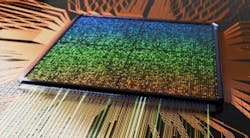
The rapid growth of generative and agentic AI is driving unprecedented demand for compute density, memory bandwidth, and low‑latency communications across data centers and distributed systems. Training and inference for large models increasingly rely on scale‑up architectures (tight coupling of graphics processing units [GPUs]/accelerators within a node), scale‑out architectures (high‑bandwidth interconnects across racks and clusters), and scale‑across networks that span data centers and regions.
As electrical interconnects approach fundamental limits in power efficiency and reach, silicon photonics (SiPh) has emerged as a critical enabler—using light to move data with higher bandwidth, lower latency, and dramatically improved energy efficiency. Optical links, whether in pluggable transceivers or copackaged optics (CPO), are becoming essential to sustain AI system scaling while keeping power and total cost of ownership under control.
GlobalFoundries (GF) plays a central role in this transition by providing a globally scaled, manufacturing‑proven SiPh platform that spans design, fabrication, and advanced packaging. The acquisition of Advanced Micro Foundry (AMF) in Singapore significantly expands GF’s photonics manufacturing capacity and technology depth, particularly within data center communications and long‑haul optical communications, while strengthening supply chain resilience across regions.
Our acquisition of InfiniLink adds deep design expertise in high‑speed optical connectivity, including SerDes, optical transceiver chipsets, and monolithic SiPh. Together, AMF and InfiniLink allow GlobalFoundries to deliver an end‑to‑end SiPh roadmap, from architecture and design through high‑volume manufacturing, supporting pluggable optics, CPO, and next‑generation 400G/λ and beyond for AI data centers and adjacent markets.
AMF supports GF’s scalable SiPh manufacturing
AMF brings a proven 8-inch SiPh platform that has been validated in production across demanding optical communications applications. This mature 200-mm foundation enables immediate manufacturing readiness, with established process control, device performance, and yield learning already in place. By integrating AMF’s platform into GF’s broader technology portfolio, GF accelerates time-to-market for customers while providing a stable and reliable SiPh baseline that is already qualified for volume deployment.
Beyond platform maturity, AMF expands our ability to support customers across scale-out, scale-up, and scale-across requirements. The combined roadmap enables scale-out for high-volume data center deployments, scale-up for higher performance and tighter integration, and scale-across into advanced optical domains such as coherent and C-band applications.
For customers, the key benefit is not only platform stability, but a clear and credible path to scale leveraging GF’s manufacturing footprint, particularly in Singapore. AMF’s Singapore operations, now integrated into GF’s global network, provide a strong foundation for regional scale, supply assurance, and future capacity expansion. This underscores our commitment to the broad proliferation of SiPh across the industry.
With the acquisition of AMF, GF became the largest SiPh foundry by revenue, reinforcing its leadership position and long-term investment in making SiPh a mainstream, high-volume semiconductor technology.
InfiniLink enables GF’s system‑first design engagement
InfiniLink brings deep, end‑to‑end expertise across communication systems, digital signal processing, and both electrical and optical integrated circuits. Rather than approaching customer engagements from a device‑ or process‑only perspective, InfiniLink operates at the system architecture level, understanding how bandwidth, latency, power, signal integrity, and reliability tradeoffs propagate from the system through the package and down into silicon. This system awareness allows GF to engage customers earlier in their design cycles and frame discussions around real system requirements and workloads, and positions us as a strategic technology partner rather than a downstream manufacturing provider.
InfiniLink’s expertise with GF technologies, including our SiPh and FDX platforms, enables true co‑design and optimization of photonic integrated circuits (PICs) and electrical integrated circuits (EICs). By tightly coupling process knowledge with circuit, photonic, and system‑level insight, InfiniLink helps align device choices, architectures, and layouts to maximize performance, yield, and scalability. This co‑optimization across electrical and photonic domains is critical for next‑generation optical interconnects, where system‑level metrics like energy per bit and link margin are directly influenced by silicon and process decisions made early in the design phase.
Beyond this, InfiniLink delivers high‑value electrical and photonics intellectual property (IP) that significantly reduces customer time‑to‑market. Proven IP blocks, design methodologies, and reference architectures lower risk and accelerate development while ensuring alignment with GF’s manufacturing capabilities. Collectively, these capabilities elevate our customer engagement model: GF can now meet customers at their level of system engagement, speak the language of system architects, and jointly shape solutions that span from system definition through silicon realization. This system‑first approach strengthens GF’s differentiation and positions it as a key enabler of advanced electrical and optical systems.
A new roadmap in SiPh leadership
These recent acquisitions advance GF’s position in SiPh and serve as an industry example of SiPh’s key role in expanding manufacturing and system level design to address key customer needs driven by AI and data center deployments.
Data centers aren’t the only technology that requires high-bandwidth and lower-power connectivity to operate. Automotive and communications industries also find these to be key challenges in powering their innovations. Increased design flexibility and high-bandwidth speeds are how manufacturers can meet this growing demand with SiPh.
With these two acquisitions, GF is demonstrating why SiPh is key to accelerating the AI journey. End-to-end photonics solutions, from design to packaging, with increased bandwidth will drive AI applications, and accelerate growth for automotive, industrial, and quantum markets.
SiPh is system‑defining for AI data center technology. The ability to align design, manufacturing, and supply into a repeatable global engine is a powerful position. With the additions of AMF and InfiniLink, alongside a 300-mm monolithic platform and an advanced packaging pathway in the U.S., GF has seen the power of SiPh to drive this repeatable reality by delivering more bandwidth, at lower power, on predictable timelines.
About the Author
 Vikas Gupta
Vikas Gupta
Vikas Gupta is a Fellow at GlobalFoundries (Santa Clara, CA).