Spark Photonics Foundation expands reach of its educational programs
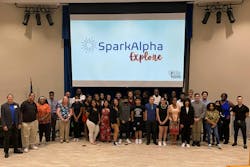
A generous grant is helping expand the Spark Photonics Foundation’s reach in four states where Intel has manufacturing operations—Arizona, New Mexico, Ohio, and Oregon—and includes the SparkEd professional development program for teachers and SparkAlpha Explore for students.
Spark Photonics Foundation provides professional development for educators as well as project-based learning for students—delivered via a ‘train the teacher’ modality. All teachers involved become part of Spark’s “Community of Practice,” in which teachers can interact with each other, experts from academia and industry, and with the Spark Photonics Foundation staff.
“Intel’s grant is validation that leaders within the semiconductor industry value scalable K-14 programs to build the future workforce. Our hats are off to Intel for having the vision to invest in America’s youngest students and their educators,” says Kevin McComber, who founded the Spark Photonics Foundation, a nonprofit that specializes in K-12 and early college (K-14) educational outreach about photonics and semiconductors. He also launched Spark Photonics Design, a commercial company that offers photonic integrated circuit (PIC) design services and software, on the same day in 2019.
Although the idea for the commercial company came first, “we realized we needed to grow the workforce in integrated photonics if we really want this industry to take off,” says McComber. “Efforts were already underway in integrated photonics workforce development at the higher education level, but we thought we could move the needle by reaching younger students. And we felt strongly that industry should take a leadership position in K-14 engagement and put skin in the game—not delegate it to academia or government. So we put our skin in the game, with me serving as the founding executive director of the Spark Photonics Foundation.”
McComber set out with an ambitious goal of becoming the “front door” for integrated photonics in both technology and workforce. The Spark Photonics Foundation’s scope has expanded to all of semiconductors because of the clear need for K-14 engagement across the entire industry.
Make learning about photonics and semiconductors accessible
One main challenge to the Spark Photonics Foundation’s work is the sentiment within the semiconductor industry that this topic isn’t accessible to students and teachers in K-14 because the math and science of photonics and semiconductors get deep quickly. “This assumption is founded on the false belief that students and teachers need to understand the technology to be interested in it,” says McComber. “We tore this assumption up and started with what it takes to get students and teachers interested: Applications of the technology. Then, we can build onto this interest and get them interested in learning more about the technology. But it must begin with excitement or we lose them quickly.”
Another challenge is getting teachers to sign up to adopt Spark’s programs. “Teachers and their administrators are rightfully skeptical of external organizations coming in and asking them to run new programs,” McComber says. “We’ve done our best to make our programs a light lift and engaging—and our staff are all former public school teachers, so they walk the talk.”
By starting small, the Spark Photonics Foundation proved their model works and can be implemented without further burning teachers out, and now they’re building on these wins to continue scaling across the U.S. “Our programs expanded from one state to three states by 2024, and 11 states by the end of 2025,” says McComber. “We’re seeing momentum continue to grow.”
Their project-based learning program SparkAlpha Explore—in which students conceptualize photonics-based sensing devices to address problems they care about—was created and piloted in Massachusetts from 2021 to 2023. “We were then introduced to teachers in Montana, who ended up adopting our program,” says McComber. “A few Montana students who participated in SparkAlpha went on to win a statewide entrepreneurship challenge, and their teacher wrote to us about the thrilling experience. This was a turning point for us and a source of hope that more teachers across the U.S. would want to bring our program into their schools and adopt it as a platform to help their communities thrive.”
Spark Photonics Foundation will continue to deliver scalable workforce programs in anticipation of the industry’s future needs.
If you’d like to get involved, you can visit www.sparkphotonics.org/get-involved.
More on Spark Photonics
About the Author
 Sally Cole Johnson
Sally Cole Johnson
Editor in Chief
Sally Cole Johnson is Laser Focus World’s editor in chief, and she has more than 25 years’ experience as a science and technology journalist. She specializes in physics and semiconductors, and wrote for the American Institute of Physics for more than 15 years, and also covered theoretical physics and neuroscience for the Kavli Foundation, and complexity for the Santa Fe Institute. Johnson has also written extensively about military embedded systems, high-performance computing, software-defined networks, and infosec. She is a member of the National Association of Science Writers (since 2001).
When she isn’t writing about optics, photonics, or quantum advances, you can find her outside in northern NH in the garden with birds landing in her hand or heading for the mountains with her bike, skis, or crampons and ice axe.