Nonlinear metasurfaces convert infrared light to visible
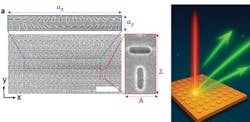
In an advance for metasurfaces, a team of researchers led by Andrea Alù, distinguished professor and Einstein professor of physics at The City University of New York (CUNY), and founding director of the CUNY ASRC Photonics Initiative, demonstrated the first known nonlinear metasurface with engineered nonlocalities to simultaneously deliver high-Q resonance enhancement and pixel-level control of the wavefront of third-harmonic light.
What the heck does this mean? It’s essentially a new approach to design a compact chip that, when illuminated via an optical pump beam in the near-infrared, generates visible light with high efficiency while simultaneously controlling the direction in which this light is emitted. The emission direction is optically controlled—simply by changing the pump polarization—without the need for any electrical bias (see video).
To pull this off, Alù and colleagues designed an ultrathin amorphous silicon film patterned with subwavelength meta-atoms to convert infrared light near 1530 nm into visible light near ~510 nm and steer the generated light toward desired angles—minus traditional phase-matching constraints.
“We were motivated by the limitations of traditional nonlinear metasurfaces, which rely on localized resonances,” says Alù. “Generally, these traditional designs offer good control of the emission direction but suffer from low efficiency. For a couple of years we’ve been exploring nonlocal metasurfaces, which support extended resonances with high-Q factors and enable strong light–matter interaction, but their potential for wavefront control had remained unexplored.”
For this work, his team combined the efficiency typical of delocalized resonances with subwavelength spatial structuring of the resonance to create a platform that overcomes the tradeoff between performance and flexibility. “While all our previous works on nonlocal metasurfaces were limited to linear responses, we’ve just demonstrated the powerful ability of this platform to enhance and control nonlinear optical responses,” says Alù.
Three key ingredients
The team’s device relies on a combination of key ingredients. First: Optical metasurfaces, which are nanostructured ultrathin surfaces that manipulate light’s phase, amplitude, and polarization. These are engineered to support nonlocal modes—strongly delocalized guided resonances with high-Q factors, a.k.a. quasibound states in the continuum (qBICs). Second: The response of the nonlocal resonances supported by the devices is enriched by a geometric phase. By rotating the features etched onto the silicon metasurface along the horizontal direction (see Fig. 1), Alù’s team can induce a controlled and spatially dependent phase shift of the light. This type of control of the phase enables control of the wavefront—and control of the emission direction. Third: To efficiently generate visible light, the researchers leverage the third-harmonic emission provided by the silicon and enhanced by the high-Q resonance.
“Once you mix these ingredients together, you get a device that emits light within the visible range with high efficiency, and its emission direction can be dynamically controlled via simply rotating the pump polarization (while keeping the pump direction constant),” says Michele Cotrufo, a former postdoctoral fellow in Alù’s group, now an assistant professor at the University of Rochester. “In fact, the efficiency we achieved with this device is currently among the best values ever demonstrated for similar material platforms.”
A schematic of the team’s overall process is shown in Figure 2. The nonlocal metasurface “is excited from below by circularly polarized light at the pump frequency (~1500 nm), which generates a nonlocal mode within the metasurface,” says Cotrufo. “The chirality of the pump and geometric phase induced by the rotated nanostructures induces a spatially tailored resonant polarization and phase gradient.”
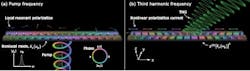
The injected pump field-generates third-harmonic radiation within the visible (close to 500 nm) inside the silicon, which inherits the pump’s phase gradient. This gives rise to nonlinear polarization currents that scatter the third harmonic to the far field in a direction dictated by the engineered phase gradient. Because the phase gradient of the third-harmonic field is dictated by the chirality of the pump, it can be used as a dial/knob to control the emission direction of the generated light.
“Beyond achieving efficient beam steering of third-harmonic generation controlled by pump chirality, another important feature of our device is that the emitted signal remains linearly polarized while it gets steered—unlike previous nonlinear metasurfaces—and it’s an important requirement for many applications,” says Alù. “It was great to verify experimentally that the nonlinear geometric phase scales as 6x the geometric phase, which enables precise control of the generated wavefront.”
Biggest challenges involved in this work? Fabrication precision and thermo-optic effects. “These effects are due to a coherent and collective behavior of all features within one macro unit cell. Small deviations in aperture dimensions can affect diffraction order intensities during fabrication,” Cotrufo explains. “And at high pump powers, heating can shift the resonance and lower efficiency.”
Simulations were “critical for various steps of this work,” says Alù. “While our designs are rationally conceived, optimization of the nanostructures is essential. We used the eigenmode analysis to identify and optimize qBIC modes with large Q-factors, linear response simulations to predict transmittance spectra and phase control, and nonlinear simulations to model third-harmonic generation by computing nonlinear polarization currents and far-field emission. They guided our design choices and validated experimental observations.”
New paradigm for nonlinear metasurfaces
The team’s work introduces a new paradigm for nonlinear metasurfaces because it “combines high efficiency (via nonlocal resonances) with wavefront control (via geometric phase), eliminates phase-matching constraints to enable compact devices, and opens pathways for programmable nonlinear optics within classical and quantum domains,” says Alù.
This approach may find applications in on-chip optical computing because nonlinear metasurfaces can perform frequency conversion and wavefront shaping within ultrathin platforms to enable compact optical logic and signal processing. Its potential for generating entangled photon pairs with tailored spatial properties also looks promising for quantum photonics. And AI and data centers can benefit from the efficient wavelength conversion and beam steering for integrated photonic interconnects.
“In general, our metasurface can provide low-power nonlinear operations for neuromorphic and analog optical computing,” says Alù.
Next?
In the short term, Alù and his team plan to expand the concept to broader resonances and different materials with stronger nonlinearities such as gallium arsenide (GaAs) and multi-quantum wells. “We’ve done a lot of work on these material platforms within the context of nonlinear local metasurfaces and want to extend it to nonlocal geometries,” he says.
A little further out on the horizon, expect to see the team integrate it with waveguides for on-chip photonic circuits and analog optical computing or even possibly develop multifunctional nonlinear metasurfaces for optical computing and quantum information processing.
This work received support from the U.S. Air Force Office of Scientific Research, the Simons Foundation, and the European Research Council.
FURTHER READING
M. Cotrufo, L. Carletti, A. Overvig, and A. Alù, eLight, 6, 5 (2026); https://doi.org/10.1186/s43593-025-00116-7.
About the Author
 Sally Cole Johnson
Sally Cole Johnson
Editor in Chief
Sally Cole Johnson is Laser Focus World’s editor in chief, and she has more than 25 years’ experience as a science and technology journalist. She specializes in physics and semiconductors, and wrote for the American Institute of Physics for more than 15 years, and also covered theoretical physics and neuroscience for the Kavli Foundation, and complexity for the Santa Fe Institute. Johnson has also written extensively about military embedded systems, high-performance computing, software-defined networks, and infosec. She is a member of the National Association of Science Writers (since 2001).
When she isn’t writing about optics, photonics, or quantum advances, you can find her outside in northern NH in the garden with birds landing in her hand or heading for the mountains with her bike, skis, or crampons and ice axe.