The future of optical networks: Evolution and imperatives

During the past 25+ years, the journey of my career has been both exciting and fulfilling. Experiencing the anxiety of the “Millennium Bug,” the “Telecom Bubble,” and more recently the “AI Boom” gives me an insightful view of the road that lies ahead. As I started writing this article, I decided to approach it not just as a technologist but a student of the evolution of technology itself, and to share my perspective of what’s on the horizon for optical networks.
Today, I’m responsible for strategic innovation and communications technology, such as optical networks, which are undergoing a profound transformation to address the world’s soaring connectivity needs. Previously the silent backbone of long-haul telecommunications, optical links are now essential enablers for transcontinental cloud computing, high-speed broadband such as fiber-to-the-home (FTTH) and 5G, and artificial intelligence (AI).
The evolution of optical networking (see Fig. 1) involves more than simply boosting speed—it’s about reimagining network architectures for greater agility and scalability, and we’re at the beginning of this transformation. Next-generation coherent optics, silicon photonics, and intelligent optical switching are converging to redefine fiber network capabilities.
Unprecedented demand is driving evolution
Traditionally, optical networks were defined by their capacity and reach. Today, demand is increasing at an exceptional rate: Hyperscale data centers, streaming media, and AI supercomputing workloads all require higher bandwidth and lower latency—but with energy efficiency. In 2025, the needs of AI infrastructure highlighted this shift, pushing optical technology to a pivotal point where it has the potential to provide all three elements: Reach, speed, and energy-efficient consumption.
Unlike past incremental upgrades, today’s environment requires fundamental architectural changes. High-performance computing (HPC) clusters and cloud platforms now regard optical connectivity as a strategic core asset. The network must no longer serve as a bottleneck. This is a shift from simply adding more fibers and transceivers to a comprehensive rethinking of end-to-end optical connectivity and network design and management. As optics move closer to compute, whether connecting data centers hundreds of miles apart or linking racks within a facility, networks must become ultrahigh-capacity, software-adaptable, and seamlessly integrated with computing infrastructure. For this to happen, several milestones are required in terms of technology and collaboration.
Technology milestones to meet
Coherent optics: The high-capacity backbone. During the past decade, coherent optical technology revolutionized network capacity. By encoding data within the amplitude, phase, and polarization of light, coherent systems have far surpassed the traditional 10-Gbit/s per wavelength limit. The introduction of 100G coherent systems around 2010 was a turning point, and today coherent transponders can transmit at 400G, 800G, and even 1.6 Tbit/s on a single wavelength in advanced trials—a 160-fold increase in spectral efficiency compared to earlier technologies. Industry demonstrations exceeded 1 Tbit/s per carrier by 2022, and efforts are underway to reach 3.2 Tbit/s using multi-carrier superchannels. Each leap in throughput means fewer channels or fibers are needed, which reduces both cost and energy per bit.
Coherent optics are no longer confined to transoceanic or national backbones. With rapid innovation, these systems shrunk from large, power-intensive hardware to compact pluggable modules. Early 100G coherent line cards required about 80 W of power, but today’s thumb-sized pluggable coherent optics consume merely 5 to 20 W. This miniaturization enables deployment in metro networks, data center interconnects, and even access networks. For example, 100G/200G coherent pluggable transceivers are expanding fiber-to-the-premises backhaul capacity without new fiber installation. Coherent links are also used for high-throughput free-space optical connections between low-Earth-orbit satellites to bring broadband from space. The ubiquity of coherent optics allows for a consistent, high-capacity infrastructure across the network edge and core.
Looking ahead, coherent optics will continue to advance, and I anticipate “coherent lite” solutions—lower-cost, lower-power interfaces for shorter distances—that can replace traditional optics in campus and mobile networks. Research into new optical materials and improved photonic integration is ongoing to support higher baud rates and efficiency. Coherent techniques may also be adopted within data centers for rack-to-rack connections, especially as Ethernet lane rates increase. Achieving the full potential of coherent technology will require industry-wide coordination—from setting module standards to achieving scalable, cost-effective manufacturing. Progress in digital signal processing (DSP) algorithms, photonic integration, and thermal management will be essential for broad deployment of high-capacity channels. Nevertheless, the benefits outweigh the challenges.
Silicon photonics and copackaged optics: Integration at scale. As data volumes grow, integrating optics directly with electronic circuits is crucial to reduce latency, power consumption, and cost. Silicon photonics enables the fabrication of optical components using standard semiconductor manufacturing, which makes it possible to integrate lasers, modulators, and detectors directly onto chips. This approach supports high-bandwidth interconnects in data centers, HPC, and edge devices. Copackaged optics (CPO), in which optical engines are placed next to switch application-specific integrated circuits (ASICs), eliminate the need for long electrical traces and enable unprecedented throughput between chips (see Fig. 2). These innovations allow networks to scale up while reducing their energy consumption and physical footprint.
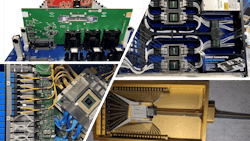
With silicon photonics, data center switches can support hundreds of terabits per second to enable cloud and AI workloads to communicate at scale. The transition to CPO represents a major shift in network architecture, as the traditional separation between computing and connectivity fades. While challenges remain in standardization, manufacturing yield, and the integration of laser sources, industry consortia are making progress. As these technologies mature, we’ll see a new generation of optical interconnects that combine speed, efficiency, and scalability.
Intelligent optical switching and automation. Intelligent optical switching uses software-defined networking (SDN) and machine learning to automate configuration, fault detection, and optimization (see Fig. 3). This enables real-time reallocation of bandwidth, faster recovery from failures, and efficient use of network resources. Automated optical networks can respond instantly to user demands, which makes them ideal for cloud platforms, AI clusters, and mission-critical applications.

Optical switching at the photonic level, using integrated devices and programmable circuits, allows for flexible, low-latency connectivity—with the added advantage of an optical switching fabric that’s transparent to the modulation and protocol of the data. These capabilities are essential to achieve the vision of autonomous, self-healing networks to support future digital infrastructure. While there are limited comparisons of the energy efficiency of conventional electronics switches vs. optical switches, the energy efficiency of an optical switch may prove to be another nudge toward its adoption.
Imperatives and industry collaboration
Despite remarkable progress, several gaps must be addressed to fully achieve the potential of optical networks (see Fig. 4). Technical challenges include further reducing cost per bit, improving energy efficiency, and supporting higher data rates across all network segments. Commercial imperatives involve creating scalable supply chains, standardizing interfaces, and ensuring interoperability among vendors. Operationally, the shift to automated, software-driven networks requires new skills, tools, and processes for managing complex environments.

Industry collaboration is essential to accelerate innovation and overcome fragmentation. Open standards, shared testing platforms, and coordinated development can help align efforts across technology providers, operators, and end-users. Strategic investments in research, education, and workforce development will also be crucial. By working together, the industry can close remaining gaps and deliver the connectivity needed for next-generation digital experiences.
The transformation of optical networks is redefining how we connect, compute, and innovate. From coherent optics and silicon photonics to intelligent switching and automation, the pace of change is accelerating. As demand for bandwidth and agility continues to grow, successful deployment of these technologies will depend on collaboration, standardization, and strategic vision. Our future of connectivity will be shaped by those who embrace network evolution and drive the imperatives needed for global digital infrastructure.
About the Author
Bernard Lee
Bernard Lee, Ph.D., RCDD, CEng, is senior director of Strategic Technology & Innovation, as well as general manager for SENKO Advanced Components Ltd. in the U.K.