A new record set for attosecond isolated light pulses?

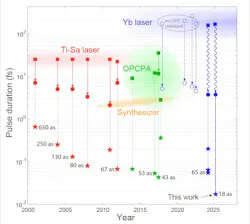
A group of researchers led by Meng Han, an assistant professor of physics at Kansas State University, recently generated and characterized 18-attosecond isolated light pulses—and these are believed to be the shortest light pulses experimentally measured so far.
Ever-shorter and brighter light pulses are a holy grail for ultrafast science, because these pulses offer a better temporal resolution to observe the electron-scale world within atoms, molecules, and materials.
“An attosecond is 10-18 seconds, which is the natural timescale of electron motion,” says Han. “If we want to directly observe how electrons move and interact, we need a ‘camera’ with an extremely fast shutter—and attosecond light pulses provide it. Our motivation was to create the shortest light pulse possible and also make it bright and stable enough to be useful for experiments.”
It starts with a Yb laser
The group’s approach begins with a high-power ytterbium (Yb) laser, which is known for its excellent stability and scalability. “We first compress its pulses to a few femtoseconds, and then use them to drive high-harmonic generation in helium gas,” explains Han. “The strong laser field drives electrons away from atoms and then draws them back. When the electrons recombine with their parent atoms, they emit an extremely short burst of high-energy light through this high-harmonic generation process.”
A very short pulse requires a broad range of frequencies, akin to combining many musical notes with precisely controlled timing. When all frequencies are synchronized properly, they can form an extremely short burst in time. “For our experiment, we generated an exceptionally broad extreme-ultraviolet (EUV) and soft x-ray spectrum and carefully controlled its spectral phase to compress light into an 18-attosecond pulse,” he says.
Producing an extremely broad spectrum that extends from the EUV into the soft x-ray region enables the researchers to “optimize and control the spectral phase of this radiation so different frequency components arrive together in time,” Han says. “And we characterize the pulse using an angle-resolved attosecond streaking technique on helium atoms, which allows us to accurately reconstruct its temporal profile. By using this approach, we measured an isolated light pulse with a duration of 18 attoseconds.”
A big surprise for the group was how far they could push a Yb-based laser system. “Yb lasers are widely known for their stability and high average power, but they certainly weren’t associated with generating the shortest attosecond pulses before now,” Han says. “Our ‘aha!’ moment was that after strong pulse compression and careful optimization of high-harmonic generation, this extremely stable laser platform can produce an extraordinarily broad and coherent spectrum—broad enough to support pulses below 20 attoseconds.”
There are still a few hurdles to clear, and making the pulse extremely short is only one part. “For many applications, we also need attosecond pulses that are brighter, more stable and controllable, and available at higher repetition rates,” Han points out.
Another challenge is to extend these capabilities to even higher photon energies—while maintaining high photon flux. And also to precisely control properties such as polarization, waveform, and spatial structure. “Ultimately, we want attosecond sources to become reliable tools that scientists can use routinely, rather than for specialized experiments that require extensive optimization,” he adds.
This video shows the generation of the 18-attosecond light pulse from high-order harmonic generation and the optimization/characterization via the attosecond streaking technique. Credit: Yiming Yuan (KSU graduate student/member of Han’s group)
An ultrafast photonics milestone
What does 18 attoseconds mean for photonics? It actually goes beyond simply reaching 18 attoseconds because the researchers pulled it off via a high-power Yb-laser platform. “Yb lasers have become increasingly important in ultrafast photonics because of their excellent stability, efficiency, high average power, and scalability,” says Han.
It shows this mature laser technology can be pushed into an entirely new regime to generate and optimize extremely broadband, bright isolated attosecond pulses. “The source provides a photon flux exceeding 1012 photons per second, while its spectrum extends from about 50 to 320 eV,” he says. “This combination of extremely short duration, high brightness, and a stable laser platform can help make advanced attosecond spectroscopy more broadly accessible.”
Applications ahead? The most obvious one is to observe and ultimately control electron dynamics within atoms, molecules, and materials. “Many fundamental processes—including photoionization, electron correlation, charge migration, and the earliest steps of chemical reactions—begin with electron motion at the attosecond timescale,” Han says. “Brighter and shorter pulses allow us to resolve these processes with greater temporal precision.”
Attosecond light: A powerful scientific tool
Next? The group’s goal is to make the pulse shorter—and turn attosecond light into a more powerful scientific tool. “We’re working toward brighter and more controllable attosecond sources and developing attosecond-pump/attosecond-probe spectroscopy,” says Han. “Rather than using a single attosecond pulse simply to take a snapshot we’d like to use one to initiate electron dynamics and another to observe how the system evolves. In this sense, 18 attoseconds isn’t an endpoint. It’s a new tool for exploring questions about electron dynamics that were previously difficult—or impossible—to access experimentally.”
FURTHER READING
J. Gao et al., Nat. Commun., 17, 8810 (2026); https://doi.org/10.1038/s41467-026-76827-3.
More Coverage
About the Author
 Sally Cole Johnson
Sally Cole Johnson
Editor in Chief
Sally Cole Johnson is Laser Focus World’s editor in chief, and she has more than 25 years’ experience as a science and technology journalist. She specializes in physics and semiconductors, and wrote for the American Institute of Physics for more than 15 years, and also covered theoretical physics and neuroscience for the Kavli Foundation, and complexity for the Santa Fe Institute. Johnson has also written extensively about military embedded systems, high-performance computing, software-defined networks, and infosec. She is a member of the National Association of Science Writers (since 2001).
When she isn’t writing about optics, photonics, or quantum advances, you can find her outside in northern NH in the garden with birds landing in her hand or heading for the mountains with her bike, skis, or crampons and ice axe.