Break the peak-power wall: Long-lifetime gain media redefine efficient high-energy lasers
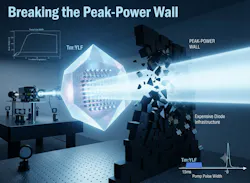
Commercial and scientific demand for solid-state lasers capable of delivering multi-joule, high-energy pulses continues to grow. From industrial materials processing and laser shock peening to advanced extreme-ultraviolet (EUV) lithography light sources, high-energy pulsed systems at Hertz-level repetition rates are transitioning from specialized laboratory configurations to rugged industrial tools. But as system designers attempt to push these systems to higher pulse energies, a question arises: Is there a more efficient gain material?
During the past few decades, ytterbium-doped gain media, particularly ytterbium-doped yttrium aluminum garnet (Yb:YAG), served as the industry benchmark for high-power laser design. While Yb:YAG has been extensively modeled and successfully deployed in high-repetition-rate systems operating within the multi-kilohertz regime, its performance profile shifts drastically when scaled down to low repetition rates. The root of this limitation lies in the fundamental physics of its upper-state fluorescence lifetime, which is relatively brief at ~0.95 ms. When a system is restricted to a low shot rate, almost all stored energy decays via spontaneous emission between individual pulses. To combat this rapid decay and achieve high energy storage before a pulse is triggered, designers are forced to pump the crystal with intense, ultrashort bursts of light. This requires massive, capital-intensive diode arrays designed solely to deliver high instantaneous peak power, which drives up the initial capital cost of the laser infrastructure to prohibitive levels.
Tm:YLF
A design paradigm is emerging centered on long-lifetime gain media: Thulium-doped lithium yttrium fluoride (Tm:YLF). By using an upper-state lifetime of approximately 15 ms (roughly 15x Yb:YAG), these systems alter the temporal dynamics of laser amplification. This extended energy storage window permits energy accumulation via longer, lower-intensity pump pulses and distributes the required energy delivery across a broader temporal window. Consequently, this approach decreases peak power demands placed on the pump diode architecture, lowers overall wall-plug energy consumption, and improves system efficiency.
Inside the energy storage window
To understand how a simple shift in host material characteristics can yield such profound systemic advantages, we must explore the temporal relationship between the pump cycle and the seed pulse injection. In any pulsed laser amplifier, an external light source supplies energy to drive electrons into an excited quantum state to create a population inversion that can be cleanly extracted by an incoming seed pulse.
When comparing the temporal dynamics of these two architectures, the storage efficiency advantages become obvious (see Fig. 1). Because Yb:YAG possesses a sub-millisecond fluorescence lifetime, any pump duration extending beyond 1 ms causes the accumulated energy to rapidly bleed out of the system via spontaneous decay. Consequently, Yb:YAG amplifiers demand rapid, high-intensity pump pulses to outpace this decay.

Conversely, the 15-ms storage window of Tm:YLF allows the population inversion to steadily accumulate over tens of milliseconds with negligible fluorescence loss during the pumping cycle. The laser system can be fed by pump diodes that remain active for a significantly longer duration. Because energy is the product of power and time, expanding the time variable by a factor of 15 means the instantaneous peak power required from the diode arrays drops dramatically for the exact same target energy. This structural shift allows system engineers to specify smaller, less complex, and significantly cheaper diode stacks.
Flashlamp legacy
Despite being decades-old technology, 10-Hz flashlamp systems continue to command a substantial share of the commercial and scientific market today. The persistence of flashlamps is driven entirely by upfront economics: Flashlamps are cheap to manufacture and purchase compared to modern semiconductor diode arrays.
But flashlamps emit light nondirectionally and across a broad, untuned spectral range, which means only a tiny fraction of the generated light matches the absorption bands of the laser crystal. The rest of the broadband energy is wasted as heat and creates severe thermal distortions in the gain medium and requires massive cooling infrastructure.
Diode pumping offers a leap forward by providing highly directional, spectrally tuned light that matches the absorption lines of the crystal perfectly, which maximizes efficiency and minimizes heat generation. But when conventional ytterbium-based designs are used at low repetition rates, the high capital cost of the peak-power-heavy diode infrastructure wipes out long-term operational cost savings and locks users into inefficient flashlamp systems.
Long-lifetime media such as Tm:YLF improve the economic viability of diode lasers for low-repetition-rate applications. It enables the use of longer-pulse diode architectures that reduce initial capital expenditures toward parity with flashlamp baselines. Consequently, systems can transition away from legacy flashlamps but retain the reliability, beam quality, and wall-plug efficiency of diode-pumped systems.
Quantifying high-energy tradeoffs
The tangible performance divergence between long-lifetime thulium hosts and short-lifetime ytterbium media is best illustrated by evaluating how each material converts identical diode pump energy into usable laser output across varying pulse durations. When restricted to a controlled double-pass amplifier geometry, the unique scaling behaviors of each crystal are clearly visible.
When examining the behavior of both systems as a function of the pump window length, the Yb:YAG amplifier responds poorly to extended pumping (see Fig. 2). Extending the pump pulse length into the multi-ms domain fails to yield an increase in output energy, because the crystal can’t retain the energy; it simply saturates at 300 mJ, because the inversion decays as fast as it is supplied.
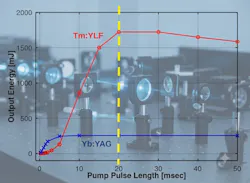
In contrast, the Tm:YLF curve scales rapidly as the pump duration is extended and reaches a clear operational threshold, where it achieves a true transparency state at a 2-ms pump duration. From this point, the output scales aggressively and climbs into the multi-joule regime and peaks around an optimized 20-ms pump window to deliver an impressive 1.75 J of pulse energy (yellow dashed line in Fig. 2). Under these operational conditions, the thulium host provides a nearly 7-fold increase in extracted energy over its ytterbium counterpart from the exact same diode stack.
For brief pump windows below 2 ms, Yb:YAG comfortably outperforms Tm:YLF. This occurs because Yb:YAG’s short fluorescence lifetime is perfectly matched to high-brightness, sub-millisecond bursts. Tm:YLF requires a much longer duration to build up an equivalent population inversion.
But scaling a Yb:YAG system upward to match the 1.75-J output of the optimized Tm:YLF amplifier exposes the peak-power wall. To force the ytterbium crystal to output 1.75 J, the required peak pump power must be increased to 32.7 kW. This represents a punishing 2.2-fold increase in peak pump power compared to the thulium configuration. Yb:YAG possesses a significantly higher emission cross-section and a lower saturation fluence, which means it can release its stored energy with greater physical ease once inverted. This partly offsets the severe storage lifetime penalty it suffers during low-frequency pump phases.
Comparative electrical-to-optical efficiency: Beyond the peak power wall
Evaluating overall electrical-to-optical conversion efficiency involves analyzing performance across four stages: Diode electrical-to-optical conversion, gain media energy storage, quantum yield, and pulse extraction efficiency.
Reaching a 1.75-J output requires approximately 15.1 kW of peak diode power for Tm:YLF, compared to 32.7 kW for Yb:YAG, so the required peak power is reduced by a factor of 2.16. When factoring in the compounding conversion efficiency losses across the diode infrastructure and power-conditioning stage, this reduction in peak electrical demand directly enhances overall wall-plug efficiency by a factor of approximately 2. Furthermore, scaling down the required peak diode power decreases the thermal load, reduces thermal dissipation requirements, and alleviates strain on the thermal management and cooling systems.
Driving the future of laser fusion
While an individual multi-joule amplifier represents a vital building block for industrial applications, the transformative scale of long-lifetime gain media extends into conceptual system architectures like inertial confinement fusion (ICF) and inertial fusion energy (IFE) systems. Achieving controlled, net-positive fusion ignition requires delivering multi-megajoule pulses of laser energy onto a target fuel pellet.
Because no single laser channel can generate megajoule-level energies without instantly destroying its own optics, fusion facilities achieve this massive energy target through spatial multiplexing. This involves arraying hundreds of individual laser beam lines, each engineered to deliver between 10 to 100 J, and firing them simultaneously so their individual pulses converge perfectly on the fusion target. For a commercial fusion power plant to be viable, this massive array must fire reliably at a repetition rate of 10 to 20 Hz. This operating frequency of 10 to 20 Hz is ideal for the Tm:YLF concept, because the extended millisecond pumping window inherently restricts this architecture to lower repetition rates where sufficient population inversion can accumulate.
Extending this framework to facility-scale designs illustrates how long-lifetime gain media could make high-repetition-rate fusion viable. By shifting plant designs to a Tm:YLF framework, facilities could exploit extended pumping windows to bypass the severe economic barriers imposed by massive diode infrastructure requirements.
Engineering the roadmap ahead
Transitioning these amplifier concepts into operational facility-scale hardware requires addressing key challenges in aperture scaling and thermal handling. Single crystal Tm:YLF or alternative holmium-doped hosts (specialized optical gain media) must be grown at larger apertures to support high energy extraction without inducing optical damage. To address the physical size limitations inherent to single crystal growth, research is examining transparent ceramic gain media, such as thulium- or holmium-doped sesquioxides, which provide uniform apertures along with improved mechanical strength and thermal fracture resistance.
Furthermore, managing localized thermal gradients and wavefront distortions over extended millisecond pump cycles will require specialized cooling loops to preserve beam quality. And ultimately, long grain lifetimes provide a viable pathway toward cost-effective high energy architectures by lowering peak diode power requirements for advanced manufacturing.
FURTHER READING
N. K. Metzger, W. M. Lee, and R. Sulkas, J. Opt., 28, 7, 075502 (2026); https://doi.org/10.1088/2040-8986/ae81c0.
I. Tamer et al., Opt. Lett., 46, 19, 5096–5099 (2021); https://doi.org/10.1364/ol.439238.
J. Vetrovec, D. A. Copeland, and A. S. Litt, Proc. SPIE, 9726, 972619 (2016); https://doi.org/10.1117/12.2220008.
W. Koechner, Solid-State Laser Engineering, 6th ed., Springer (2006); https://link.springer.com/book/10.1007/0-387-29338-8.
B. M. Walsh, N. P. Barnes, and B. Di Bartolo, J. Appl. Phys., 83, 5, 2772–2787 (1998); https://doi.org/10.1063/1.367037.
P. Loiko et al., IEEE J. Quantum Electron., 55, 1–12 (2019); https://doi.org/10.1109/jqe.2019.2943477.
About the Author
 Nikolaus Klaus Metzger
Nikolaus Klaus Metzger
Nikolaus Klaus Metzger is a visiting academic at the Australian National University’s John Curtin School of Medical Research, where he works on advanced laser systems and photonics engineering. His recent work examines how gain-medium choice affects the economics and energy efficiency of high-energy solid-state lasers, particularly in regimes relevant to fusion drivers and other large scientific and industrial systems.
He is also CEO of high-E Photonics (www.highephotonics.com), a company focused on advanced laser technologies and high-energy photonics systems. In that role, he works at the intersection of laser engineering, system design, and the translation of photonics innovation into practical applications.