Optical frequency combs: Spectral purity transfer
Optical frequency combs (OFCs) are precise laser light sources whose spectra consist of a series of equally-spaced frequency lines that resemble the teeth of a comb. As highly accurate rulers for measuring optical frequencies, OFCs have revolutionized precision measurement and metrology since their development in the late 1990s. One of the most important capabilities enabled by OFCs is spectral purity transfer. It refers to the ability of an OFC to transfer the spectral purity—frequency stability and narrow linewidth—of one light source to another operating at a different wavelength.
In an ultralow-noise implementation (patented by Menlo Systems1), spectral purity transfer preserves the characteristics of ultrastable optical reference systems across the entire comb spectrum, including frequency-converted outputs spanning the visible to the mid-infrared spectral regions.
Intro to optical frequency combs
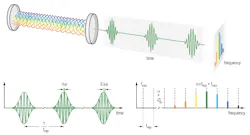
An OFC is a laser source whose optical spectrum consists of a series of discrete, equally-spaced frequency lines. In the frequency domain, this regular structure resembles the teeth of a comb. OFCs are most commonly generated using ultrashort, modelocked lasers (see Fig. 1, top). Modelocking is a technique in which the longitudinal modes of a laser cavity are forced to oscillate with a fixed phase relationship. Consequently, the laser emits a series of ultrashort optical pulses. The circulating pulse propagates back and forth inside the laser resonator at a repetition rate frep, which is determined by the cavity round-trip time. During each round trip, a small amount of pulse energy is extracted via a partially transmissive mirror to form the laser output. In the time domain, this output appears as a regular pulse train and in the frequency domain, it corresponds to a comb of equidistant spectral lines (see Fig. 1, bottom).
Due to dispersion in the laser cavity, the group velocity of the pulse envelope usually differs from the phase velocity of the optical carrier. This mismatch results in a gradual phase shift Δφ of the carrier wave with respect to the pulse envelope from one round trip to the next. This phenomenon is referred to as carrier-envelope phase offset (see Fig. 1, lower left).
Ideally, in the absence of noise and external perturbations, the Fourier relationship between the time and frequency domains implies that a strictly periodic pulse train corresponds to a discrete set of equally spaced frequency modes (see Fig. 1, lower right).
In the frequency domain, the individual comb lines νn are given by:
vn = nfrep + fceo,
where n is an integer mode index, frep is the pulse repetition rate, and fceo denotes the carrier-envelope offset frequency. The entire comb spectrum is shifted by fceo as a result of the pulse-to-pulse carrier-envelope phase slip, while the spacing between adjacent lines is solely determined by frep. In practice, both the repetition rate frep and the carrier-envelope offset frequency fceo must both be measured and actively stabilized for an ultrafast pulsed laser to function as an OFC. The measurement of frep is comparatively straightforward, because it typically lies within the range of tens of megahertz to a few gigahertz and can be detected using a fast photodiode. Repetition rate stabilization is achieved by closing a feedback loop on actuators that allow for effective cavity length adjustments. In contrast, measuring and controlling fceo is significantly more complex and represented a major challenge in the early development of OFC technology.
Difference-frequency generation (DFG) frequency combs
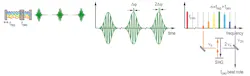
Historically, one of the early strategies for dealing with the carrier-envelope offset frequency was an optical scheme that avoids the need for its explicit measurement and control altogether. This is achieved using the inherently carrier envelope phase stable nonlinear process of DFG to create a replica of the original laser pulse train, which results in an average fceo value of zero (<fceo> = 0). In such DFG-based OFCs, two distinct spectral components originating from the same laser oscillator (typically after spectral broadening in nonlinear fibers) are mixed in a nonlinear crystal. In an ideal case both components will carry the same fceo, so subtracting their frequencies will cancel out the offset to produce an “offset-free OFC.” From a purely technical standpoint, offset-free OFCs offer simplicity by requiring only one control loop: Their only control variable is the repetition rate frep. But this comes with a tradeoff: An expectation value <fceo> = 0 does not imply the overall absence of fceo phase noise. In other words, while the DFG process removes the average offset it does not suppress incoherent noise associated with fceo (see Fig. 2). Instead, DFG-based OFCs have been shown to exhibit quadratic scaling of phase noise with frequency, described by an “elastic tape” model with a fixpoint at zero frequency.2
In retrospect, it is worth noting that the technique of generating offset-free frequency combs via DFG was originally patented by the Max Planck Society,3 and during the early days of OFC commercialization it was exclusively licensed to Menlo Systems. The method is still highly advantageous for the generation of frequency-comb radiation at otherwise difficult-to-access wavelengths, which is why we continue to use DFG to extend spectral coverage into the mid-infrared and beyond.

Self-referenced frequency combs
After the development of the first practical comb systems, advances in nonlinear optical fibers enabled reliable carrier-envelope offset detection. These developments allowed for the relatively simple and efficient generation of octave-spanning combs; i.e., frequency combs covering a frequency range of more than twice their lowest frequency. With octave-spanning comb spectra available, the carrier-envelope offset frequency can be characterized using a straightforward self-referencing method. This method relies on an interferometer that heterodynes two distinct portions of the comb spectrum: A comb mode with index n at the red end of the spectrum
vn = nfrep + fceo
is sent through a nonlinear crystal to generate its second harmonic
2vn = 2(nfrep + fceo),
which is shifted by twice the offset frequency. This frequency-doubled signal is then beaten against a comb mode with index 2n
v2n = 2nfrep + fceo.
The beat note between these two frequencies directly reveals the carrier-envelope offset frequency:
2vn − v2n = fceo.
This “f–2f” method is nothing short of a landmark achievement in OFC technology because it enables direct measurement of the carrier-envelope offset frequency. In particular, it supports the implementation of dedicated active dispersion control actuators inside the laser cavity for ultralow noise stabilization and control of fceo (see Fig. 3).
Spectral purity transfer
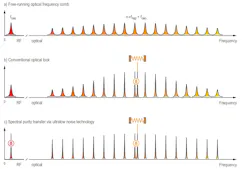
Effective control and stabilization of an optical frequency comb’s degrees of freedom—its repetition rate as well as its carrier-envelope offset frequency—are crucial for precision applications, which require linewidths and stabilities far beyond those achievable with any free-running comb (see Fig. 4a). The ubiquitous approach is to establish an optical lock; i.e., to transfer the spectral purity delivered by an external optical reference to one of the frequency comb lines. Menlo Systems’ optical reference systems routinely achieve sub-hertz linewidths paired with excellent frequency stabilities. They combine a single-mode continuous-wave (CW) laser, a high-finesse optical reference cavity, and the associated optical and electronic locking components—all engineered to provide high sensitivity and a wide locking bandwidth.4 The conventional setup for locking an OFC to an external optical reference is illustrated in Figure 4b. Such a repetition rate control loop relies on detecting a beat note between the CW reference laser and one of the comb teeth, measuring any frequency drift, and applying feedback to the comb’s repetition rate actuator accordingly.
Crucially, although the scheme stabilizes the chosen comb tooth, only the spacing between the reference laser and that single comb line is truly fixed: Because the repetition rate actuator provides control over only one degree of freedom, it primarily influences comb lines close to the locking point. Consequently, the linewidth and phase noise increase with spectral distance from the optical reference. This limitation is inherent to the locking scheme and independent of the comb architecture: Whether an offset-free or a self-referenced comb, when locked via the repetition rate alone, the spectral purity will inevitably degrade the farther away a comb line is from the external optical reference, and leave the virtual RF-domain comb lines essentially unaffected. Rather, as illustrated in Figure 4c, spectral purity transfer across the entire frequency comb spectrum requires complementing the repetition rate actuator with a second control loop for the carrier-envelope offset frequency (fceo). Engaging such a fceo feedback loop accomplishes three essential tasks: Locking fceo at a chosen value, suppressing its coherent and incoherent noise, and reducing phase noise across all comb teeth that are remote to the external optical reference. The fceo actuation acts symmetrically on the spectrum in the sense that it has minimal influence on comb lines near the optical reference, but strongly affects all comb lines far away from it, including both the optical ones as well as the virtual ones in the RF-domain. Overall, the fast loop for carrier-envelope offset frequency control can be perceived as an actuator complementing the repetition rate actuator—for locking the second degree of freedom of an OFC.
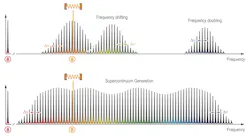
Menlo Systems’ dual actuation design enables true spectral purity transfer—precisely replicating the spectral purity of an optical reference across every single comb line. As illustrated in Figure 5, the spectral purity is also maintained throughout frequency conversion stages, including frequency shifting, second-harmonic generation, or supercontinuum generation.
Application spotlight: Optical atomic clocks
Menlo Systems’ ultralow-noise technology delivers precision across the spectrum, advancing applications that require the most precise performance, such as optical atomic clocks. In this field, our OFCs enabled the transfer of the world’s most precise optical references to the world’s most precise optical clocks, high-accuracy cross-species clock comparisons, as well as long-distance dissemination of optical clock signals via fiber networks.
Transferring ultimate precision
As illustrated in Figure 6, optical reference cavities are most commonly available in the near-IR wavelength region (typically around 1550 nm), where they offer excellent performance and high reliability at comparatively low cost. Unsurprisingly, this wavelength range also hosts the highest-performing reference cavities currently available. In groundbreaking work by a collaboration of JILA (U.S.) and Physikalisch-Technische Bundesanstalt (PTB; the National Metrology Institute of Germany), a cryogenic monocrystalline silicon cavity with silicon mirrors demonstrated a fractional frequency instability as low as 4 × 10-17 at one second, and a linewidth of 5 mHz.5
This development is a tenfold improvement over state-of-the-art ultralow expansion glass (ULE) cavities at room temperature. To transfer this unmatched stability and linewidth from the cavity operational wavelength at 1542 nm into the visible spectral range for a record-breaking strontium optical lattice clock operated at 698 nm,6 researchers rely on Menlo Systems’ ultralow-noise frequency comb technology (in parallel, we engineered the cryogenic cavity into our model ORS-ULN).
Clock-to-clock comparison
Although the current definition of the second that relies on the 9.2-GHz hyperfine transition within cesium has stood for more than half a century, a global collaborative effort is underway to redefine the SI standard using ultranarrow optical transitions inside cold atoms and trapped ions. Accordingly, optical clocks based on a wide range of atomic species are being explored as candidates. To evaluate these new standards, various optical clocks must be compared against each other at the highest level of precision (see Fig. 6), but their transition frequencies can differ by hundreds of terahertz and it renders any direct electronic measurement impossible.
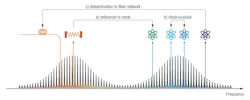
As recent work demonstrates, these frequency gaps can be bridged with highest precision via spectral purity transfer: Menlo Systems’ ultralow-noise OFCs enable cross-species clock comparison at the 10-18 level and beyond.7 Within this context, spectral-purity transfer is a future-proof feature required for any optical clock laboratory, because it provides the option of investigating various atomic species while confidently relying on a single source for referencing the frequency comb.
Dissemination via fiber networks
While pioneering experiments are paving the way to transportable optical clocks, today’s most precise clocks remain stationary installations operated by expert teams at national metrology institutes, research facilities, and universities. On the other hand, long-distance comparisons and dissemination of ultrastable clock signals are feasible only via the telecom band. This imposes a challenge for network applications, because OFCs locked to an optical clock transition typically can’t readily interface with fiber networks or enable the distribution of reference signals to other sites.
The challenge derives from the combined effect of phase noise scaling in conventional frequency combs and the spectral gap between the optical clock transitions and the telecom band. As illustrated in Figure 6, spectral purity transfer overcomes this barrier to enable both long-distance clock comparisons as well as the dissemination of ultrastable references to laboratories that don’t operate their own optical clocks. This capability unlocks a wide range of exciting scientific opportunities—including advances in quantum technologies, high-precision geodesy, astronomy, navigation, and tests of fundamental physics.8,9
REFERENCES
1. Patents US9705279B2, EP3041093B1, US8873601B2, and EP2637265B1.
2. A. Liehl et al., Phys. Rev. A, 101, 023801 (2020).
3. R. Holzwarth and T. W. Hänsch, Patent US6724788B1.
4. See www.menlosystems.com/products/ultrastable-lasers.
5. D. G. Matei et al., Phys. Rev. Lett., 118, 263202 (2017).
6. E. Oelker et al., Nat. Photon., 13, 714 (2019).
7. T. Bothwell et al., Opt. Lett., 50, 646 (2025).
8. J. Grotti et al., Phys. Rev. Appl., 21, L061001 (2024).
9. T. Lindvall et al., Optica, 12, 843 (2025).
About the Author
Jaroslaw Sperling
Jaroslaw Sperling is business developer at Menlo Systems. He joined the company in 2021, bringing his passion and experience gained in sales-related roles across the photonics industry. With a background in ultrafast laser spectroscopy, he holds a Ph.D. in physical chemistry from the University of Vienna.
Marko Perestjuk
Marko Perestjuk is a product manager for optical frequency combs at Menlo Systems GmbH in Munich. He studied physics at the Humboldt University Berlin, where he specialized in photonics and worked on integrated photonics at Fraunhofer HHI. From 2021 to 2025 he worked toward his Ph.D. with an EU Marie-Curie program at RMIT University in Melbourne and the Institut des Nanotechnolgies de Lyon, focusing on microresonators for the mid-infrared.