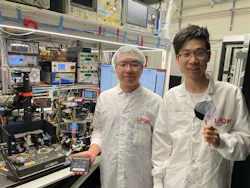
An on-chip modelocked laser is a long-sought-after holy grail of sorts for the photonics community. But a team of researchers at École Polytechnique Fédérale de Lausanne (EPFL) in Switzerland has designed an on-chip ultrafast laser that delivers 1.05 nanojoules in pulses as short as 147 femtoseconds—and it rivals its bulky tabletop femtosecond laser cousins (see video).
“Our broader motivation is to help bring ultrafast laser technology beyond its current niche market to enable wide adoption—moving from artisanry-crafted bulky laser systems to chipscale devices fabricated at scale and potentially at much lower cost,” says Zheru Qiu, a doctoral assistant in EPFL’s Laboratory of Photonics and Quantum Measurements.
While microcombs and III-V lasers that can generate pulses already exist, “their repetition rates are often too high and their pulse energies too low to efficiently drive nonlinear effects within waveguides or other materials, such as for wavelength conversion or seeing two-photon effects,” Qiu says. “Our approach provides a route toward chipscale femtosecond lasers with pulse energies closer to what’s needed for practical ultrafast and nonlinear optical applications.”
A key enabling technology for the team’s on-chip ultrafast laser was work they did back in 2022,1 in which they showed erbium ion implantation can be used to add optical gain to an otherwise passive silicon nitride waveguide. “It allows us to create an on-chip counterpart of erbium-doped fiber—but at a miniaturized scale,” Qiu says. “We also borrowed the Mamyshev oscillator concept pioneered in fiber-based lasers, which turned out to be important for achieving this functionality on chip (to mitigate excessive nonlinearity within waveguides).”
On-chip ultrafast laser design
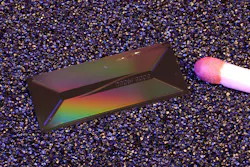
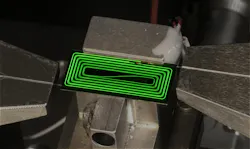
The laser is essentially constructed from a piece of erbium-doped silicon nitride waveguide sandwiched between two Bragg gratings, pumped with (currently) off-chip 1480-nm continuous-wave diodes.
“Using the Mamyshev oscillator concept, the two gratings are deliberately offset in wavelength so continuous-wave lasing can’t be sustained,” explains Qiu. “No single wavelength is reflected by both gratings. Pulses, however, can undergo self-phase modulation within the waveguide, which broadens their spectrum and effectively bridges the wavelength gap between the two gratings. It allows pulsed operation and suppresses ordinary continuous-wave lasing.”
Biggest challenge? “Fabricating such a long cavity on chip, about 42 cm in length, was technically challenging,” says Qiu. “This was made possible, thanks to previous work by generations of members of our lab, as well as the continuous effort and vision of Professor Tobias Kippenberg, in developing low-loss silicon nitride PICs.”
The researchers performed extensive simulations using a custom code for generalized nonlinear Schrödinger equation pulse propagation, along with an original self-consistent iteration approach for the erbium-doped gain. “These simulations were essential for mapping out the feasible parameter regime and guiding the design,” Qiu says. “We’re making the code publicly available.”
As far as projects go, this one went remarkably smoothly—it took only about eight months from coming up with the design to observing the first on-chip modelocking.
And the backstory behind the idea to use Mamyshev oscillators is a good one. “I’d been thinking about how to build a modelocked laser using erbium-doped waveguides, but simulations showed the high nonlinearity of tightly confined waveguides could easily lead to pulse breaking and I couldn’t find a good solution,” says Qiu. “Then, during a walk to lunch, I described this struggle to Zhongshu Liu, an intern student from Tsinghua (now at Harvard) that I was mentoring. He was working on an unrelated project but had prior experience with fiber-based Mamyshev oscillators. We immediately realized this concept solved exactly this problem for fiber-based lasers and could be a solution to our problem as well—and moved forward from there. It’s a nice reminder that informal and international scientific exchanges can spark ideas in completely unexpected ways.”
Smaller footprint, lower cost
One of the immediate applications Qiu expects for their laser is as a drop-in replacement for solid-state or fiber-based modelocked lasers—potentially offering a much smaller footprint and lower cost. “Such lasers could serve as the engine for supercontinuum sources, UV light sources, and THz spectrometers,” he points out. “They can also enable applications that currently can’t justify the cost or complexity of an ultrafast laser, for example as seed lasers for laser cutting systems.”
Qiu and colleagues are now pursuing a few different directions. “On the applications side, we’re developing ways to use these pulses for novel on-chip systems, including spectroscopy and microwave photonic instruments,” he says. “We’re also working toward different operating wavelengths, lower threshold/power requirements, and lower noise performance. In parallel, we’re investigating a complementary approach to integrated modelocked lasers based on dispersion-managed solitons and hybrid-integrated semiconductor saturable absorber mirrors (SESAMs).”
REFERENCE
1. Y. Liu et al., Science, 376, 1309–1313 (2022); https://doi.org/10.1126/science.abo2631.
FURTHER READING
Z. Qiu et al., Nature, 654, 57–63 (2026); https://doi.org/10.1038/s41586-026-10517-4.
About the Author
 Sally Cole Johnson
Sally Cole Johnson
Editor in Chief
Sally Cole Johnson is Laser Focus World’s editor in chief, and she has more than 25 years’ experience as a science and technology journalist. She specializes in physics and semiconductors, and wrote for the American Institute of Physics for more than 15 years, and also covered theoretical physics and neuroscience for the Kavli Foundation, and complexity for the Santa Fe Institute. Johnson has also written extensively about military embedded systems, high-performance computing, software-defined networks, and infosec. She is a member of the National Association of Science Writers (since 2001).
When she isn’t writing about optics, photonics, or quantum advances, you can find her outside in northern NH in the garden with birds landing in her hand or heading for the mountains with her bike, skis, or crampons and ice axe.