Researchers help demystify laser-driven plasma self-magnetization for fusion

One key part of the race to put clean laser-driven fusion energy on the grid by the 2030s or 2040s involves gaining a better understanding of the complex behavior of the plasma (a superhot ionized gas) generated. A new study led by researchers at the U.S. Department of Energy’s Princeton Plasma Physics Laboratory (PPPL) helps demystify how strong magnetic fields form as plasmas and rapidly expand—which is essential because unexpected magnetic fields can affect how heat moves though plasmas in ways existing simulation tools can miss.
Direct-drive inertial (laser) fusion works by pointing lasers onto a target—typically a spherical capsule containing fusion fuel within its core—to heat the surface and create pressure to make the target implode. This leads to an increase in target density and temperature, which produces a hot, dense fuel that begins to fuse and generate energetic neutrons. The energy carried by these neutrons can then be captured and converted into heat.
Laser plasma self-magnetization—produced not by an external magnet but by self-consistently generated currents and their associated magnetic fields—is often a byproduct of efforts to study laser-driven fusion or laser-driven particle sources.
“In our case, a discrepancy became apparent when we increased the laser intensity in our computer simulations and began to observe deviations in plasma behavior between two simulation approaches that had agreed at lower laser intensities,” says Kirill Lezhnin, an associate research physicist at PPPL. “This inspired us to look more deeply into the physics of laser-produced expanding plasmas, and ultimately led to our study of laser-driven plasma and self-magnetization.”
Basic concepts behind the study
Collisional laser absorption is one of the key concepts involved in the team’s work. “If we assume the laser field is a plane electromagnetic wave and consider a single electron within a vacuum, we can solve the electron’s dynamics within this field,” says Lezhnin. “The result is the electron has no net energy gain after the wave has passed: It gains and loses energy as it ‘rides’ the electromagnetic wave.
But if ions are present around the electrons, the electrons passing close to these ions ‘feel’ their Coulomb fields and scatter off them. They ‘collide’ with the ions. Electrons no longer simply ride the wave but are randomly kicked out of this steady motion. This leads to a net energy gain by the electrons and, correspondingly, energy loss from the laser. Although this concept has been known for more than 50 years, it remains an active subject of research and novel properties of collisional absorption were recently discovered.”
Another concept is Weibei instability, which can occur when sufficiently strong anisotropies—differences between plasma properties in different directions—are present within a plasma. “To relax toward a more isotropic state, the plasma generates magnetic fields, which creates a mechanism that helps smooth out the differences,” says Lezhnin. “For our study, we show that rapid plasma expansion in one direction creates a temperature imbalance, which leads to magnetic field generation.”
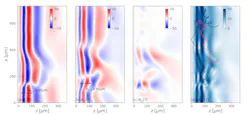
Thanks to computer simulations, the team explored plasma behavior when a high-power laser struck an aluminum target. When its intensity exceeded a threshold of roughly 1014 W/cm2 (important to note it’s target material dependent), the expanding plasma self-magnetized within a billionth of a second and generated magnetic fields as strong as 40 tesla (one million times stronger than the Earth’s magnetic field). Below this intensity, the plasma is largely unmagnetized.
Why? As laser-heated plasma expands, it cools faster along the direction of expansion rather than perpendicular directions—and causes a temperature imbalance. This fuels Weibel instability, which generates magnetic fields. Collisions between particles push the plasma back toward a balanced state. The threshold-like behavior reflects a balance between expansion (which generates anisotropy) and collisions (which relax it).
Self-generating magnetic fields can alter plasma dynamics
One of the team’s most important findings, and most unexpected to Lezhnin, is that even if the experimental setup is symmetric, with a perfectly flat target, perfectly uniform laser intensity, and normal laser incidence, fast plasma expansion alone can produce magnetic fields strong enough to alter the plasma dynamics.
Best part of the study? “It was satisfying to interpret our simulation results using an analytical argument,” says Lezhnin. “Interestingly, only a very restrictive class of plasma flows don’t generate temperature anisotropy.”
To make the team’s simulations possible, the researchers first had to implement a laser ray-tracing module within their code, and then improve the fidelity of the binary particle collision module. “We also benchmarked our simulations against a hydrodynamic code within a regime where no temperature anisotropy generation is expected,” Lezhnin says. “These efforts represent a substantial contribution from a diverse team of experts at PPPL, Princeton University, the University of Kansas, MIT, and the University of Maryland.”
Their study shows “self-generated magnetic fields may need to be considered when interpreting and designing laser-plasma experiments,” Lezhnin points out. “In the case of direct-drive fusion, we might expect that uniform laser illumination of a capsule would help avoid magnetic field generation. But our study shows that even such a symmetric situation can still produce magnetic fields that may be dynamically important. Fortunately, it seems that this effect could potentially be incorporated into design codes with only moderate effort.”
Since the team’s work was a theoretical and computational simulation study, the next step is experimental verification. “We focused mostly on a uniform laser drive, whereas a single laser spot has finite extent and a nonuniform intensity distribution,” says Lezhnin. “It could potentially lead to other magnetization mechanisms, as well as interplay with the mechanism we highlighted. And to demonstrate the importance of the physical phenomenon we discovered for inertial fusion, we may want to use the relevant physics in codes used to design inertial fusion experiments and show its impact.”
FURTHER READING
K. V. Lezhnin et al., Phys. Rev. Lett., 136, 115101 (Mar. 20, 2026); https://doi.org/10.1103/stmq-c433.
About the Author
 Sally Cole Johnson
Sally Cole Johnson
Editor in Chief
Sally Cole Johnson is Laser Focus World’s editor in chief, and she has more than 25 years’ experience as a science and technology journalist. She specializes in physics and semiconductors, and wrote for the American Institute of Physics for more than 15 years, and also covered theoretical physics and neuroscience for the Kavli Foundation, and complexity for the Santa Fe Institute. Johnson has also written extensively about military embedded systems, high-performance computing, software-defined networks, and infosec. She is a member of the National Association of Science Writers (since 2001).
When she isn’t writing about optics, photonics, or quantum advances, you can find her outside in northern NH in the garden with birds landing in her hand or heading for the mountains with her bike, skis, or crampons and ice axe.