Microwaves generate tunable modelocked pulses within a monolithic semiconductor laser
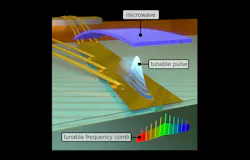
In a departure from standard modelocking approaches, a team of researchers led by Professors Giacomo Scalari and Jerome Faist in the Department of Physics at ETH Zurich, and Professor Christian Jirauschek at the Technical University of Munich, created a monolithic modelocked semiconductor laser with a continuously and widely tunable repetition rate from 4 to 16 GHz. And, intriguingly, their approach should work for other semiconductor lasers and laser emission wavelengths (see video).
To pull it off, the researchers used a terahertz (THz) quantum cascade laser (QCL) to produce coherent frequency combs. While it’s well known that THz QCLs can be used to generate combs, the team’s recent development of planarized THz QCLs with improved microwave properties encouraged them to explore the strong modulation of the laser cavity using external microwaves—and they discovered several novel regimes of semiconductor laser operation.
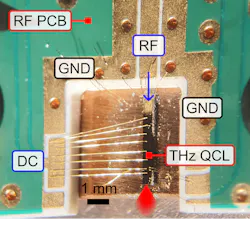
“Our device is based on a planarized THz QCL. Its active region material consists of a gallium arsenide (GaAs)/aluminum gallium arsenide (AlGaAs) superlattice, wafer-bonded to a GaAs carrier substrate,” explains Urban Senica, who at the time was a Ph.D. student at ETH Zurich but is now a postdoctoral fellow at Harvard University’s Laboratory for Nanoscale Optics. “By using photolithography and dry etching, an active ridge waveguide is defined and subsequently planarized with the low-loss polymer benzocyclobutene (BCB). A waveguide is sandwiched vertically between two extended metallization layers, which confine the optical and microwave modes and act as electrical contacts for biasing the laser device.”
This configuration results in low propagation losses, reduces chromatic dispersion, increases heat dissipation, and improves microwave properties, because the laser is embedded within a low-loss, low-impedance microwave waveguide.
Active modelocking
The team’s method is based on active modelocking, which involves modulating the laser bias voltage via an external electrical signal to generate a train of coherent short optical pulses (a frequency comb). In previous demonstrations, this only worked if the frequency of the modulation signal was synchronized with the time it takes light to travel between the two mirrors of the laser (it’s fixed by the physical cavity dimensions).
“We demonstrated a completely novel regime, in which we can continuously and widely tune the repetition rate frequency of the pulse train by as much as 400%,” says Senica. “This extraordinary tunability is achieved by forming a standing microwave oscillation along the entire laser cavity, which results in a pulse pulling effect that speeds up or slows down the optical pulse to always be synchronized with the external modulation frequency.”
Controlling the speed of on-chip optical pulses via microwaves
One of the coolest aspects of this work is “we can essentially control the speed of optical pulses on a photonic chip with microwaves,” Senica says. “In a simple analogy, it’s similar to a water wave pushing a surfer forward. In more technical terms, there’s a frequency-dependent phase shift between the microwave and optical pulse, and the resulting gain/loss gradient results in a modified group velocity of the optical pulse so that the new repetition rate matches the external microwave frequency. A breakthrough moment was when we were able to fully understand this process, with good agreement between the experimental and simulation results.”
This entire project is a culmination of several years of major technical and scientific advancements, including the design and molecular beam epitaxy growth of the broadband laser active region; the simulation, fabrication, and characterization of planarized THz QCLs; and extensive analytical and numerical simulations of the modulated laser cavity.
A key part of the team’s work involved advanced simulations of their devices. “In particular, our collaborators at TU Munich in Germany developed a new simulation approach for modeling the entire modulated laser cavity,” says Senica. “This includes modeling the quantum system of the laser, the microwave propagation, and the optical pulse generation—combining three different domains within a single simulation study, accurately reproducing the experimental results and providing crucial insights into the laser dynamics.”
Communications, spectroscopy, and sensing applications ahead
Thanks to their continuously and widely tunable modelocked lasers, there are many potential applications for communications, spectroscopy, and sensing. “For the time domain, the coherent pulse train can be synchronized to an arbitrary external microwave signal or tunable delay line,” says Senica. “For the frequency domain, the tunable mode spacing within the frequency comb can close any spectral gaps.”
In fact, Senica and colleagues already demonstrated an absorption spectroscopy experiment that required only a simple intensity detector—rather than a tabletop-sized spectrometer instrument.
“We believe our approach will also be relatively straightforward to implement with other types of semiconductor lasers across the infrared and visible regions of the electromagnetic spectrum and pave the way for a wide variety of applications,” Senica says. “An important aspect will be optimized microwave properties, along with advanced packaging of such devices.”
FURTHER READING
U. Senica et al., Nature, 652, 892–898 (2026); https://doi.org/10.1038/s41586-026-10387-w.
About the Author
 Sally Cole Johnson
Sally Cole Johnson
Editor in Chief
Sally Cole Johnson is Laser Focus World’s editor in chief, and she has more than 25 years’ experience as a science and technology journalist. She specializes in physics and semiconductors, and wrote for the American Institute of Physics for more than 15 years, and also covered theoretical physics and neuroscience for the Kavli Foundation, and complexity for the Santa Fe Institute. Johnson has also written extensively about military embedded systems, high-performance computing, software-defined networks, and infosec. She is a member of the National Association of Science Writers (since 2001).
When she isn’t writing about optics, photonics, or quantum advances, you can find her outside in northern NH in the garden with birds landing in her hand or heading for the mountains with her bike, skis, or crampons and ice axe.