U.S. GAO issues report critical of DoD satellite laser comms progress
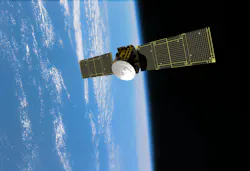
The U.S. DoD’s Space Development Agency (SDA) is crafting a large constellation of satellites—expected to cost roughly $35B through 2029—and currently working on switching from radio-frequency (RF) comms to speed-of-light laser comms to support them.
Why is this work critical? A constellation of satellites with laser comms can perform mission-critical tasks from missile tracking and warning to speeding data transport.
In Laser Communications: Space Development Agency Should Create Links between Development Phases, a report issued by the GAO on February 26, 2025, it points out that, as of December 2024, the SDA hadn’t fully demonstrated this technology in space.
SDA has scheduled iterations of satellites and systems every two years (a.k.a. tranches). Tranche 0 (T0) faced development challenges and delays, and the GAO found that only one of four prime contractors in T0 demonstrated three of eight planned capabilities, while another contractor demonstrated one, and the two others achieved none.
Satellites initially planned for launch in 2022 were launched instead during 2023 and 2024.
Contracts for Tranche 1 and 2—worth $10B—have already been awarded.
The GAO recommends SDA fully demonstrate laser communication capabilities in space before finalizing efforts in T0 and making further investments.
You can read the full report here: https://files.gao.gov/reports/GAO-25-106838/index.html?_gl=1*indyur*_ga*MTQwMDAyNjkxMC4xNzQxMTg5NTAw*_ga_V393SNS3SR*MTc0MTE4OTUwMC4xLjEuMTc0MTE4OTgxOC4wLjAuMA..
FURTHER READING
See www.sda.mil/sda-demos-laser-links-crucial-for-future-satcom-missile-tracking-network.
About the Author
 Sally Cole Johnson
Sally Cole Johnson
Editor in Chief
Sally Cole Johnson is Laser Focus World’s editor in chief, and she has more than 25 years’ experience as a science and technology journalist. She specializes in physics and semiconductors, and wrote for the American Institute of Physics for more than 15 years, and also covered theoretical physics and neuroscience for the Kavli Foundation, and complexity for the Santa Fe Institute. Johnson has also written extensively about military embedded systems, high-performance computing, software-defined networks, and infosec. She is a member of the National Association of Science Writers (since 2001).
When she isn’t writing about optics, photonics, or quantum advances, you can find her outside in northern NH in the garden with birds landing in her hand or heading for the mountains with her bike, skis, or crampons and ice axe.