Handheld laser devices for materials processing: From viral video to workplace risk
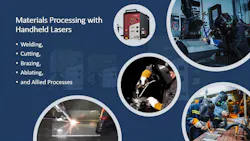
Video clips of handheld lasers are difficult to ignore: A compact gun-style tool lays a clean weld bead, flashes rust off a fender, or slices plate like paper. With millions of shares on social media, they’ve popularized handheld laser processing more than any datasheet. What you don’t see are the multikilowatt Class 4 source, the invisible infrared beam and its reflections, the enclosures and interlocks required, or the compliance paperwork that should follow it into the workplace. For a first-time buyer, the purchasing experience reinforces a dangerous assumption: If a product can be ordered, cleared through customs, and delivered, surely someone vetted it.
Likely, no one has.
The device is a high-power industrial tool with strict compliance and operational obligations that online listings and influencer demos routinely omit. This first article in a series maps out what buyers of handheld laser devices for materials processing must understand before making a purchase—where caveat emptor isn’t merely a phrase but the operating condition.
Delivered means vetted is a fallacy
One gigantic misconception is that buyers treat sale, customs entry, and safety compliance as one event. In the U.S., laser products entering into commerce must conform to the Federal Laser Product Performance Standard (FLPPS) under 21 CFR 1040.10 and 1040.11. Before import, a product report is filed with FDA/CDRH, which returns an accession number—often falsely presented as approval. It is not: An accession number acknowledges receipt of a manufacturer’s self-certified report, but isn’t proof that the device meets U.S. product requirements.
A legal wrinkle sharpens the point: Under FDA rules, whoever imports a laser product is treated as a manufacturer, so a buyer ordering a noncompliant device from overseas can inherit manufacturer-level obligations. Refused shipments are returned or destroyed at the importer’s expense. Custom officials check trade documents and the accession number, not beam enclosure, labeling, or interlocks; a device can clear the port and remain noncompliant on the shop floor.
A new class of buyer, an old set of hazards
Distribution has changed during the past five years, but physics hasn’t. Low-cost solid-state handheld lasers—many built overseas and sold through social media—have erased the barriers that once separated industrial lasers from end users. A kilowatt-class system that once arrived with an integrator, site survey, and safety office now arrives in a box that reaches small fabrication and mobile repair shops, onsite contractors near bystanders, and mobile providers stripping paint in open driveways. The result is a new stakeholder: An individual owner-operator, often without laser safety experience or organizational support. The hazards remain as with any Class 4 source, and broader access without broader competence raises the risk to workplaces and the public.
Compliance is a precondition, not a feature
Laser safety follows a sequence easy to invert: Equipment compliance first, workplace controls second. A device must be properly classified, labeled, engineered, documented, and instructed before training, protective personal equipment (PPE), and controlled-area procedures can do their work. Administrative controls over a noncompliant device only mask the defect—and modifying one “up the spec” can transfer manufacturer-level responsibility to the owner.
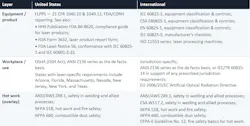
These layers rest on interlocking regulations and consensus standards layers partially tabulated (see table). Notably, the U.S. Occupational Safety and Health Administration (OSHA) doesn’t mandate the ANSI Z136 series. It points to it and absent state-plan adoption, Z136 is the de facto standard of care. Outside the U.S., the sequence still holds. The table summarizes the governing laser and hot-work references (electrical and other standards are beyond the scope here).
Key laser and hot-work equipment and user-safety standards (partial listing)
What do listings leave out?
Because compliance is invisible in a product photo, it’s the first to be omitted online. Devices frequently arrive with noncompliant eyewear, missing labels or engineering controls, manuals silent on safety use, and no verifiable conformance to the standards in the table. Counterfeit CE safety marks and invented “FDA Certified” claims complete a picture that’s unverifiable at best, misleading at worst.
This matters most to industrial buyers because handheld processing fuses two separate hazard domains. Beam hazards include retinal injury, skin burns, specular and diffuse reflections, and uncontrolled beam paths. Invisible near-infrared wavelengths mean the worst exposures but give no warning. Hot-work hazards add ignition, fumes, and fire spread. Welding experts may underestimate the beam, while laser experts the fire load. Handheld systems demand both models at once, with controls integrated rather than bolted together.
Before you issue a purchase order
Shift the burden of proof to the seller—only accept documentation, not assurances. Request certificates of conformance and test reports for the model, naming the standards tested against, plus the owner’s manual and its safety sections. For U.S. purchases, ask for the FDA/CDRH accession number. Confirm that the manual replicates every required label and its location, and have your Laser Safety Officer review the specs before purchase, not after delivery. Capture every verification in writing; if any one item can’t be verified, pause the acquisition process. An unverifiable Class 4 laser is a liability regardless of price.
Awareness before acquisition
Handheld lasers are fast, portable, precise, and low on consumables—transformative in the right application. But these advantages depend on responsible integration that begins before the purchase, not after the first weld. An uninformed purchase can expose operators, bystanders, and the public to a Class 4 hazard sold as a gadget. The first step is decisive: Confirm compliance before energizing the equipment.
CURATED RESOURCES
- U.S. FDA: Laser Products and Instruments; Compliance Guide for Laser Products (21 CFR 1040.10 / 1040.11, FLPPS).
- Canada: Health Canada Guidance for Laser Products.
- U.S. OSHA: Laser Hazards–Standards; OSHA Technical Manual (OTM), Section III, Chapter 6.
- ANSI Z136.1 and Z136.9; IEC 60825-1 and 60825-5; ISO 11553 series.
- Hot work: ANSI Z49.1; CSA W117.2; applicable NFPA (including 51B, 660); CFPA‑E Guideline No. 12.
Note: Informative only; intended to complement—not replace—applicable regulatory requirements and consensus standards. Not a comprehensive compliance audit.
About the Author
Randolph Paura
Randolph (Randy) Paura, P. Eng., CLSO, B11 LMSS, of Fort Erie, ON, Canada, is a professional engineer with over 45 years of expertise in special‑purpose machine design and build for automotive, aerospace, and heavy‑equipment manufacturing. As a lifetime member of the Laser Institute of America, he contributes to ANSI Z136, is an active member of IEC TC 76 standards and regularly presents at the International Laser Safety Conferences (ILSC), U.S. DOE LSO Workshops, and Canadian Radiation Protection Association (CRPA) annual conferences.
Barbara Sams Contrata
Barbara Sams Contrata is a seasoned executive administrator with over two decades of leadership in the laser safety community, including 11 years as executive director of the Board of Laser Safety. As president of Samata Enterprises LLC, she now leverages her expertise in program development and strategic project management to deliver specialized training materials and administrative solutions worldwide.
Thomas Lieb
Thomas Lieb, CLSO, is an internationally recognized laser safety expert and president of LAI International, with extensive experience shaping optical radiation safety standards and laser equipment requirements. He served the maximum terms as chairman of IEC TC 76 and has led ANSI Z136.9 since 2008, overseeing laser safety requirements for industrial and manufacturing applications while contributing to the Board of Laser Safety and the Laser Institute of America.
Kenneth Barat
Kenneth Barat, CLSO, has been serving the laser user community for over 30 years as a working Laser Safety Officer, author of textbooks, standards committee member, and laser safety advisor to a variety of laser users.
Scott Wohlstein
Scott Wohlstein is president and photonics specialist at The Photonics Group, bringing more than 40 years of experience helping clients from startups to global organizations solve complex technical challenges. His career spans naval nuclear, defense, aerospace, instrumentation, and light safety compliance work, supported by publications, patents, university teaching experience, and degrees in laser technology, photonics science, and technology management.
David Sliney
Dr. David Sliney, CLSO, is a biophysicist who managed the Laser/Optical Radiation Program for the U.S. Army Center for Health Promotion and Preventive Medicine before retirement. Dr. Sliney has been active in the establishment of safety standards for protection of the eye and skin from high‑intensity optical sources, having published over 200 papers and co-authored a 1,000-page handbook, Safety with Lasers and Other Optical Sources, which includes his UV and blue light from arc welding for the American Welding Society.