Copper welds via green laser create superfast data center connections
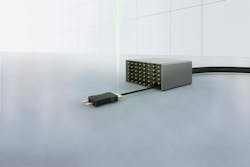
With the rapid rise of artificial intelligence (AI) and cloud services, internal data links inside data centers must support speeds well above 100 Gbit/s, or roughly 1,000x faster than a typical digital subscriber line (DSL) connection. To deliver these rates reliably, the cables and the copper connections that form the network backbone must be welded with extreme precision. To meet this challenge, TRUMPF has proven the ability of green wavelength lasers combined with AI-driven process check and inspection to deliver the speed, accuracy, and repeatable quality that data centers demand.
Market opportunity and scalability
From a market perspective, data center operators—including major hyperscalers and other large-scale cloud service providers—plan to invest more than $314 billion in new data center capacity through 2030. About half of this investment is expected to take place in the U.S., with an additional 25% in Europe and 25% in Asia. This scale of spending will drive strong demand for high-performance welding of copper cables and connectors. Our green lasers, used with a no-code cloud-based AI platform, address this demand, and have demonstrated success for other high-performance industries such as automotive electronics, medical devices, and defense. The potential extends well beyond the data center market.
Copper laser welding matters
In high-speed transmission environments, small defects such as contact irregularities, microgaps, or uneven weld seams can cause signal degradation, bit errors, or even system failures. As data centers scale and connector density increases, tiny variances in individual joints accumulate and can create major operational risks. A welding technology that can reliably process ultrasmall components while guaranteeing consistent electrical and mechanical properties is indispensable (see Fig. 1). Equally important is an automated, nondestructive quality check system that inspects each weld in real time and enables immediate corrective action.
One solution established by TRUMPF centers on three core elements: green laser sources for welding copper, AI-supported process check and inspection, and complete integration.
Green laser sources optimized for copper. Copper absorbs green wavelengths significantly better than near-infrared wavelengths. Our green lasers deliver high power in a stable, continuous-wave operation to produce reliable and reproducible welds. Compared with conventional processes, the system can increase productivity by as much as 10x. Faster cycles raise throughput while reducing the heat-affected zone, minimizing thermal damage to surrounding plastic housings, and preserving electrical performance.
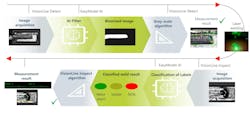
AI-supported process check and inspection. TRUMPF used AI-developed models—EasyModel AI together with VisionLine Detect and VisionLine Inspect—to analyze pre- and post-weld images within milliseconds. For this purpose, a hybrid approach is used: The image is analyzed using an a) AI semantic segmentation algorithm, which results in a binarized image after thresholding; and b) the image is then analyzed with image processing algorithms according to position of objects and if the dimensions are within the predefined threshold.
This approach allows us to reliably locate component positions and weld points, even under difficult surface or low lighting conditions. Before welding, the system detects part position and pixel scale gaps and automatically adjusts the laser parameters. After welding, multiclass AI models measure the trained features, which enables more than the differentiation between a good or defective weld result. Training is straightforward: New components can be accommodated with a low number of training images.
A one-stop integrated solution. No third-party components were necessary, which simplifies the system integration, deployment, and maintenance on production lines. The green laser sources, optics, software, AI models, and quality data storage were supplied as a complete package.
Technology deep dive: Quality check workflow
The vision system uses a hybrid approach that combines an AI model with a grayscale algorithm. This hybrid method minimizes computation time and enables reliable detection of parts and gaps within 50 milliseconds.
Step 1: Semantic segmentation. In the first step, EasyModel AI performs semantic segmentation to identify multiple objects within the image at pixel resolution. Using its multiclass capability, the AI classifies different object types after supervised learning process. For the model training. no code or programming is required, and the cloud-based service allows the model to train without highly performing hardware onsite. Instead of coding, the drawing of the relevant features with the given tool is all the EasyModel AI needs for the labeling process. EasyModel AI uses an algorithm architecture, suitable for “few shot” problems and can produce valid results with just a few training images. The AI output is a filter which binarizes the image that highlights relevant features.
Step 2: Grayscale parameterization. Next, the created filter is used within VisionLine Detect where it creates a binarized image and the grayscale algorithm that performs geometric parameterization such as measuring distances, tilt angles, and pixel scale gaps. By combining the AI-generated binary mask with grayscale analysis, the system determines the precise positions of each component and optimal welding points. Potential gaps between joining surfaces are detected at pixel scale. Not just blind trust of AI—a plausibility check of AI performance can also be done with grayscale parameterization. In this way, the decision-making process is explainable and understandable.
Step 3: Post-weld inspection. After welding, VisionLine Inspect works together with EasyModel AI to analyze the weld quality. A multiclass model assigns different classes to features based on preconfigured criteria and training data to enable immediate classification into categories such as weld seam, housing, or non-OK (NOK). For the next step, each category can be further analyzed with set of pre-defined algorithms; for example, ratio of areas, number of objects, and user-defined threshold limits. This completes the fully automated pre- and post-weld quality check loop.
The full sequence is shown in Figure 2: Pre-weld image acquisition, AI-generated binarized images, grayscale measurement overlays, and final classification (OK vs. NOK). End-to-end automation allows operators to make immediate production decisions without additional inspection steps.
Achieve throughput and quality
Using TRUMPF’s green laser and AI-enabled quality check made it possible to achieve a 10x increase in productivity vs. conventional methods and an error-free yield above 99%. The combination of high throughput and rigorous quality check meets the demands of high-volume manufacturing for data center connectors. Our solution also supports ongoing miniaturization of connector designs, which produce higher signal density assemblies without sacrificing reliability.
Overall, the process resulted in several customer benefits in terms of productivity, quality, and ease of use:
Productivity. The process yielded welding speeds up to 10x faster than conventional methods and is suitable for very small connector components and high-density assemblies.
Quality. As a result of an almost real-time, AI-driven process correction and nondestructive inspection, the process delivers a 99% yield.
Ease of use. A fully integrated system (laser, optics, software, AI, data storage) makes it easy to quickly adapt with AI. New part variants typically require only a few training images. Laser welding is one of several laser-based innovations relevant to data center components.
As data highways inside data centers become faster and more densely populated, the quality of every connection becomes critical to overall system performance. Our green laser welding technology combined with AI-based process check and inspection offer the speed, precision, and reliability to meet these increasing demands. With applications extending into automotive, medical, and defense sectors, the technology is well positioned to support the infrastructure of an increasingly connected future.
About the Author
Woo-Sik Chung
Dr. Woo-Sik Chung is the global business development manager at TRUMPF Laser- & Systemtechnik SE (Ditzingen, Germany).
Pierson Cheng
Pierson Cheng is an industry manager at the TRUMPF Inc. Laser Technology Center (Plymouth, MI).