Can the U.S. and China really ‘wall off’ AI?
The race to develop better, faster, and lower-cost AI models has fueled intense debate over the sustainability of announced capital expenditures, and how to structure and manage the supply chains—from components and data center infrastructure through applications and content.
National security has become increasingly intertwined with this debate. U.S. policymakers, technology vendors, AI developers, and customers have proposed various tariffs, taxes, export controls, and other restrictions involving Chinese open-weight AI models, advanced processors, and the infrastructure required to support them. As the New York Times recently framed the question: “Will the U.S. and China Wall Off AI?”
Optical components and systems have emerged over the past two years as critical enablers of AI performance, scale, and economics. Publicly traded U.S. companies including Coherent, Lumentum, Corning, Fabrinet, and Applied Optoelectronics have become investor favorites as indirect plays on AI infrastructure, similar to how memory suppliers, cooling companies, and other data center infrastructure providers continue attracting increased attention.
NVIDIA has also made significant investments across the optical ecosystem, underscoring the strategic importance of photonics to the next generation of AI infrastructure and the need to secure sufficient supply-chain capacity.
I have been watching this transition for some time.
At the 2024 OFC Executive Forum, I presented a framework for how I expected optics to accelerate its penetration into AI infrastructure. Earlier, from 2020 through 2022, I developed and published a “Photonics Stock Index” for Laser Focus World to illustrate how optical companies across multiple application segments had spent two decades trading at a discount to semiconductor companies.
The index tracked approximately 100 global companies, ranging from optical-component manufacturers to downstream users, and included separate segments for U.S. and internationally listed companies. Notably, many Chinese and other Asian-listed companies performed better than their U.S. counterparts.
Today, the picture looks dramatically different.
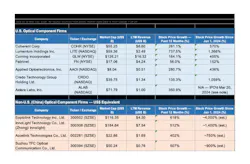
As optical communications growth has accelerated, and as the market has recognized the critical role photonics plays in scaling AI infrastructure, optical companies have become stock-market darlings (see figure).
For investors, suppliers, data center designers, and policymakers, it’s important to consider U.S. optical companies within the broader context of global competition and supply-chain interdependence. Several China-based optical-component suppliers have also performed exceptionally well. Approximately 61% of Innolight’s revenue comes from the U.S., while non-China customers account for roughly 75% of TFC’s revenue and 78% of Eoptolink’s, and U.S. customers represent a significant portion of this demand.
Looking deeper into publicly available forecasts, several Asian suppliers are projecting growth rates that exceed those of many U.S. companies. Some are also seeking substantial amounts of new capital through Hong Kong listings, attracting international investors and global financial institutions.
Eoptolink, Innolight, and TFC are among the companies pursuing significant capital raises with participation from major global investment banks. Numerous Chinese companies across the broader AI ecosystem—from data center infrastructure and AI processors to models and supporting technologies—have completed or are considering Hong Kong offerings designed to attract international capital and support global expansion.
Difficult new reality for policymakers
Non-U.S. optical suppliers are deeply embedded in the supply chains supporting American and global AI infrastructure. Despite considerable discussion of reshoring, semiconductor independence, and domestic optical-manufacturing capacity, the U.S. and Asian AI infrastructure ecosystems remain highly interconnected.
In optics, the relationship is becoming more interconnected as AI infrastructure scales. Broad tariffs or trade restrictions across the AI ecosystem risk creating unintended consequences. U.S. data center operators and their suppliers could face higher costs, constrained component availability, and slower infrastructure deployment.
The geographic balance of AI infrastructure also continues to evolve. North America represents a major share of current AI data center deployment, but China, the rest of Asia, and the Middle East are widely expected to grow rapidly.
It is a large global market, and much of it seeks lower-cost AI infrastructure, greater access to technology and talent, and fewer barriers to deployment. This creates competitive pressure on any market pursuing a more isolated, and potentially higher-cost, approach.
NVIDIA CEO Jensen Huang has repeatedly emphasized the global nature of this competition. He describes AI as a long-term race and argues that lower-cost, broadly available AI models can accelerate adoption. In his view, greater AI adoption ultimately increases demand for processors, computing capacity, and the data center infrastructure required to support them.
Huang’s argument has important implications for the optical industry. The innovations, engineering talent, manufacturing capacity, and capital required to scale AI infrastructure are distributed around the world. Photonics is no exception. Optical transceivers, lasers, fibers, connectors, packaging technologies, and increasingly sophisticated optical architectures depend upon an international ecosystem that can’t easily be divided into separate national supply chains.
Attempts to “wall off” AI face an economic reality: The infrastructure underneath AI is already global. The question for the U.S. is not simply whether it can restrict access to particular technologies but whether these restrictions strengthen the competitiveness of U.S. companies or inadvertently raise their costs, constrain their supply chains, and slow the deployment of AI infrastructure.
Capital, technology, and customers will continue to seek the most competitive opportunities.
For the optical industry, this may be the most important lesson of the AI race: the U.S. and China may increasingly compete at the model, semiconductor, and policy levels while remaining deeply interconnected through the photonic infrastructure required to make AI scale.
Economic decoupling sounds straightforward as a policy objective. In the optical infrastructure underlying AI, the reality is considerably more complicated.
About the Author
 John Dexheimer
John Dexheimer
John Dexheimer has been an investor and advisor in the optical sector for more than 30 years. As an investment banker in the 1990s, he led the IPO of the predecessor to Lumentum and advised on dozens of financings and M&A transactions involving photonics and optical communications companies. He is currently an active venture investor and advisor to private companies focused on AI, quantum technologies, and sensing. He serves as a mentor at the NYU EFL accelerator and holds an MBA from Harvard.