Less Trial and Error: How ENCY Supports DAMRC’s Robotic Machining Research
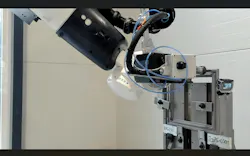
Robotic machining gives manufacturers access to large parts, complex toolpaths, and more flexible work-cell organization. The main challenge lies elsewhere: a robot’s behavior changes together with its pose, so the same process can be stable at one point along the toolpath and problematic at another. DAMRC uses ENCY in its research to connect robot programming with the analysis of the factors that affect the actual machining result.
What prevents robots from taking a bigger place in machining
Interest in robots for machining is growing where a conventional machine tool is too expensive, too rigidly limited in working volume, or inconvenient for a large-scale part. A robot offers a large working range, fits more freely into a cell, and opens up more options for positioning the tool and the workpiece.
But along with that freedom comes instability, which is usually less pronounced in machine-tool machining. In a robot, system stiffness depends on the axis configuration, reach, tool orientation, and TCP position. Because of this, vibration behavior, dynamic response, and acceptable cutting conditions change over the course of the same operation.
This is where the main engineering barrier appears. In robotic machining, it is not enough to define a toolpath and choose a cutting mode once. It is necessary to understand how the robot behaves along the entire toolpath, where machining will remain stable, where sensitive zones are located, which axis configurations are safer, and which ones create the risk of vibration, loss of accuracy, and accelerated tool wear.
That is why the development of robotic machining depends not only on stiffer robots and better spindles. It requires tools that connect CAM, kinematics, dynamics, experimental measurements, and stability analysis into a single engineering chain. This is exactly the task DAMRC’s research is focused on.
DAMRC: a research center focused on advanced manufacturing DAMRC — Danish Advanced Manufacturing Research Center — is an applied research center based in Denmark. Its task is to help industrial companies improve production efficiency and turn complex engineering topics into working methods suitable for real manufacturing challenges.
DAMRC focuses on advanced manufacturing, including robotic machining. The center works at the intersection of research, testing, simulation, and industrial implementation. What matters to the team is not an academic result in itself, but a method that can be used in work with a specific cell, a specific robot, and a specific operation.
This is clearly reflected in its partner environment. In DAMRC’s projects, research work is accompanied by suppliers of industrial technologies and equipment. These companies include ENCY, Mitutoyo, and KUKA. Funding for individual initiatives is supported by Industriens Fond.
ENCY in the daily work of the research team
In DAMRC’s work, ENCY is used as a practical tool for preparing and analyzing robotic operations. This is important for the research team because in robotic machining it is not enough simply to generate a toolpath. It is also necessary to understand how exactly the robot will execute it in axis space, whether it will enter a singularity, whether collisions may occur, and which configuration will provide more stable behavior.
Before ENCY, some of these tasks had to be handled in several different programs: one for preparing the operation, another for checking kinematics, and another for reviewing robot limitations. That kind of process slowed the research down and made it more difficult to compare results.
With ENCY, this workflow became noticeably more direct and shorter. Operation preparation, kinematic verification, and robot behavior analysis are carried out in one environment. This is especially important for the research team because robotic machining almost always starts not with cutting, but with a different question: in which configuration should the robot execute this path at all? With ENCY, DAMRC compares different positions and axis configurations for the same operation. ENCY solves several critically important tasks:
· singularity checking;
· collision analysis;
· analysis of robot behavior across different axis configurations;
· evaluation of how the robot’s pose around the toolpath affects the machining result.
The axis mapping function brought particular value to DAMRC. It makes it possible to look at the toolpath not as an abstract tool movement, but as a set of specific robot poses. For machining, this is fundamental: the same toolpath executed with different axis configurations can produce different system stiffness and different results on the part.
How ENCY helps analyze robot behavior along the toolpath
One illustrative example of this collaboration is a study focused on pose-dependent stiffness and dynamics of a six-axis robot in machining applications. The project was carried out with the participation of an academic partner with strong expertise in vibrations, modal analysis, and EMA, as well as with the support of ENCY and other industrial partners.
The DAMRC team studied how the robot’s natural frequencies, stiffness, and dynamic response change depending on TCP position and axis configuration. This is an important question for manufacturing: if the system’s dynamics change across the workspace, then safe machining parameters cannot be treated as constant either.
The work was built step by step. First, the team refined the measurement methodology and model calibration on a simplified system. Then the approach was transferred to a real industrial robot. The goal was to create a foundation for a process in which the engineer sees not only the toolpath, but also the dynamic picture along it: where resonance zones may occur, which spindle speed ranges are undesirable, and which robot positions are preferable for stable machining.
Against this background, ENCY’s role was especially visible.
First, ENCY gave DAMRC a working digital environment in which the research could be tied to a real CAM process rather than considered in isolation from robotic operation programming. This is always important for a research team: a model and tests only make sense when they can be linked to a specific toolpath, a specific configuration, and a specific machining scenario.
Second, ENCY helped deal with the level of complexity that arises in robotic machining even before vibration analysis begins. The same TCP can often be reached through different axis configurations. These configurations differ not only kinematically, but also in stiffness, sensitivity to external loads, and process stability. The ability to quickly compare such options within one workflow greatly simplifies research work.
Third, ENCY proved to be a convenient foundation for moving to the next stage: a workflow in which CAM and postprocessing are followed by another analysis layer. In that layer, the engineer evaluates not only the geometry and reachability of the toolpath, but also the robot’s behavior along that toolpath from the standpoint of dynamics.
As a result, the study showed how a more systematic process for preparing robotic machining can be built: from toolpath and kinematics to an understanding of stability and a more informed choice of parameters. In this chain, ENCY serves as the foundational production environment, without which such a transition would be much more difficult to implement in practice.
How to scale robotic machining for industrial deployment
For industry, the value of this kind of research is quite concrete. The better the robot’s dynamics are understood across the workspace, the less time is spent selecting cutting conditions, the lower the risk of entering an unstable zone, and the higher the chance of achieving a repeatable result from the first cycle.
This matters to integrators who design the cell. It matters to manufacturing engineers who need to choose the toolpath, tool, and parameters. It matters to end users who need not an experiment, but a predictable production process.
DAMRC’s work shows the direction in which robotic machining is developing as an engineering discipline. In this logic, ENCY occupies an important place: it helps connect CAM, robot kinematics, and applied engineering analysis within one process. This is exactly the kind of combination the market needs when the goal is not a one-off demonstration, but robotic machining that can be applied at industrial scale.