Laser technology makes battery manufacturing faster, safer, and more cost-effective
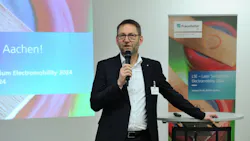
Battery manufacturers face mounting pressure to reduce scrap, cut energy consumption, shorten cycle times, make better use of materials and ensure the quality of every connection. At LSE – Laser Symposium Electromobility on September 15 and 16, 2026, in Aachen, experts from the automotive industry, supplier sector, equipment manufacturing, and research will discuss how laser-based processes can make battery production faster, more robust, and more scalable. The symposium program at Fraunhofer ILT combines presentations from Mercedes-Benz, BMW, Bosch, and MAHLE with the latest developments from research and equipment manufacturing. Focus areas include process stability, quality assurance, and the challenge of bringing high-precision laser processes reliably into series production.
A battery’s performance in a vehicle depends on more than the cell itself. The design of the module and pack plays an equally important role. Manufacturing these systems requires countless electrical and mechanical connections. Each connection must combine low electrical resistance, high mechanical strength, and minimal thermal impact over the long term. Variations in weld quality can generate heat, accelerate aging, and compromise the safety of the entire system. That is why laser micro welding has become a critical manufacturing technology: It transforms individual battery cells into a robust, high-performance battery system.
“LSE’26 focuses on exactly these challenges,” says Dr. Alexander Olowinsky, Head of the Joining and Cutting Department at Fraunhofer ILT, who will chair the symposium. “Under the heading Process stability and scalability of laser-based joining processes in battery manufacturing, the symposium will show how industry and research are advancing laser-based micro- and macro-joining technologies.” The program highlights process windows, thermal process control, reproducible contact quality, system integration, inline metrology, and quality assurance throughout cell manufacturing, module assembly, and battery-pack production.
“In battery manufacturing, a laser process has to do more than perform well in the laboratory,” adds Dr. André Häusler, Head of the Metal Joining Group at Fraunhofer ILT. “The real challenge is integrating these processes into industrial production chains in a stable, monitored, and economically viable way.”
Series production requires measurable quality
The program demonstrates how strongly industrial requirements now shape technological development. Mercedes-Benz will present laser applications for electric drivetrains. BMW and weldmetrix will show how sensor fusion can improve process reliability in e-mobility manu-facturing. Bosch Manufacturing Solutions will discuss the challenges of applying laser technology to battery packs, eDrive components, and control units.
The symposium therefore spans the entire manufacturing chain – from individual welds to complete production lines. In high-volume production, precision and speed alone are not enough. Processes must remain stable at high output levels, minimize scrap, and allow relia-ble monitoring. Only then can manufacturers maintain the quality of battery modules and packs while keeping costs, energy consumption, and cycle times under control.
Suppliers and equipment manufacturers also play a key role in the program. TRUMPF will discuss electrical architectures in electric vehicles and laser welding with integrated quality assurance. MAHLE will present data-driven approaches to process optimization, while BBS Automation will demonstrate how laser automation helps move new manufacturing concepts from development into industrial practice. IPG Laser will showcase fiber-laser solutions for battery production. Clean-Lasersysteme will focus on efficient laser-based surface preparation for joining processes. Blackbird Robotersysteme will demonstrate how different OCT systems can measure weld penetration depth inline during remote laser welding.
Sharing know-how across equipment, processes, and metrology systems
LSE’26 goes beyond presentations and technical talks. At the beginning, participants will take guided tours of the laboratories at Fraunhofer ILT and RWTH Aachen University – ISEA. On the evening of the first day, the Battery LAB will host a marketplace featuring live demon-strations, expert discussions, and networking opportunities alongside the technologies themselves. This hands-on format brings together research results, industrial experience, and practical manufacturing expertise in a single environment.
In addition to battery-contact joining, the program covers a broad range of laser-based manufacturing technologies for e-mobility applications. Topics include laser-based drying of functional electrodes for PEM fuel cells, dynamic beam shaping, lithium-ion battery systems for mobile and stationary applications, and ultrashort-pulse laser processes for battery production. The symposium will also explore emerging manufacturing approaches, including hybrid cell production and flexible, scalable production systems.
Laser technology combines speed, quality, and safety
LSE’26 builds on previous editions of the symposium. One year earlier, LSE 2025 demonstrated that laser precision in battery production is not a technical luxury but a direct competitive factor. The upcoming edition will now focus even more strongly on how this precision can be transferred to industrial manufacturing in a robust, measurable, and cost-effective manner. “Modern batteries must combine long range, short charging times, long service life, and outstanding safety,” says Dr. Olowinsky. “Achieving that goal requires more than high-performance cells alone. The design and manufacturing quality of the module and pack are just as important.”
LSE’26 will take place on September 15 and 16, 2026, at Fraunhofer ILT in Aachen. The conference language is English. Professionals from development, production, equipment manu-facturing, and research will gain insights into current laser processes, quality assurance, process data, and industrial solutions for e-mobility manufacturing. Those looking to make battery production faster, safer, and more cost-effective can register for the symposium until August 26, 2026.