The fast computational speed of Photon Design's EME simulation tools has transformed photonic device design.
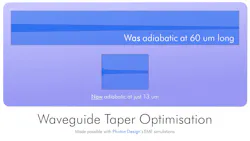
The fast computational speed of Photon Design’s market-leading, photonics simulation CAD software has enabled engineers to take an optimised, iterative design approach to photonic device design, for the best results. At the recent Photonic West exhibition, this fast-processing speed was clearly demonstrated when Photon Design’s FIMMPROP Maxwell Solver tool was used to produce the smallest possible adiabatic taper, mitigating for loss from sidewall roughness. This was achieved in minutes, on a standard PC, with no use of expensive, Cloud processing services. This fast processing speed is achieved using the EigenMode Expansion (EME), computational engine. It will produce equally rigorous results as the more commonly used, Finite-Difference Time-Domain (FDTD) engine, but far quicker. It is this speed that allows engineers to fine tune a device design by making multiple, automatic calculations, to deliver optimal results.
Alex Edwards, Scientific Advisor at Photon Design, said, “The EME-based computational engine at the core of Photon Design’s FIMMPROP enables compound design and simulation. After a single calculation, EME and FDTD produce similar results, with EME taking only seconds. This computational speed means FIMMPROP can include a global optimiser, generating many thousands of potential taper designs per minute to select the best approximate design. A local optimiser then creates the detailed design, including parameters like shape, length and optical performance.
“The EME computational model is unaffected by device length, whether the taper is 10 μm or 100 μm. It produces Eigenvalues across the taper length, calculating where a waveguide can be tapered more rapidly or more gradually, adjusting the lateral position of taper sections to suit; and without requiring re-simulation. By comparison, with FDTD, any doubling of taper length quadruples processing time. FIMMPROP will also balance taper length, seen as enhancing performance, against etching-induced surface roughness which increases loss, to give the best results.
“Returning to the adiabatic taper example at Photonics West. We showed that the geometry allowed for a significant reduction in length, dropping from 17 μm to just 6 μm. Despite little change in performance, this gave huge savings on wafer real estate. Not surprisingly, the customer is now trialling our software in a wide range of applications!”
For more information about Photon Design Ltd contact:
www.photond.com
Photon Design Ltd
34 Leopold Street
Oxford, OX4 1TW
United Kingdom
Tel: +44 1865 324990