Noa Schmid wins CSEM Inventor Award 2026
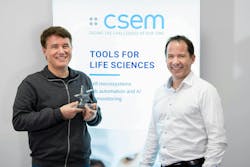
CSEM Inventor Award celebrates innovations behind faster and more accurate laboratory diagnostics
- Improving healthcare analytics: Noa Schmid receives the CSEM Inventor Award 2026 for several innovations that increased the speed and accuracy of the automated analysis of biological samples.
- A serial inventor: Noa Schmid’s work has led to 8 patents focused on precision liquid handling.
- Market impact: His technologies are integrated into products commercialized by leading laboratory analytics companies.
Micromechanical engineer Noa Schmid has received the CSEM Inventor Award 2026 for his foundational contributions to devices handling liquids with high precision. His collaborations with Swiss and global companies led to the commercialization of new automated laboratory devices that analyze biological samples faster and more accurately, lowering costs for diagnostics and health monitoring.
This year’s CSEM Inventor Award celebrates the foundational work of Noa Schmid in the field of precision liquid handling. Over two decades, his innovations improved the performance of laboratory equipment used to control and dispense liquids in minute volumes. Such devices are central to the biochemical analysis of biological or environmental samples, for example to measure pollution, develop new drugs, diagnose infectious diseases, or monitor health.
His work together with his CSEM colleagues resulted in eight patents and numerous collaborations with the industry that brought new liquid-handling products to market with improved functionality, accuracy, speed, and cost efficiency. A central achievement of his work was the miniaturization of laboratory devices while maintaining their precision. “Small devices are faster, as liquids have shorter distances to travel,” Noa explains. “Using smaller volumes of biological samples also reduces the cost of reagents, the chemicals used for biochemical analysis. One challenge with miniaturization is to ensure precision and reliability.”
Devices at home and in space
For example, his work with the Swiss company Tecan resulted in a pipetting machine able to handle the broadest range of volumes on the market, from milliliters down to microliters (around 50 times less than a drop of blood). Another collaboration helped the French company Fluigent develop and commercialize the first device to measure minute liquid flows with a sensor not in contact with the fluid, reducing the risk of contamination.
The micromechanical engineer developed with the international laboratory automation company Hamilton a component for routine accuracy testing of automated liquid-handling systems. He also designed a pump that eliminates the pulsations usually observed in liquid flow. This technology was used on the International Space Station in a flow cytometer to analyze cells and hormones from blood samples taken from crew members. His latest patent filed in 2022 helped the Swiss start-up Testmate Health develop a device for use at home to diagnose four sexually transmitted diseases from a urine sample.
“At heart, I am an engineer,” says Noa Schmid, who works as Expert in the group Automated Sample Handling at CSEM in Alpnach (Obwalden). “My motivation is to create devices that improve people’s lives. I am not deliberately looking for difficult problems, but some of the projects I worked on proved very challenging. It is usually very difficult to simplify a product or a process.”
Innovating at the convergence of biology and technology
“Producing patents is hard, but even more challenging is to develop innovations that translate into successful products, meeting real customer needs and creating added value,” says Vincent Revol, VP, Industry 4.0 & Life Sciences at CSEM. “Noa has pushed the limits of what laboratory devices can achieve, resulting in numerous patents and successful collaborations with the industry. His work reflects CSEM’s mission to address real-world challenges and underscores our vision to combine biotechnology, engineering, and computing to tackle complex challenges in health science”.
The CSEM Inventor Award
Launched in 2022, the CSEM Inventor Award recognizes each year the development of innovative and disruptive technologies that have had a proven market impact. It honors the inventiveness and creativity of CSEM engineers and researchers, highlights cutting-edge collaborations with industry and underscores CSEM’s mission to address real-world challenges and drive societal progress.
Additional information:
CSEM
Jessica Volpe
Communication Campaign Owner
+41 79 242 19 62
About CSEM–Facing the challenges of our time
CSEM is a Swiss technology innovation center developing advanced technologies with a high societal impact, which it then transfers to industry to strengthen the economy. The non-profit orientated, public-private organization is internationally recognized, and works to support the disruptive activities of companies in Switzerland and abroad. CSEM operates in the domains of precision manufacturing, digitalization, and sustainable energy. To accomplish its mission as gateway between research and economy, CSEM's more than 650 employees from 46 countries collaborate with leading universities, scientific institutions, research institutes, and industrial partners. With its seven sites in Allschwil, Alpnach, Bern, Landquart, Neuchâtel, Schwyz and Zurich, CSEM is active all over Switzerland. www.csem.ch