Gigahertz-Optik's LCRT-2005H-S Spectral Transmission & Haze Measurement Kit
September 2026
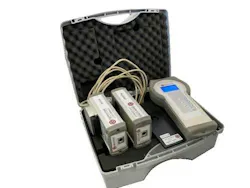
The LCRT-2005H-S, introduced in 2022, consists of a transmitter, receiver and controller. It measures the spectral transmission of transparent materials according to CIE 130 and DIN 5036. Compared to its discontinued predecessor LCRT-2005-S, it offers an extended spectral range from 380 nm to 780 nm (previously 425 nm to 705 nm) and a transmission measurement range from 5% to 100%. It is also equipped with a manually operated light trap that enables spectral haze measurements according to ASTM D1003-13 to be performed.
We received an enquiry asking if the LCRT-2005H-S would be able to accurately measure haze for 100mm thick multi-layered ballistic glass.
Engineering set-up an experiment to determine the LCRT-2005H-S limits and measurement uncertainty for various level haze standards at a distance of about 8 cm. They found that the alignment between transmitter (light source) and receiver (spectral light detector) is super critical.
The better the alignment, the better the measurement fits. Source to detector alignment with only the LCRT-2005H-S built-in camera is not sufficient.
For a precise and repeatable haze measurement the PMS-RIT stand is definitely needed.
The test results are shown in the table below. Note that the manufacturer calibration uncertainty of the haze reflectance standards has not been considered here.
Findings:
- The higher the haze value the larger the measurement deviation
- The further away the hazy layer is the larger the deviation
Obtaining haze standards along with the LCRT-2005H-S so that readings can be corrected for any differences - to a certain extent - is recommended. The highest precision we like to see in our measurements is not directly possible for such very thick ballistic glass. But at least the measurements can work with the LCRT-2005H-S set to the “far distance” mode and mechanically supported with the RIT Stand with a bit of correction. Level of haze present is also a factor.
Another possibility maybe since the ballistic glass is built in layers perhaps more accuracy can be obtained by measurement in intermediate steps? But in the end the measurement uncertainty for this method would be very hard to determine.
Contact us for further discussion.